Ammo, Inventory and Scarcity: How Survival Horror Resource Management Works
Why survival horror rations your bullets and pockets, how Resident Evil, Silent Hill, Dead Space and Signalis handle scarcity, and tips for new players.
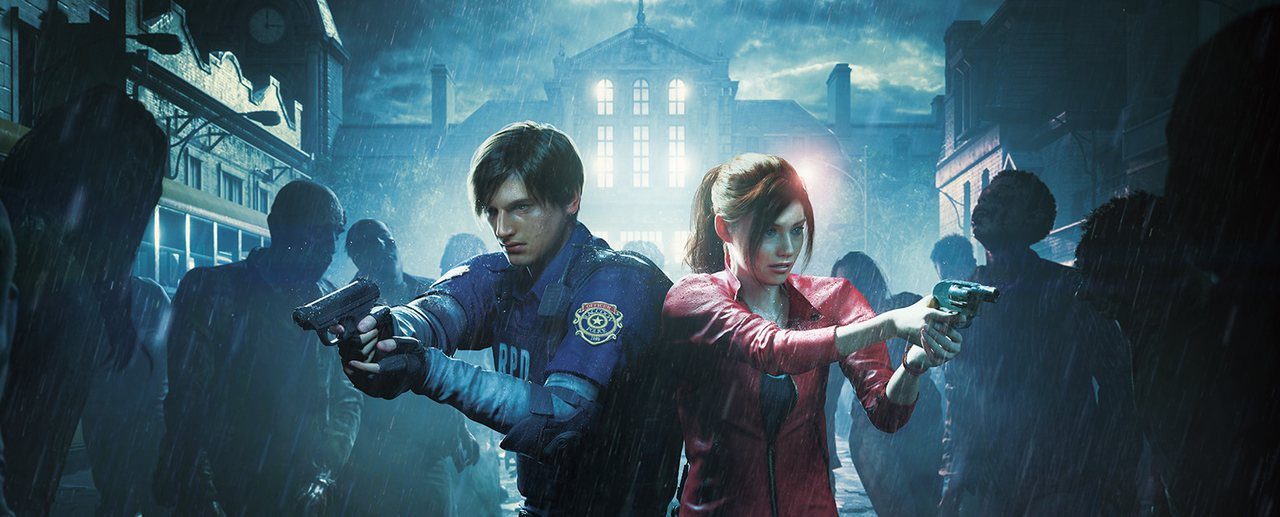
Every survival horror fan knows the feeling: a corridor ahead, a shambling shape in the half-light, and a pistol with three rounds left in it. Do you spend them, or do you try to slip past? That small decision is the beating heart of the genre. Monsters and dark rooms set the mood, but it is scarcity — of bullets, healing, inventory space and sometimes even saves — that turns atmosphere into tension you have to manage with your own hands.
This article explains how resource management works in survival horror, why designers deliberately keep you short, and how four very different games approach the same problem. If you are new to the genre as a whole, our primer on what survival horror is is a good place to start.
Why Scarcity Is a Design Tool, Not a Punishment
In most action games, resources exist to be spent. Ammo refills constantly, health regenerates behind cover and the player’s job is to clear every room. Survival horror inverts that relationship. Resources exist to be worried about. The original Resident Evil (PlayStation, 1996) made this explicit: ammunition is scarce enough that you cannot realistically kill everything you meet, so the game constantly asks whether a given fight is worth it.
Scarcity does several jobs at once:
- It makes the player feel vulnerable. An enemy is only frightening if it can genuinely beat you. If you can always shoot your way out, a zombie is just a target.
- It turns exploration into a decision. Every side room might hold a box of shells or a healing item — or another threat. Searching costs time and risk; skipping it costs potential supplies.
- It creates long-term tension. A mistake now (wasting shells on a weak enemy) may only hurt an hour later when a boss appears. Fear stretches across the whole game rather than living only inside individual encounters.
Good scarcity is carefully tuned. If players are starved too hard, they get stuck in an unwinnable state and quit. If supplies are generous, the dread evaporates. Most classic games aim for a middle ground where a careful player usually has just enough, while a reckless one will feel the pinch.
The Four Pillars of Survival Horror Resources
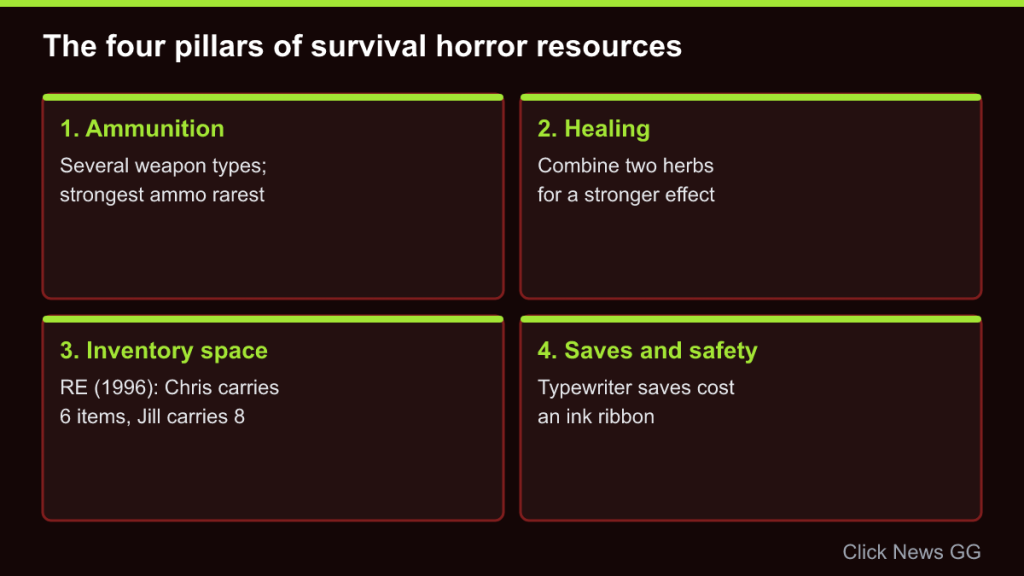
1. Ammunition
Bullets are the most obvious resource. Survival horror usually spreads several weapon types across the game, each with its own ammo, so you are never fully stocked for everything at once. Stronger weapons tend to have rarer ammunition, which encourages saving them for emergencies — and creates the classic problem of finishing a game with a stash of magnum rounds you were too nervous to use.
2. Healing
Healing items are often the second tightest resource. In the original Resident Evil, items in the inventory can be combined for stronger effects, such as mixing two herbs to increase their potency. That one mechanic adds a layer of planning: do you use a herb now, or carry it until you can combine it into something better?
3. Inventory space
Pocket space is the quiet resource that ties everything together. In the 1996 Resident Evil, Chris Redfield can carry six items and Jill Valentine eight. Key items, weapons, ammo and healing all compete for those slots. Picking up a crank handle might mean leaving behind a box of shells, and many players remember long trips back across the mansion simply because they had no room for a key.
4. Saves and safety
Some games treat saving itself as a resource. In the original Resident Evil, typewriters let you save, but each save uses up an ink ribbon you have to find. Safe rooms, which pair a typewriter with an item box, become islands of calm in a hostile map. Even games with unlimited saving use save rooms and checkpoints to shape the rhythm between danger and relief.
Item Boxes and the Backtracking Loop
Limited carrying space only works if there is somewhere to put the rest. Classic Resident Evil answers that with item boxes in safe rooms. Spare items stored in one box are available from the others, so the box functions as a shared stash across the map.
This creates a recognisable loop:
- You leave a safe room carrying only what you think you need.
- You explore, find new keys, puzzle items and supplies, and fill your pockets.
- You head back to a safe room to drop off extras and save.
- You set out again with a different loadout, often through rooms you have already visited — and which may now contain new threats.
The loop is why backtracking in survival horror feels different from backtracking in other genres. Every return trip is another risk calculation: is the zombie you left alive in that corridor still there? Do you have enough ammo to deal with it, or do you need to take the long way round?
How Four Games Approach Scarcity
Resident Evil: the template and the attaché case
The 1996 Resident Evil established the template described above: tight slots, item boxes, combinable healing and limited saves. Resident Evil 4 (GameCube, January 2005, directed by Shinji Mikami) reworked it. Instead of fixed slots, its inventory is a grid represented by an attaché case, where each item occupies a set number of spaces and the case can be upgraded to hold more. Weapons, ammunition and healing items go in the case, while key items and treasures live in a separate menu.
The attaché case turned inventory management into a spatial puzzle: rotating and arranging items so a rifle and a stack of grenades fit side by side. It also arrived alongside a wandering Merchant who buys treasures and sells weapons, first-aid sprays and upgrades. Contemporary reviewers noted that ammunition was more plentiful than in earlier entries, part of the game’s shift towards action. Scarcity did not disappear, though; it moved from “will I have enough bullets?” towards “how do I spend my money and case space?”
Silent Hill: vulnerability without the HUD
The first Silent Hill (PlayStation, 1999, by Konami’s Team Silent) takes a different emphasis. Its protagonist, Harry Mason, is an ordinary man whose aim is often unsteady; he fights with both melee weapons and firearms. There is no heads-up display — you check your health in a separate menu — and Harry’s flashlight is the main light source for most of the game. A portable radio crackles with static when creatures are near.
Here, the scarce resources are information and confidence as much as bullets. You often hear an enemy before you see it, and you may be able to avoid notice by switching off the flashlight. Melee weapons mean you are rarely completely helpless, but they force you into close range, which is its own deterrent. The result is a style of scarcity built on sensory limits rather than pure item counts.
Dead Space: economy and diegetic menus
Dead Space (EA Redwood Shores, October 2008) adds a full economy to the formula. Isaac Clarke finds ammunition, health packs and Power Nodes around the ship, buys supplies at stores, and uses workbenches to improve weapon and suit attributes. Nodes also open special doors, so you face a trade-off between immediate loot and long-term upgrades.
Two other design choices sharpen the pressure. First, the inventory is a holographic display projected in the game world rather than a pause menu — time keeps running while you browse, so rearranging your pockets in a hostile room is genuinely dangerous. Second, the game’s “strategic dismemberment” principle asks you to sever limbs rather than aim for the head. Wasted shots on the torso are wasted ammunition, so skill directly translates into supply conservation. Abilities such as stasis (which slows enemies temporarily) and kinesis (which lets you grab and throw objects) give you ways to stretch your ammo further, for example by launching debris at enemies.
Signalis: six slots and a deliberate squeeze
Signalis (developed by the two-person German studio rose-engine, published by Humble Games and Playism, October 2022) is a modern game that leans hard into classic restrictions. Its protagonist, Elster, can carry only six items on her person — weapons, ammunition and key items included. Safe rooms let you save and store items for later.
That six-slot limit is a conscious throwback, and it is also one of the game’s most debated features: some reviewers criticised the limited inventory and combat even while praising the atmosphere. That reaction is useful in itself, because it shows how thin the line is between productive tension and frustration. For players who enjoy the classic loop, the squeeze is the point; for others, it is a barrier.
Choosing Which Fights to Avoid
Perhaps the most important skill in survival horror is recognising that not every enemy needs to die. Scarcity is designed to push you towards evasion. Some practical ways to think about it:
- Kill what blocks your routes. An enemy in a corridor you will cross repeatedly is worth dealing with properly. An enemy in a room you will visit once might be better dodged.
- Learn enemy patterns before committing. Watch how far a creature follows you and how fast it recovers. Many enemies can be outmanoeuvred with patience.
- Remember the long game. A boss or a dangerous late-game area may demand the stock you are tempted to spend now.
Of course, avoidance has its own costs. An enemy you leave alive may still be waiting on your return trip, which is part of the backtracking tension described earlier.
Practical Tips for New Players
If scarcity sounds stressful, it can be — but a few habits make it much more manageable:
- Travel light, but not empty. Leave room for new pickups. Running out of space far from an item box is one of the most common early frustrations.
- Check your map before leaving a safe room. Plan a route that collects what you need and gets you back to safety.
- Do not hoard to the point of dying. Saving resources is wise, but finishing a game with dozens of unused healing items usually means you took fights at a disadvantage you did not need to.
- Combine and upgrade where you can. Combining items or upgrading storage often gives better value than carrying everything separately.
- Use difficulty settings without guilt. Many modern horror games offer easier modes that increase supplies or reduce enemy toughness. They exist precisely so more people can enjoy the tension without hitting a wall.
How Modern Remakes Tweak Scarcity
The Resident Evil remakes and other modern horror releases tend to keep the core idea of scarcity while smoothing some of the roughest edges, for instance with expandable inventories, crafting systems and difficulty modes that change how many supplies you find. If you are deciding between a classic version and a remake partly because of how resources feel, our guide to Resident Evil remakes vs. originals walks through the differences game by game. And if any of the terms here are unfamiliar — item box, safe room, ink ribbon — the horror game glossary covers them in more detail.
Frequently Asked Questions
Why do some players finish with huge stockpiles?
Because scarcity is psychological as much as numerical. Fear of running out makes many people over-conserve. Over time, experienced players learn roughly how generous a particular game is and spend more confidently.