Horror Game Glossary: Jump Scares, Tank Controls, Safe Rooms and More
An A-to-Z glossary of horror game terms, from asymmetric multiplayer and ink ribbons to stalker enemies and tank controls, with real examples.
Horror games have their own vocabulary. Fans talk about tank controls, item boxes, Crimson Heads and stalkers as if everyone knows what they mean, and reviews assume you can tell a run-and-hide game from an action horror game. This glossary collects the most common terms, each with a short definition and an example from a real game.
Terms are grouped by theme so related ideas sit together. If you are completely new, start with our survival horror explainer, then use this page as a reference.
Genres and styles
- Action horror: horror with frequent combat and a generous arsenal, where fear comes from intensity rather than scarcity. Example: Resident Evil 5 (2009), the first co-op-focused mainline entry.
- Asymmetric multiplayer: a format where one side has different goals and abilities than the other, usually one monster against a group of survivors. Example: Dead by Daylight (2016), one Killer against four Survivors.
- Body horror: fear built on the distortion or destruction of the human body. Example: the Necromorphs of Dead Space (2008).
- Co-op horror: horror designed for groups of players working together. Example: Lethal Company (2023), where up to four players scavenge scrap on abandoned moons.
- Cosmic horror: horror about vast, indifferent forces beyond human understanding, usually inspired by H. P. Lovecraft. Example: Call of Cthulhu: Dark Corners of the Earth (2005).
- Interactive drama: a cinematic, choice-driven game where most action is handled through quick-time events. Example: Until Dawn (2015).
- Psychological horror: horror rooted in a character’s mind, guilt or unreliable perception. Example: Silent Hill 2 (2001).
- Run-and-hide (stealth horror): horror in which the player cannot fight back and must flee or hide. Example: Outlast (2013).
- Survival horror: horror built around a vulnerable protagonist, scarce resources, puzzles and a dangerous space. Example: Resident Evil (1996), which Capcom marketed with that label.
- Walking simulator: a narrative exploration game with little or no challenge, often sharing horror’s atmosphere. The term began as a pejorative. Example: Dear Esther (2012).
For a deeper comparison of these styles, see our horror subgenres guide.
Camera and controls
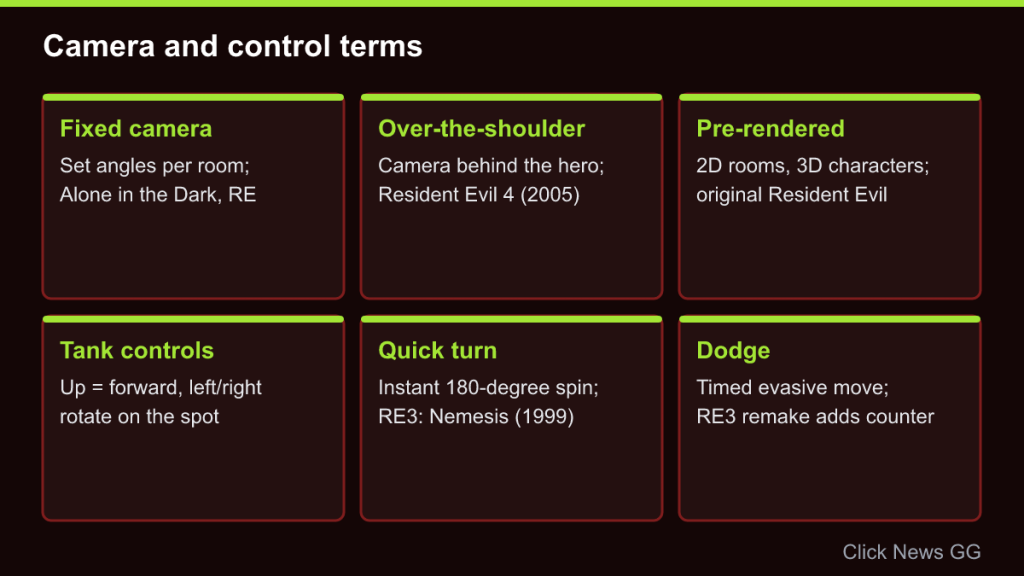
- Fixed camera: a camera locked to set angles in each room, switching as the player moves, like shots in a film. Pioneered in the genre by Alone in the Dark (1992) and adopted by Resident Evil.
- Over-the-shoulder camera: a third-person camera placed just behind the character. Popularized by Resident Evil 4 (2005).
- Pre-rendered backgrounds: detailed 2D images of rooms, rendered in advance, with 3D characters moving on top. Example: the original Resident Evil. Code: Veronica (2000) replaced them with real-time 3D environments.
- Tank controls: a control scheme where “up” moves the character forward relative to the way they face, and left and right rotate them on the spot, regardless of camera angle. Example: Resident Evil (1996). The 2019 Resident Evil 2 remake replaced them with free movement.
- Quick turn (180-degree turn): a button that spins the character around instantly, added to ease tank controls. Example: Resident Evil 3: Nemesis (1999).
- Dodge: a timed evasive move. Resident Evil 3: Nemesis introduced one; the 2020 remake rebuilt it with a counterattack.
Resources and saving
- Backtracking: returning to previously explored areas, usually with a new key or item. Central to classic survival horror’s interconnected maps.
- Combining items: merging items in the inventory to create something more useful, such as mixing healing herbs in Resident Evil.
- Crafting: building items from collected materials. Example: the 2023 Resident Evil 4 remake lets players craft ammunition and items.
- Hardcore mode: a harder difficulty, often with fewer resources or limited saves. Example: on Hardcore in Resident Evil 2 (2019), typewriter saves require ink ribbons.
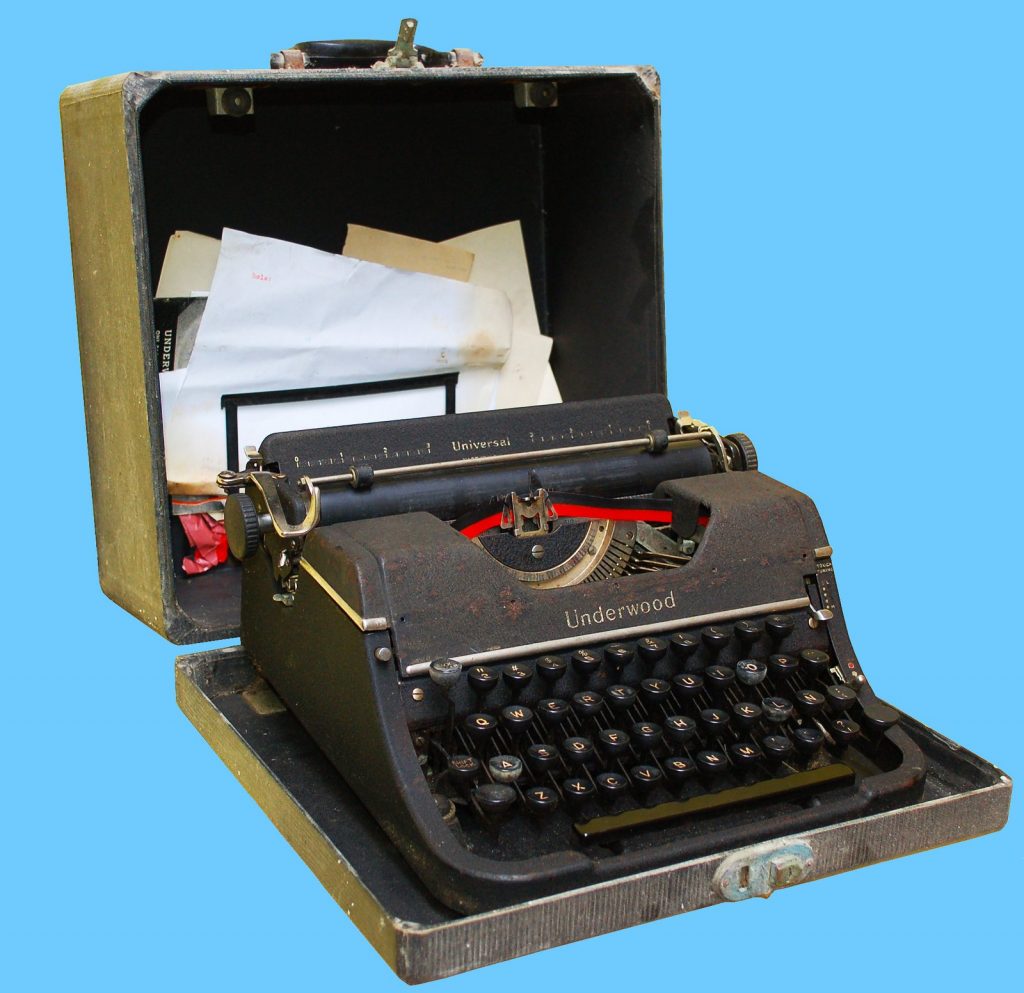
- Ink ribbon: a consumable item needed to save at a typewriter. Example: Resident Evil (1996).
- Inventory management: deciding what to carry with limited space. Example: Signalis (2022), where the protagonist carries only six items.
- Item box: a storage chest, usually in safe rooms, where you leave items you are not carrying. Example: Resident Evil. Resident Evil Zero (2002) removed item boxes and let players drop items anywhere.
- Light management: rationing light sources as a resource. Example: tinderboxes and lantern oil in Amnesia: The Dark Descent (2010).
- Battery management: a variation where a device drains power. Example: the camcorder’s night-vision mode in Outlast.
- Merchant: a trader who sells and upgrades equipment. Example: Resident Evil 4‘s Merchant, who in the 2023 remake also repairs Leon’s knife.
- Safe room: a room where enemies cannot attack, often with a save point and calmer music. Example: in Resident Evil 2 (2019), the stalker Mr. X cannot enter safe rooms.
- Save station: a fixed save point that takes time to use. Example: Alien: Isolation (2014), where saving takes a few seconds, during which you are vulnerable.
- Typewriter: the classic Resident Evil save point.
Enemies and threats
- Crimson Head: a zombie that revives in a faster, more dangerous form if its body is not destroyed. Introduced in the 2002 Resident Evil remake.
- Invulnerable enemy: an enemy that cannot be killed, only avoided or temporarily stopped. Example: Mr. X in Resident Evil 2 (2019) can only be stunned.
- Monster AI that hunts: an enemy that searches by sight and sound rather than following a set route. Example: the alien in Alien: Isolation.
- Stalker enemy: a persistent pursuer that follows the player through the game. Examples: Scissorman in Clock Tower (1995), Nemesis in Resident Evil 3: Nemesis.
- Strategic dismemberment: combat where enemies die only when their limbs are severed. Example: Dead Space (2008).
- Symbolic monster: a creature that represents a character’s psychology. Example: Pyramid Head in Silent Hill 2, tied to James Sunderland’s guilt.
Atmosphere and presentation
- Diegetic UI: interface elements that exist inside the game world. Example: in Dead Space, Isaac’s health appears on the back of his suit and menus are holographic projections.
- Door loading screen: a short animation of a door opening that hides loading. Example: Resident Evil, inherited from Sweet Home (1989).
- Environmental storytelling: telling a story through spaces and objects instead of dialogue. Example: Gone Home (2013).
- Fog: a visual effect limiting visibility. In Silent Hill (1999), it hid the console’s draw-distance limits and became the series’ trademark.
- Jump scare: a sudden shock, usually a loud noise and an abrupt image. Example: encounters with the ghost Lisa in P.T. (2014).
- No-HUD design: removing on-screen meters to increase immersion. Example: Call of Cthulhu: Dark Corners of the Earth conveys health through breathing, heartbeat and loss of color.
- Otherworld: a nightmarish alternate version of a location. Example: the Silent Hill series.
- PS1 aesthetic: low-polygon graphics imitating the original PlayStation era, often with a CRT filter. Example: Signalis.
- Radio static: an audio warning of nearby enemies. Example: the pocket radio in Silent Hill and Silent Hill 2.
- Sanity meter: a measure of a character’s mental state that affects perception or gameplay. Examples: Amnesia: The Dark Descent, where darkness and monsters drain sanity, and Phasmophobia, where low sanity makes ghost hunts more likely.
Story and structure
- Butterfly effect: a branching system where choices ripple forward to change later events. Example: Until Dawn.
- Live selection: timed choices during dangerous moments that alter scenes or endings. Example: Resident Evil 3: Nemesis.
- Multiple endings: different conclusions based on choices or behavior. Example: Silent Hill 2 has six; The Quarry (2022) has 186.
- Permadeath (character): characters who die stay dead for the rest of the playthrough. Examples: Sweet Home and Until Dawn.
- Playable teaser: a short game released to reveal a larger project. Example: P.T., the teaser for the cancelled Silent Hills.
- Quick-time event (QTE): an on-screen button prompt during a cinematic moment. Example: most action in Until Dawn.
- Remake vs. remaster: a remake rebuilds a game, often with new design; a remaster updates an existing game’s presentation. Example: Resident Evil 2 (2019) is a remake; Resident Evil HD Remaster (2015) is a remaster of the 2002 remake.
- Zapping system: linked scenarios where one character’s actions affect another’s playthrough. Example: Resident Evil 2 (1998).
Player slang and general terms
- Hiding spot: a locker, cabinet, bed or table where the player can hide from a pursuer. Example: Alien: Isolation lets players hide inside lockers and under tables.
- Monster closet: slang for an enemy placed to burst out of a hidden space as soon as the player arrives. Often criticized when overused, because it trains players to expect every cupboard to be a trap.
- New Game Plus: replaying a finished game while keeping some upgrades or items. Many modern horror games offer it, often alongside unlockable harder difficulties.
- Speedrun: finishing a game as fast as possible. Classic Resident Evil games reward fast completion times with unlockables, which has made them popular with speedrunners.
- Cheese: exploiting AI or level geometry to avoid a threat in an unintended way, such as standing where a stalker cannot reach.
Multiplayer terms
- Proximity voice chat: voice chat that only works for players close to each other in the game world, so separation means silence. Example: Lethal Company.
- Quota: a target the group must meet to keep playing. Example: Lethal Company‘s rising profit quotas.
- Speech recognition: the game listens to what players say. Example: in Phasmophobia, ghosts can respond to specific spoken words.
- Hook (Dead by Daylight): where the Killer places captured Survivors; the third hooking sacrifices them.
Using this glossary
Many terms here overlap. A game can be survival horror with a stalker enemy, a sanity meter and multiple endings all at once, and labels like “psychological” or “action” describe emphasis rather than strict categories. If a term in a review confuses you, look for the mechanic behind it: what does it ask you to do, and how does that create fear? That question explains almost everything in this list. For more on how these ideas developed, our Resident Evil history traces many of them through a single series.