Detective Games Explained: How Deduction Mechanics Work
How detective games make you think: contradictions, deduction boards, fill-in-the-blank solutions and database searches, explained with key examples.

Plenty of games put you in a trench coat. Far fewer make you feel like a detective. The difference lies in one question: who is doing the reasoning? In many mystery games the protagonist solves the case while the player watches, clicking through a list of clues until a cutscene announces the culprit. The best detective games move the thinking onto the player’s side of the screen, and they use a surprisingly small set of mechanical tricks to do it.
This guide breaks down the main deduction systems in detective games, how each one tests your reasoning, and where they tend to slip back into guesswork. All plot details stay spoiler-free.
The Core Problem: Proving the Player Actually Knows
A detective game has to check whether you have understood the case. That is harder than it sounds. A game cannot read your mind, so it must ask you to express your conclusion through some kind of input — pointing at evidence, selecting a suspect, typing a word or filling a form. Every deduction system is really an answer to the question: what input proves the player reasoned their way here?
The weaker the input, the easier it is to brute-force. If the game asks you to pick one of three suspects with no penalty, you can simply try all three. If it asks you to name every passenger aboard a ship and how each one died, guessing becomes almost useless. Most of the design history of detective games is a search for inputs that are expressive enough to require real understanding while staying clear enough that a correct thinker is not punished by awkward interfaces.
Evidence Collection: The Foundation
Nearly every detective game starts with gathering information. This part borrows heavily from the classic adventure game: you examine rooms, talk to characters and pick up items. If you are new to that tradition, our explainer on point-and-click adventure games covers the basics.
Evidence collection on its own is not deduction. Searching every pixel of a crime scene tests thoroughness, not insight. What matters is what the game asks you to do with the evidence afterwards. The systems below are the main answers.
Contradiction Systems: Ace Attorney
Capcom’s Phoenix Wright: Ace Attorney, created, written and directed by Shu Takumi, first released in Japan on the Game Boy Advance on October 12, 2001. It splits each case into two phases:
- Investigation: you talk to your client, witnesses and police, examine locations and collect evidence. Showing specific evidence to specific characters can unlock new information.
- Trial: you cross-examine witnesses, moving back and forth between statements. You can press a statement for more detail, and when you spot an inconsistency you present a piece of evidence that contradicts it.
The genius of the contradiction system is that the input — “this statement conflicts with this evidence” — maps directly onto the reasoning a lawyer would use. You are not just picking the culprit; you are pinpointing exactly where a lie breaks down. Mistakes cost you: presenting the wrong evidence removes one of your on-screen penalty markers, and losing them all means a guilty verdict and a restart of the case.
The weakness is that the game has a single intended contradiction for each step. If you reason your way to a valid but different objection, the game will not accept it. Players often describe “fighting the game’s logic” rather than the witness’s — a recurring tension in linear detective design.
Deduction Boards: Frogwares’ Sherlock Holmes
Frogwares, the studio behind a long-running series of Sherlock Holmes games, built a different system for Sherlock Holmes: Crimes & Punishments (released in late September and early October 2014 across PC, PlayStation and Xbox platforms, with a Switch version in 2022). Discovered clues are added to a deduction board, where you link pieces of information together. Connected clues produce possible deductions, and a complete set builds a tree leading to a conclusion.
Crucially, the game allows different interpretations of the same clues. Each case has several possible solutions, so you can accuse the wrong person and the game will let you. You then decide whether to absolve or condemn the culprit you identified.
This approach does something the contradiction model cannot: it makes being wrong a real outcome rather than a game-over screen. You are reasoning with genuine uncertainty, and you have to live with your conclusion. The trade-off is that the board can sometimes feel like a combination lock: if you cycle through options on the board, you may stumble into conclusions without really holding the whole case in your head.
Fill-in-the-Blank Deduction: Obra Dinn and Golden Idol
Return of the Obra Dinn
Lucas Pope’s Return of the Obra Dinn (Windows and macOS, October 2018; consoles in October 2019) is often cited as the modern benchmark for player-driven deduction. You board a ghost ship carrying a pocket watch, the Memento Mortem, which replays the moment of death when used on a corpse. Your task is to determine the fate of all 60 people aboard: their names, how they died, who or what killed them, or where they went if they survived.

The logbook fills in basic details automatically, but you must name each person and pick a cause of death from a catalogue. The decisive design trick is batched confirmation: correct fates are only validated in sets of three. Guessing one fate correctly tells you nothing; you need three right answers at once before the game confirms anything. That makes brute-forcing impractical and forces you to build real certainty from accents, uniforms, seating plans and the relationships glimpsed in each frozen scene.
The Case of the Golden Idol
Color Gray Games, founded by brothers Ernests and Andrejs Kļaviņš, released The Case of the Golden Idol (published by Playstack) on Windows and macOS in October 2022, with later ports to Switch, mobile, Xbox and PlayStation. Each case shows a frozen moment just after a death. The game uses two modes:
- Exploring: you click on people, objects and documents to collect keywords — names, places, verbs and items.
- Thinking: you drop those words into blank slots in an incomplete account of what happened.
Answers are checked in segments, and the game signals when a segment is close — only a couple of words wrong — which nudges you without solving the puzzle for you. The fill-in-the-blank format is clever because it asks you to narrate the crime in your own words (well, the game’s words in your arrangement). A free 2024 update added a hint system, and a sequel, The Rise of the Golden Idol, followed in November 2024.
Search-Based Deduction: Her Story
Sam Barlow’s Her Story (June 2015) removes the crime scene entirely. You sit at an old computer with a police database of short video clips from interviews with a woman named Hannah — 271 clips in total. You find clips by typing words that appear in the transcripts, and you can tag clips you have watched so the tags become searchable too.
There is no accusation screen and no confirmation of a “correct” answer in the usual sense. Your deduction happens in your head as you form theories and test them by choosing the next search term. It is one of the purest examples of player-driven investigation, because the input itself — what you choose to search for — reveals what you suspect. The cost is that some players find the lack of a formal verdict unsatisfying.
Comparing the Systems
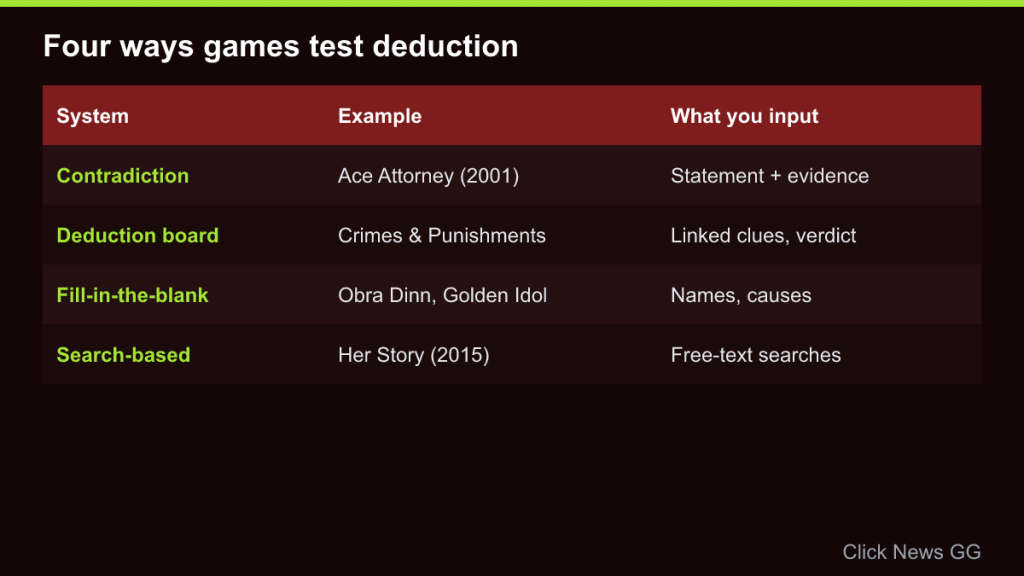
| System | Example | What you input | Main strength | Main risk |
|---|---|---|---|---|
| Contradiction | Ace Attorney (2001) | Statement + evidence | Precise, dramatic moments | Single intended answer |
| Deduction board | Crimes & Punishments (2014) | Linked clues, then a verdict | Wrong answers are allowed | Can become trial and error |
| Fill-in-the-blank | Obra Dinn (2018), Golden Idol (2022) | Names, causes, keywords | Very hard to brute-force | Demanding on note-taking |
| Search-based | Her Story (2015) | Free-text search terms | Reasoning shapes exploration | No formal verdict |
Guessing vs. Real Deduction
Every detective game faces the same tension: the harder it is to guess, the harder it can be to finish. Designers manage that in a few ways:
- Batching answers (Obra Dinn’s sets of three) makes random guessing useless without making individual mistakes fatal.
- Partial feedback (Golden Idol’s “almost there” alert) narrows the search while still requiring thought.
- Penalties (Ace Attorney’s markers) discourage spamming every piece of evidence at every statement.
- Consequences without confirmation (Frogwares’ multiple solutions) remove the safety net entirely, so you must commit to what you believe.
Good deduction design also gives you enough information to be certain. Unfairness tends to creep in when the game expects a single interpretation of ambiguous evidence. That problem overlaps with “moon logic” in older adventure games, where the designer’s reasoning and the player’s reasoning simply did not match.
Tips for Playing Detective Games Well
- Take notes outside the game. Paper, a spreadsheet or a phone note helps enormously in games like Obra Dinn and Her Story, where the game does little of your bookkeeping.
- Separate facts from assumptions. Write down what you have seen before what you think it means.
- Re-read testimony slowly. In contradiction-based games, the lie is often hidden in a small detail such as a time, a direction or a sound.
- Do not fear being wrong. In games with multiple solutions, a wrong accusation is part of the experience, not a failure of play.
- Step away when stuck. Fresh eyes are a genuine detective tool; many puzzles that felt impossible become obvious after a break.
- Use hints sparingly. Built-in hint systems, where they exist, are usually designed to nudge rather than solve. Try one hint before reaching for a full walkthrough.
Where Detective Games Overlap With Other Genres
Deduction mechanics also show up beyond pure detective games. Choice-driven dramas sometimes ask you to interpret evidence before making a decision, and the outcome may branch on whether you noticed something. Our explainer on interactive drama games covers how those branching structures work. Horror games, too, often hide their stories in documents and environmental details, rewarding the same habits of close observation that detective games train.
What unites the genre’s best examples is respect for the player’s intelligence. Whether you are spotting a contradiction in court, linking clues on a board, naming a sailor from the cut of his uniform or typing a single word into an old police database, the game is asking you to think — and trusting you to get there.