What Is a Point-and-Click Adventure Game? A Beginner’s Guide
Inventory puzzles, dialogue trees and verb menus: a beginner's guide to point-and-click adventures, from Colossal Cave to modern revivals.
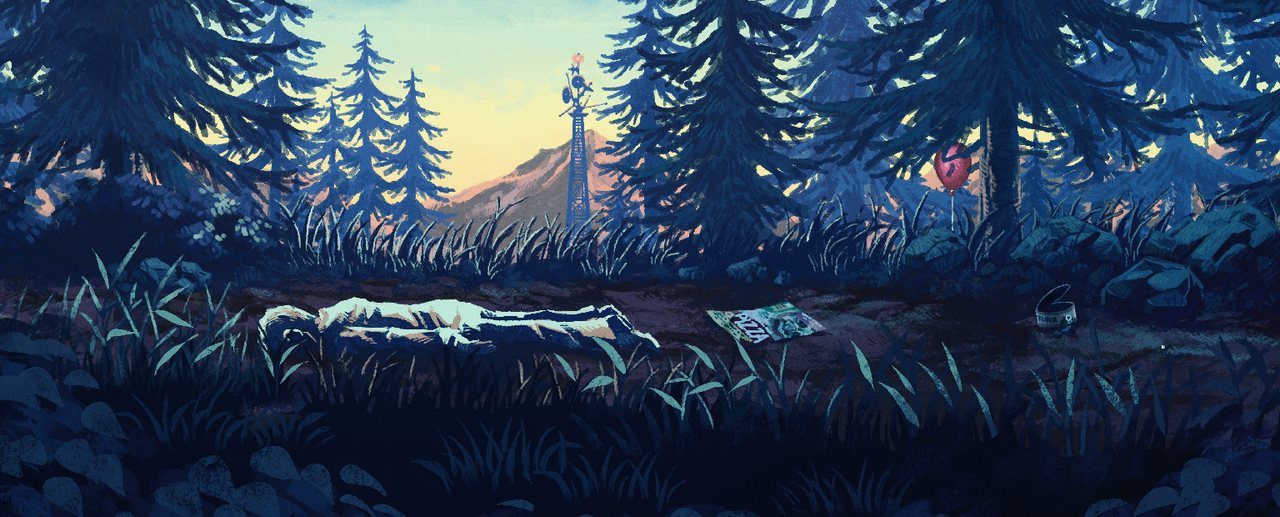
Point-and-click adventures are some of the most patient games ever made. There are no reflex tests, no skill trees and usually no way to lose by being slow. Instead you explore a place, talk to its inhabitants, collect odd objects and work out how they fit together to move the story forward. If you have ever enjoyed an escape room or a good mystery novel, the genre has a lot to offer, even though its heyday was decades ago.
This guide explains how point-and-click games work, where they came from and how to approach one today without getting frustrated.
The basic idea
An adventure game is built around story and puzzles rather than combat or dexterity. In a point-and-click adventure, you control a character by clicking on the screen with a mouse (or a cursor moved by a controller): click on the ground to walk, on a person to talk, on an object to examine or pick it up. The world is usually presented as a series of illustrated scenes, and progress depends on solving problems using what you find.
Most point-and-click games share four building blocks:
- Exploration: examining every scene for useful objects, clues and exits.
- Inventory puzzles: picking up items and using them on the world or on each other. A rubber chicken with a pulley in the middle, a key hidden in a loaf of bread, a fishing rod used to reach a ledge.
- Dialogue trees: conversations with menus of things to say. Talking can reveal information, persuade characters or unlock new options.
- Story: the reward for solving puzzles is the next scene, joke or plot twist. Writing and characters matter more than in almost any other genre.
From text adventures to graphics
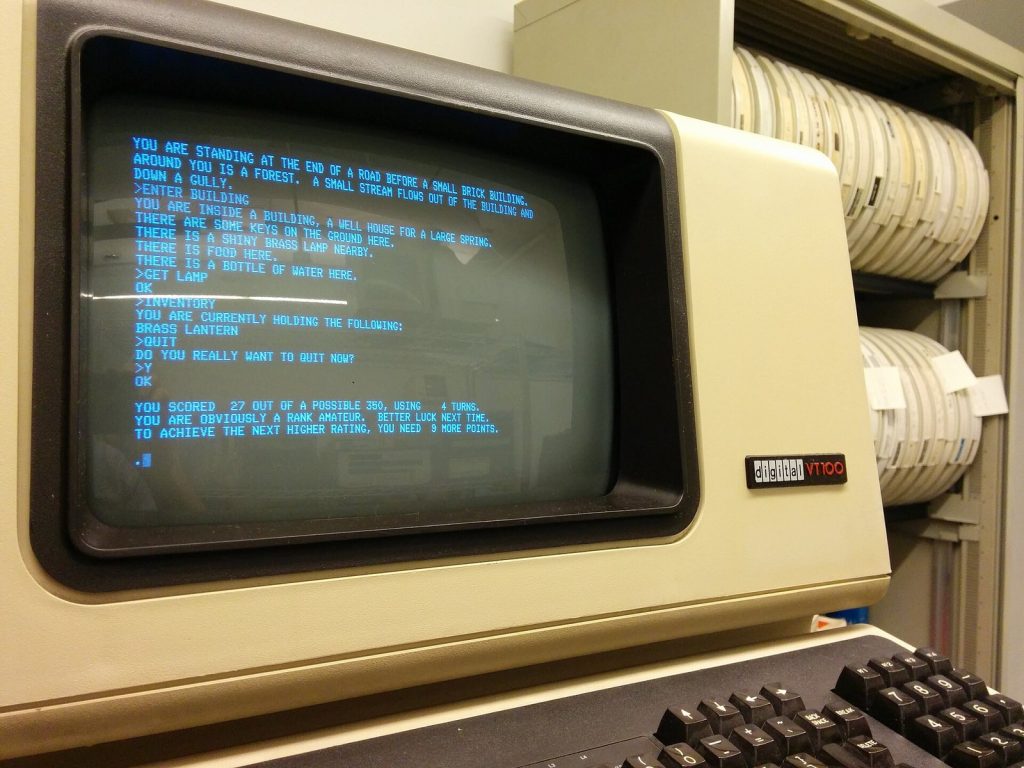
The genre began without pictures at all. Colossal Cave Adventure, written by William Crowther in 1976 and later expanded by Don Woods, is widely considered the first adventure game. Players typed short commands such as “go north” or “take lamp”, and the game described the results in text. It established the core loop of exploration, item collection and puzzles that still defines the genre.
Zork (1977) followed, created by a group at MIT who then formed Infocom to bring it from mainframes to home computers. Infocom’s text adventures became a commercial success, known for their clever writing and parsers that understood more complex sentences.
Pictures arrived with Mystery House (1980), designed by Roberta Williams and programmed with Ken Williams’ help. It is considered the first known graphical adventure and was published by their company, Sierra On-Line. Sierra’s King’s Quest, first published for the IBM PCjr in May 1984, went further: Sir Graham could walk around animated scenes, in front of and behind objects, while the player still typed commands such as “get stone”. It ran on Sierra’s Adventure Game Interpreter (AGI) engine, which powered many later Sierra games.
The verb interface: SCUMM and Maniac Mansion
Typing commands had a problem: guessing the exact word the game wanted. Lucasfilm Games (later LucasArts) tackled this with Maniac Mansion, released in October 1987 for the Commodore 64 and Apple II and designed by Ron Gilbert and Gary Winnick. Instead of a text parser, the screen showed a list of verbs such as “Walk To”, “Pick Up”, “Open” and “Unlock”, plus your inventory. You built commands by clicking a verb and then an object: Use key with door.
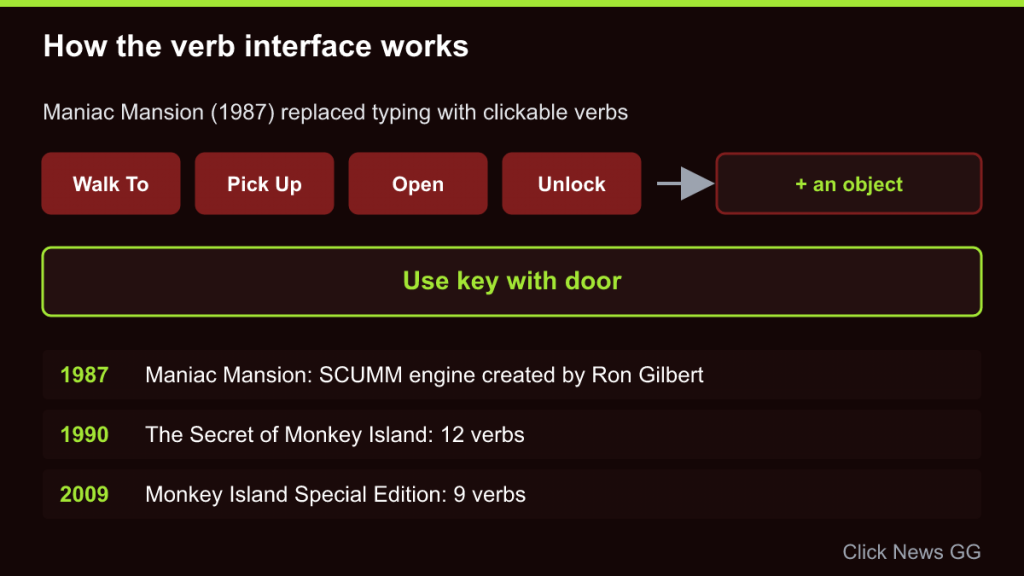
To build the game efficiently, Gilbert created an engine called SCUMM, short for “Script Creation Utility for Maniac Mansion”. It was reused in many later LucasArts adventures. Maniac Mansion is also credited with popularizing another familiar idea: Gilbert coined the term “cutscene” for its short non-interactive scenes.
The verb system made every possible action visible, which removed the guessing game of the parser era. The Secret of Monkey Island (1990), conceived by Gilbert with Tim Schafer and Dave Grossman, used twelve verbs in its original version. Its Special Edition in 2009 trimmed the set to nine.
From verbs to a single click
Over time, interfaces got simpler. Many 1990s games replaced verb lists with cursor icons or context-sensitive actions: the game decides whether clicking a door means “open” or “walk through”. Today most point-and-click adventures use one click to interact and another to examine, often with highlighting so that you can see which objects are interactive.
Each approach has fans. Verb interfaces offer more possibilities and more jokes (try “Pick up” on a person and you will usually get a witty refusal), but they can slow things down. Single-click interfaces are faster and more accessible but can make puzzles feel like clicking on everything until something happens. Some modern games deliberately go back to verbs. Thimbleweed Park (2017), designed by Gilbert and Winnick at Terrible Toybox after a 2014 Kickstarter campaign, uses a classic verb list, but also offers an in-game hint line you can call from phones.
Sierra vs. LucasArts: two design philosophies
The two big American adventure publishers of the 1980s and 1990s had different attitudes to failure.
- Sierra games, such as the King’s Quest series, often let your character die in many ways, from drowning to falling, and could leave you stuck without a necessary item. In the original King’s Quest, having items stolen could make the game unwinnable. Saving often was essential.
- LucasArts moved in the opposite direction. In The Secret of Monkey Island, the team made the hero, Guybrush Threepwood, nearly impossible to kill, shifting focus to exploration and comedy. The rare exception is a hidden drowning joke.
Neither approach is “wrong”, but the LucasArts style is more forgiving and is closer to what most modern adventure games do.
Decline and revival
The genre was among the biggest in PC gaming in the early 1990s. Cyan’s Myst (1993), a first-person puzzle adventure, sold over six million copies and helped popularize CD-ROM drives. But from the mid-1990s, adventure games’ market share dropped. Sierra was sold in 1998, and LucasArts’ Grim Fandango (1998) sold poorly despite acclaim; the studio released one more adventure, Escape from Monkey Island, in 2000.
The genre never disappeared. European studios kept it alive, and digital distribution later made it viable again. Telltale’s The Walking Dead (2012) reimagined adventure games around choices and characters. In the same year, Tim Schafer’s Double Fine launched a Kickstarter campaign seeking $400,000 for a new adventure game and raised over $3.4 million; the result became Broken Age, released in two parts in 2014 and 2015. That campaign showed there was still an audience willing to fund the genre.
Why point-and-click games are approachable today
Modern adventure games, along with remasters of classics, tend to include features that remove the worst frustrations of the old days:
- Hotspot highlighting: a button that shows every interactive object on screen, ending “pixel hunts” for tiny clickable items.
- Hint systems: built-in hints that nudge you rather than give away the answer, like Thimbleweed Park‘s hint line.
- Autosaves and no dead ends: most modern games follow the LucasArts philosophy that you should never be stuck permanently.
- Controller support: many games now play comfortably on consoles and handhelds.
- Short length: many adventures can be finished in a few evenings.
Adventure design also influenced other genres. Classic survival horror borrowed its key-and-lock puzzles and item combinations; if you enjoy those parts of horror games, you will find the same pleasures here. See our survival horror explainer for that connection.
How to approach your first adventure game
- Look at everything, talk to everyone. Examine objects even if you cannot pick them up. Exhaust dialogue options, because characters often drop hints.
- Think about what the character wants. Puzzles usually follow from a clear goal: get past the guard, open the chest, find a disguise. Ask what would solve that problem in the game’s logic.
- Try combining inventory items. Some solutions require using two items together before using the result on the world.
- Revisit earlier areas. New information or items often change what you can do in places you have already seen.
- Take breaks. Many players solve a stuck puzzle the next day without trying.
- Use hints without guilt. Older games sometimes rely on “moon logic”, solutions that only make sense to the designer. A targeted hint is better than quitting. Try to look up just the one step you need.
Common terms you will see
- Parser: a text input system where you type commands.
- Verb coin / verb list: menus of actions such as Look, Use and Talk.
- Hotspot: an interactive area of the screen.
- Dead end: a situation where you can no longer finish the game, usually because a needed item was missed.
- Pixel hunt: searching the screen for a tiny clickable spot.
- Moon logic: a puzzle solution that makes little real-world sense.
Frequently asked questions
Are point-and-click games hard?
They do not test reflexes, so anyone can physically play them. The challenge is mental: noticing details and making connections. Modern games with hint systems and highlighted hotspots are far gentler than many 1980s classics.
Can I play them with a controller?
Many modern releases and remasters support controllers, often by letting you move the character directly and cycle between nearby objects. Older PC games usually work best with a mouse.
Is it cheating to use a walkthrough?
No. Adventure games are about story as much as puzzles, and getting stuck for hours helps no one. A good habit is to check only the step you are stuck on, then close the guide.
Where to start
If you want comedy and classic design, the remastered Monkey Island games are a natural entry point. If you prefer a modern take with an old-school interface, Thimbleweed Park is designed with modern conveniences in mind. And if you like choices and characters more than puzzles, Telltale-style interactive dramas sit at the gentlest end of the adventure spectrum. Whichever you pick, give yourself time to think: the genre rewards curiosity far more than speed.