What Is Survival Horror? The Genre Explained for New Players
What makes a game survival horror? Vulnerable heroes, scarce ammo, puzzles and dangerous spaces, plus a short history from Sweet Home to today.
“Survival horror” is one of the most recognizable labels in gaming, yet people use it loosely. Some call any scary game survival horror. Others reserve the term for a very specific kind of design: a lone, underpowered character, a building full of locked doors, too few bullets and the constant question of whether a fight is worth it. If you are new to horror games, understanding that design will tell you a lot about what you are getting into and why these games feel the way they do.
This guide explains the core ingredients of survival horror, how the genre got its name, where it came from and what it looks like today.
A working definition
Survival horror is usually described as a subgenre of action-adventure games. The player character is vulnerable and under-equipped, so play revolves less around winning fights and more around evasion, puzzle-solving and careful rationing of scarce resources. The objective is to get out alive, not to clear every room of enemies.
That last point is the clearest way to tell survival horror from an action game that happens to have monsters in it. In an action game, enemies are obstacles you are expected to defeat, and the game hands you the tools to do it comfortably. In survival horror, enemies are a cost. Every shot fired is a shot you will not have later, every healing item used now cannot save you in the next corridor, and every detour risks walking into something worse.
The core ingredients
Not every survival horror game uses every one of these elements, but most combine several of them.
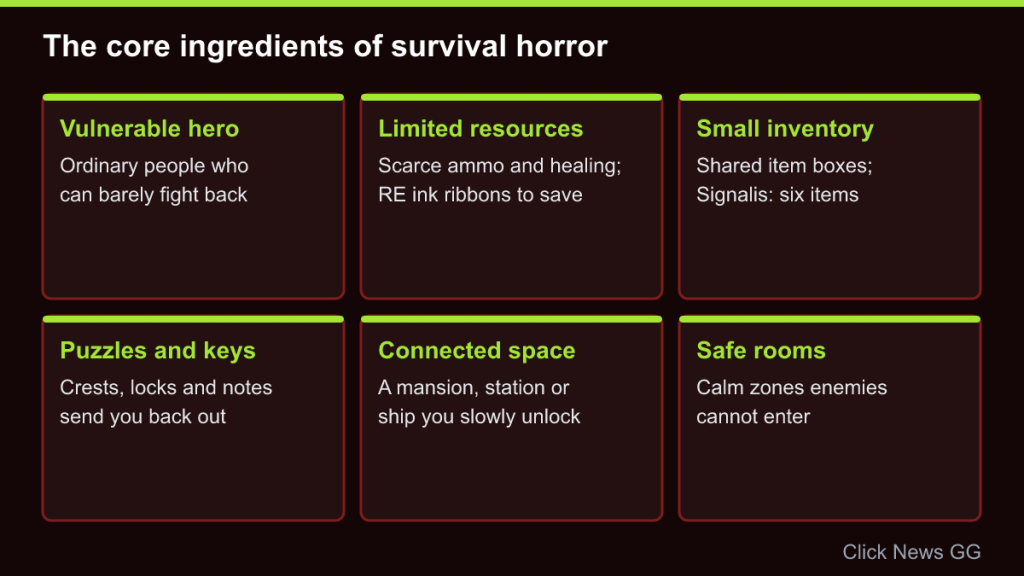
A vulnerable protagonist
The hero is usually an ordinary person, or a trained professional who has been stripped of backup and equipment. They can be hurt badly by ordinary enemies. In some games they cannot fight at all; in classic survival horror they can, but only just enough to scrape by.
Limited resources
Ammunition, healing items and sometimes save opportunities are deliberately scarce. In the original Resident Evil (1996), saving at a typewriter consumes an ink ribbon, an item you have to find. The scarcity forces decisions: run past this zombie, or spend three bullets to make the hallway safe for the rest of the game?
Inventory management
Many survival horror games give you a small inventory, so you cannot carry everything. Resident Evil pairs that with item boxes, storage chests found in safe rooms that magically share their contents. Modern games keep the idea alive: Signalis (2022) lets its protagonist carry only six items, including weapons, ammunition and key items. Juggling space turns routine trips into small planning puzzles.
Puzzles and keys
Survival horror borrows heavily from adventure games. Locked doors, crests, keys with odd symbols, combination locks and notes with clues are staples. The puzzles are rarely brutally hard; their job is to send you back into dangerous territory to find the piece you are missing.
A dangerous, interconnected space
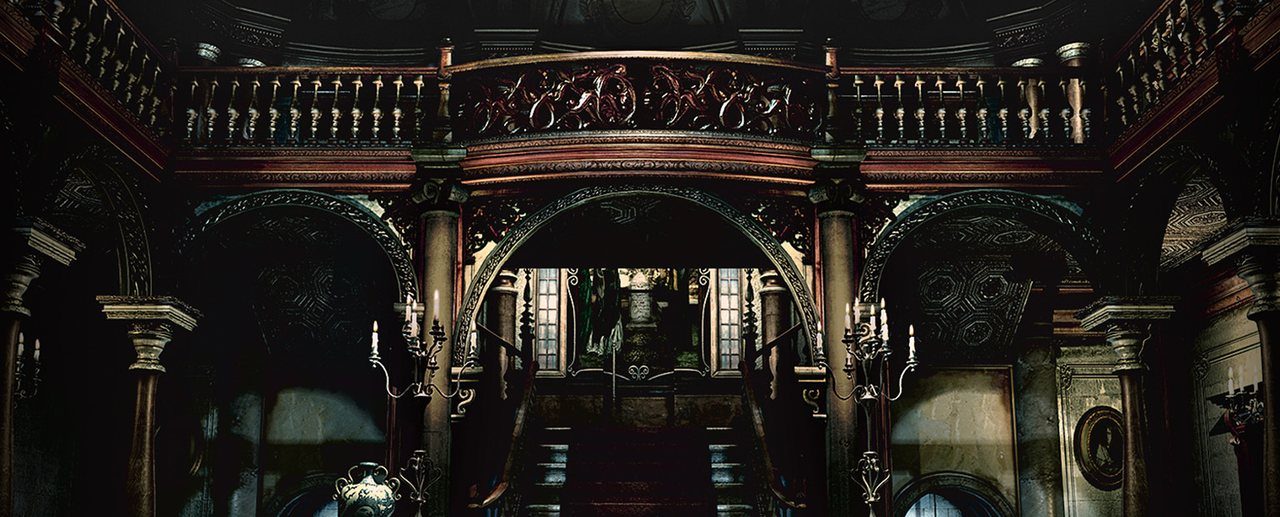
The genre loves a single large location, such as a mansion, a police station, a hospital or a spaceship, that you gradually unlock. Because shortcuts open up and old areas must be revisited, you come to know the map intimately. That familiarity is a source of tension: you know exactly which corridor has the dog behind the window.
Safe rooms
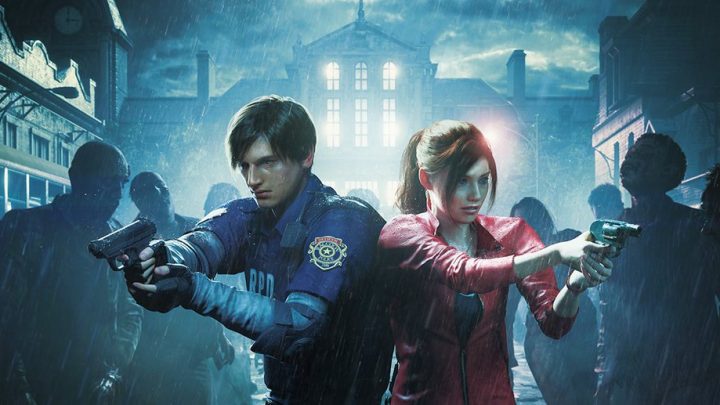
Safe rooms are islands of calm where enemies cannot follow, often marked by quieter music. In Resident Evil 2 (2019) the stalking Tyrant, Mr. X, cannot enter safe rooms. The contrast between safety and danger is as important as the danger itself.
Where the genre came from
Horror in games predates the label by more than a decade. Some reviewers have retroactively pointed to Haunted House (1982) for the Atari 2600, which emphasized puzzle-solving and evasion. 3D Monster Maze (1982), written by Malcolm Evans for the ZX81, put an unarmed player in a first-person maze with a Tyrannosaurus rex. These were simple, but they already traded combat for fear and avoidance.
Sweet Home (1989)
The most direct ancestor is Sweet Home, released in Japan on December 15, 1989 for the Famicom (the Japanese NES). Capcom developed it alongside a horror film of the same name; Tokuro Fujiwara directed the game. It was never officially released outside Japan. Sweet Home sent a group of five characters into a haunted mansion with limited weapons and healing, scattered notes and diary entries, item-based puzzles and permadeath: a character who died stayed dead, and the number of survivors affected which of five endings you saw. Each character also carried a unique item needed to finish the game.
Alone in the Dark (1992)
Infogrames’ Alone in the Dark, directed by Frédérick Raynal and released for MS-DOS in 1992, solved a different problem: how to present horror in 3D on early-1990s PCs. It placed three-dimensional polygon characters over hand-drawn 2D backgrounds, viewed from fixed camera angles that framed each scene like a film shot. Set in a Louisiana mansion called Derceto in 1925, it drew on H. P. Lovecraft’s Cthulhu Mythos and let players choose between private investigator Edward Carnby and Emily Hartwood.
Clock Tower (1995)
Human Entertainment’s Clock Tower took another path: point-and-click play with no combat at all, and a pursuer, the Scissorman, who hunted the player. Its emphasis on hiding from a relentless stalker anticipates many modern horror games.
Resident Evil and the birth of the label
Capcom’s Resident Evil launched on the PlayStation on March 22, 1996 in Japan and April 1, 1996 in North America. Shinji Mikami directed, and Tokuro Fujiwara, the creator of Sweet Home, produced. The project began as a successor to Sweet Home, which is why it shares the mansion setting, inventory management, puzzles and even the door-opening loading screens. Capcom did not have the Sweet Home license, so it built a new world.

From Alone in the Dark, Resident Evil adopted fixed cinematic camera angles over pre-rendered backgrounds. Add tank controls, ink ribbons, item boxes and a handful of bullets per room, and the formula was complete. Capcom used the term “survival horror” to market the game, and it became the first game widely described that way. It was a major hit, and the label stuck to an entire genre.
The years that followed produced classics that refined different aspects of the idea. Konami’s Silent Hill (1999) moved to real-time 3D and used fog and a flashlight to limit what players could see, leaning into psychological dread. Fatal Frame (2001) armed players only with a camera that could exorcise ghosts.
How the genre evolved
By the mid-2000s, the scales tipped toward action. Resident Evil 4 (2005) introduced an over-the-shoulder camera and far more combat, and it became one of the most influential games of its generation. Dead Space (2008), developed by EA Redwood Shores, took inspiration from it, putting engineer Isaac Clarke aboard the mining ship USG Ishimura and asking players to sever limbs rather than aim for heads. Both games kept limited inventories and scary atmospheres, but many fans felt the “survival” part was getting thinner.
Two counter-movements followed. Independent studios stripped combat out entirely: Frictional Games’ Amnesia: The Dark Descent (2010) and Red Barrels’ Outlast (2013) left players able only to run, hide and manage light. Meanwhile, Alien: Isolation (2014) by Creative Assembly built an entire game around a single creature that could not be killed and had to be avoided through stealth.
Then the bigger franchises came back to their roots. Resident Evil 7: Biohazard (2017) moved to a first-person view but returned to resource management, puzzle-solving and a single house to explore. The 2019 remake of Resident Evil 2 rebuilt a classic with a modern third-person camera while keeping item boxes, typewriters and a stalker enemy. On its Hardcore difficulty, saving at typewriters requires ink ribbons again. Smaller studios also revived the old look and feel; Signalis, by the two-person German studio rose-engine, deliberately imitates the visual style of the original PlayStation era.
Survival horror vs. other kinds of horror game
Because “horror” is a tone rather than a mechanic, many scary games are not survival horror in the strict sense. A quick way to classify a game is to ask what you spend most of your time doing:
- Managing scarce supplies and exploring a locked-down space? That is classic survival horror (Resident Evil, Signalis).
- Running and hiding with no means of fighting back? That is often called stealth or run-and-hide horror (Amnesia, Outlast).
- Confronting symbolism, unreliable reality and personal guilt? That leans psychological (Silent Hill 2).
- Fighting plenty of monsters with a decent arsenal? That is action horror (Resident Evil 5, Dead Space 3).
Many games sit across several categories at once. Silent Hill 2, for example, is both a survival horror game, with limited supplies and combat, and one of the defining psychological horror stories.
Tips for your first survival horror game
- Do not fight everything. The most common beginner mistake is treating each enemy as something that must be killed. Learn to walk around slow enemies, and save ammunition for threats in rooms you will pass through often.
- Read the notes. Files and diaries often contain puzzle solutions, door codes and hints about what lies ahead.
- Use the map. Many games mark which rooms still contain items and which doors are locked. Checking the map before leaving a safe room saves a lot of wandering.
- Do not hoard forever. Scarcity is real, but dying with a full inventory of unused healing items is a classic mistake. Use what you need.
- Choose a difficulty that suits you. Modern entries often include an easier mode. In Resident Evil 2 (2019), for example, Assisted mode is designed for players who want the story and atmosphere with less pressure.
- Save at every opportunity you can afford. Where saves are unlimited, use them often. Where they cost ink ribbons, save before bosses and after long stretches of progress.
Why the formula still works
Survival horror endures because its mechanics and its mood support each other. Fear in games is easy to produce briefly with a jump scare, but sustaining it for ten hours is hard. Scarcity does that work: when every bullet matters, every enemy matters, and every unexplored door is a small gamble. The genre also rewards learning. A space that terrified you in the first hour becomes a map you navigate confidently by the end, which gives survival horror a satisfying arc from helplessness to competence.
If you are just starting out, the modern Resident Evil remakes are a good place to see the classic formula with modern controls, while Signalis shows how independent developers keep the old-school style alive. Either way, you will quickly recognize the ingredients described above, and you will know why that last handgun bullet suddenly feels so precious.