Interactive Drama Games Explained: Choices, Branches and Quick-Time Events
How cinematic choice-driven games work: branching structures, the illusion of choice, QTEs and permanent deaths, plus the studios that defined the style.

Interactive dramas sit somewhere between a video game and a television series. You watch characters talk, argue and run for their lives, and at key moments you decide what they say or do, or hit a button prompt in time to save them. The best of these games make you feel responsible for every outcome, even when the story is less flexible than it appears.
This guide explains how the genre works under the hood, the debate over “illusion of choice”, and the four studios that shaped it.
What makes a game an interactive drama
Interactive dramas are a branch of the adventure game family, but they trade puzzles for performance and consequences. Most share these features:
- Cinematic presentation: camera work, editing and acting borrowed from film and TV.
- Dialogue choices: you pick what a character says, often under time pressure.
- Decisions with consequences: choices change relationships, scenes and endings.
- Quick-time events (QTEs): on-screen button prompts during action sequences.
- Character loss: in many games, characters can die permanently, and the story continues without them.
- Light exploration: walking around scenes, examining objects and finding clues.
How branching narratives are structured
Writing a story where every choice leads somewhere completely different is impossible in practice: the number of scenes would explode. Developers use a few common structures to manage this.
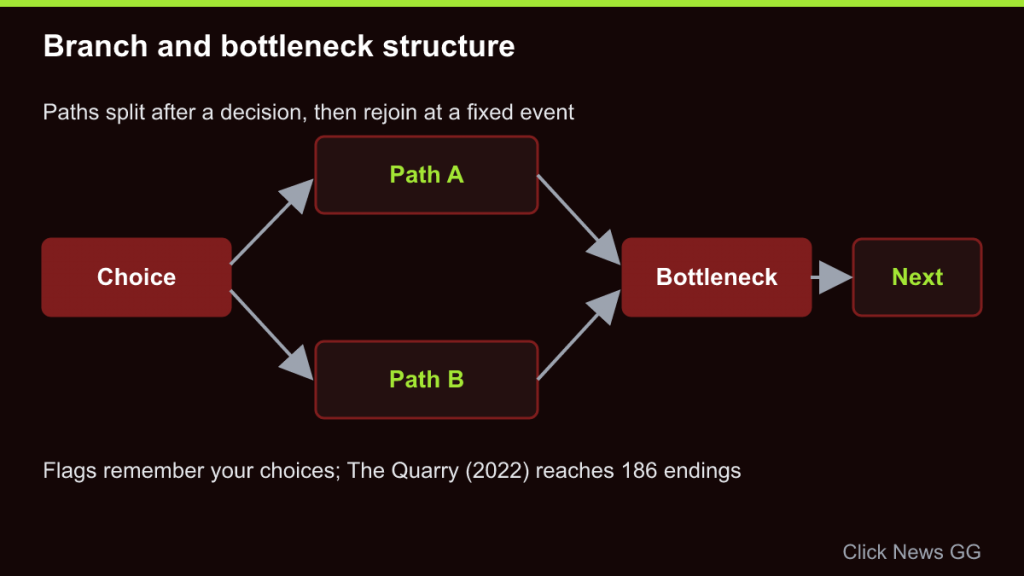
Branch and bottleneck
The story splits after a decision, then rejoins at a fixed point. You may have saved one character and lost another, but both paths lead to the same next major event. Most interactive dramas use this structure heavily, with variations in dialogue, relationships and who is still alive.
Flags and remembered choices
The game records your decisions as invisible “flags” and refers back to them later: a character remembers you lied, a door is open because you helped someone earlier. Telltale’s The Walking Dead (2012) made this visible with on-screen notifications that a character had noticed your choice. Players could switch these off in a minimal mode.
Parallel storylines
Some games follow several protagonists whose stories intersect. Quantic Dream’s Heavy Rain (2010) uses four playable characters, Ethan Mars, Madison Paige, Norman Jayden and Scott Shelby, all connected to the hunt for the Origami Killer. Its follow-up, Detroit: Become Human (2018), follows three androids: Connor, Kara and Markus.
Visible flowcharts
Some games show you the branching structure directly. Detroit: Become Human displays a flowchart of each chapter’s branches during and after it, showing what you found and what you missed. This makes replaying more appealing, but it also reveals how the story is constructed.
Large numbers of endings
Combining many small variables can produce many endings even with a bottleneck structure. Supermassive Games’ The Quarry (2022) has 186 endings, driven by which of its nine counselors survive and what evidence you find.
The illusion of choice debate
A frequent criticism of the genre is that choices matter less than they seem. Wikipedia’s article on The Walking Dead notes that its choices, while designed to feel significant, often had little effect on the larger narrative. Some players feel cheated when they discover that two different decisions lead to essentially the same scene.
Defenders argue that this misunderstands the goal. In many interactive dramas, the point is not to unlock radically different plots but to define who your character is within a story. Choosing to comfort a child or to tell her a hard truth may not change the next chapter’s events, but it changes the relationship you experience. Telltale even adjusted dialogue in later episodes of The Walking Dead so that no option looked obviously “right”, making choices more about values than outcomes.
A useful way to think about it:
- Real branching: a choice changes which scenes you see, who survives or which ending you get.
- Expressive choice: a choice changes tone, dialogue and relationships, but the plot continues similarly.
- Illusion of choice: a choice appears important but changes almost nothing.
Most games mix all three. The trick is that a well-written expressive choice can feel as weighty as a real branch.
Quick-time events and permanent death
QTEs ask you to press a button, mash a button or move a stick when prompted. In most action games they are a minor feature; in interactive dramas they are often the main form of action. Their purpose is to keep you engaged during cinematic moments while letting failure matter.
That last point is what separates the genre from ordinary QTE-heavy games. In a typical game, failing a QTE means retrying. In Heavy Rain, any playable character can die based on your actions, and David Cage designed the game so that the story continues instead of ending with a game-over screen. Until Dawn (2015) applies the same idea to a slasher story: all eight characters can survive or die, and deaths are permanent. Until Dawn also includes “Don’t Move” moments, in which you must hold the controller still to stay hidden.
The result is that a missed button press feels like a story event rather than a mistake to undo. Many players resist the urge to reload, accepting losses as part of their version of the story.
The four main schools
Quantic Dream: the auteur thriller
David Cage’s French studio built its reputation on cinematic thrillers with context-sensitive controls, where on-screen prompts and stick gestures mimic the physical action a character is performing. Heavy Rain (2010), with its roughly 2,000-page script, and Detroit: Become Human (2018) are the defining examples. Expect multiple protagonists, mature themes and deliberately everyday interactions mixed with high-stakes moments.

Telltale: episodic choices
Telltale Games turned licensed franchises into episodic adventures. The Walking Dead (2012) released in five episodes between April and November 2012 and put players in control of Lee Everett, a convicted criminal who becomes the guardian of a young girl, Clementine, during a zombie outbreak. Its timed dialogue, where staying silent is itself a choice, became the studio’s signature. It won numerous Game of the Year awards and Best Narrative at the Game Developers Choice Awards.
Dontnod: supernatural coming-of-age
Dontnod Entertainment’s Life Is Strange (2015) added a twist to the formula: Max Caulfield, a photography student in Arcadia Bay, Oregon, can rewind time within a limited window, letting you undo and redo choices. That mechanic directly addresses the anxiety of choice-driven games, since you can see some consequences before committing, while still building toward decisions you cannot take back.
Supermassive: horror ensembles
Supermassive Games applied interactive drama to horror. Until Dawn (2015) and The Quarry (2022) are built like teen horror films, with groups of characters who can each live or die. The Quarry also includes a Movie mode, local multiplayer in which players take turns controlling characters, and online play where up to eight players vote on key decisions. Supermassive’s The Dark Pictures Anthology extends the formula into shorter, standalone horror stories.
Choosing your first interactive drama
| If you like… | Try | Why |
|---|---|---|
| Emotional character drama | The Walking Dead (2012) | Focus on a central relationship |
| Crime thrillers | Heavy Rain (2010) | Four protagonists, a serial killer mystery |
| Sci-fi and big branches | Detroit: Become Human (2018) | Visible flowcharts, three storylines |
| Coming-of-age stories | Life Is Strange (2015) | Time rewind softens choice anxiety |
| Horror movies with friends | Until Dawn or The Quarry | Ensemble casts, permanent deaths, couch play |
If you are new to horror, Until Dawn and The Quarry also appear on our list of horror games for beginners, because they deliver scares without demanding combat skills.
Tips for playing interactive dramas
- Do not reload after a bad outcome, at least on your first playthrough. The genre is designed around living with consequences.
- Answer as yourself or as the character, but stay consistent. Choices feel more meaningful when they express a clear personality.
- Keep your hands on the controller. QTEs can appear suddenly, even in calm scenes.
- Explore every scene. Optional clues and conversations often influence later outcomes.
- Replay after a break. A second playthrough reveals how much the story can change, or how much it does not, which is fascinating in its own way.
Interactive dramas vs. other narrative games
Interactive dramas are easy to confuse with neighboring genres. A few distinctions help:
- Compared with point-and-click adventures, interactive dramas usually have few or no inventory puzzles. Progress comes from choices and reactions, not from combining items.
- Compared with walking simulators, they put far more emphasis on characters talking and acting on screen, and they often include failure states in the form of QTEs and character deaths.
- Compared with visual novels, they rely on 3D performance and camera work rather than text and still images, although both genres share branching structures.
- Compared with role-playing games, they track choices and relationships but rarely include statistics, equipment or combat systems.
Many modern games borrow interactive drama techniques without belonging to the genre, adding timed dialogue choices or branching scenes to otherwise conventional games.
Why the genre endures
Interactive dramas succeed because they let players inhabit a story rather than simply watch it. Even when the branches converge, the feeling of authorship is real: your version of Lee, Max or the counselors of Hackett’s Quarry belongs to you. That sense of ownership, combined with accessible controls that require no shooting or platforming skill, has made the genre a gateway for many people who would not otherwise pick up a controller.