Resident Evil Remakes vs. Originals: Which Version Should You Play?
REmake, RE2, RE3 and RE4 compared with their originals: what changed, what was cut or added, and which version suits which kind of player.
Capcom has remade four of its classic Resident Evil games, and each remake takes a different approach. Some faithfully rebuild the original’s structure; others rethink it. That means “just play the remake” is not always the full answer. This guide compares each remake with its original version, focusing only on the question of which version to choose. For the order in which to play the series as a whole, see our Resident Evil starting guide.
Mild spoiler note: this article mentions locations, enemies and modes, but not plot twists.
Resident Evil (1996) vs. Resident Evil (2002)
What the 2002 remake changed
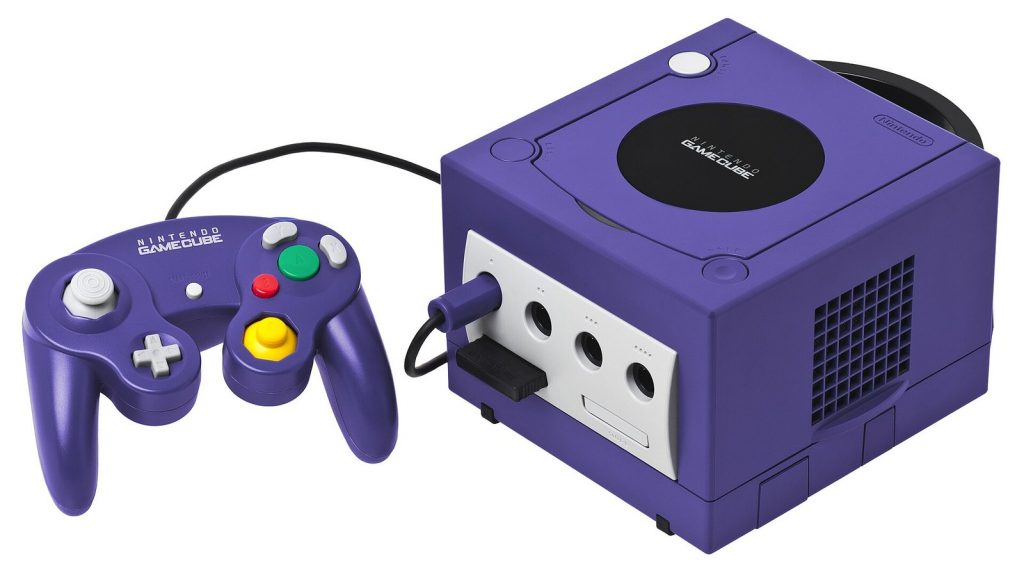
Often nicknamed “REmake”, the GameCube remake released on March 22, 2002 in Japan, directed again by Shinji Mikami. Unlike the later remakes, it kept the original’s core presentation: 3D characters over pre-rendered backgrounds viewed from fixed camera angles. But almost everything else was reworked:
- Visuals were rebuilt to a far higher standard, with detailed, atmospheric backgrounds.
- Layouts changed, with new areas added and most puzzles redesigned, so veterans of the original could not rely on memory.
- Lisa Trevor, a tragic new character, was added with her own subplot.
- Crimson Heads: zombies that are not beheaded or burned can revive later as faster, more dangerous enemies, forcing players to think about which bodies to deal with.
- Defense items such as daggers and a taser let you escape when grabbed, making some encounters more forgiving.
- The inventory was expanded, new weapons were added and enemies were rebalanced.
The HD Remaster (January 2015) brought it to modern platforms with 16:9 widescreen support and an optional control scheme that moves the character in the direction you push the stick.
Which to play
Most players should choose the 2002 remake, ideally the HD Remaster. It is the definitive version of the story and a masterclass in fixed-camera atmosphere. The 1996 original is mostly of historical interest; GOG.com re-released its PC port in 2024, so it is easy to try if you are curious about where the series began.
Resident Evil 2 (1998) vs. Resident Evil 2 (2019)
What the 2019 remake changed
The 2019 remake, directed by Kazunori Kadoi and Yasuhiro Anpo, reimagined both gameplay and story rather than just updating the visuals.
- Camera and controls: fixed angles and tank controls were replaced by a third-person camera and free movement; you can move while aiming.
- Zombies became tougher, can be dismembered and will follow you between rooms.
- Mr. X (the Tyrant) became a persistent stalker who roams the police station, cannot be killed and can only be temporarily stunned. He cannot enter safe rooms.
- Scenarios: the original’s “Zapping System” linked Leon’s and Claire’s campaigns so that actions in one affected the other. The remake instead offers a “2nd Run” for the other character after you finish, with remixed item placement and the true final boss and ending.
- Difficulty: Assisted, Standard and Hardcore modes. On Hardcore, saving at typewriters requires ink ribbons, as in the classic games.
- Extras: bonus modes “The 4th Survivor” and “The Tofu Survivor” return, joined by “The Ghost Survivors”.
Which to play
The 2019 remake is the version for almost everyone. It is one of the most acclaimed games in the series and the best single introduction to classic survival horror with modern controls. The 1998 original is worth playing later if you want to see how the zapping structure worked or enjoy fixed-camera design; the original trilogy is available again on PC through GOG.com.
Resident Evil 3: Nemesis (1999) vs. Resident Evil 3 (2020)
What the 2020 remake changed
This is the most contested remake. Released on April 3, 2020 and directed by Kiyohiko Sakata, it built on the 2019 RE2 remake’s engine and controls, but trimmed the original significantly.
What was added or improved:
- A redesigned Nemesis with smarter AI who can use weapons, grab Jill with tentacles and leap long distances, mutating into more aggressive forms as you defeat him.
- A reworked dodge with a follow-up counterattack that automatically aims at an enemy’s head.
- Modern visuals and controls, plus Resident Evil: Resistance, a separate online multiplayer game by NeoBards, bundled with the purchase.
What was cut:
- Several locations, including the clock tower, the graveyard, the park and city hall.
- The original’s live selection choices and multiple endings.
- The Mercenaries minigame (Operation: Mad Jackal).
Critics frequently criticized its short length and limited replay value, though some pointed out that a first playthrough is comparable in length to the original. Some reviewers also felt that Nemesis appears mainly in scripted sequences, rather than hunting the player freely as Mr. X does in the RE2 remake.
Which to play
This one depends on what you value. If you want a slick, cinematic action-horror ride that you can finish in a weekend, the 2020 remake delivers. If you want the full story with all its locations, branching choices and endings, the 1999 original is the more complete experience. Fans who love the RE2 remake often play the 2020 RE3 for continuity, then try the original to see what was left out.
Resident Evil 4 (2005) vs. Resident Evil 4 (2023)
What the 2023 remake changed
Released on March 24, 2023 and directed by Yasuhiro Anpo and Kazunori Kadoi, the RE4 remake keeps the original’s overall journey through a Spanish village, castle and island, but reworks the details.
Added or changed:
- A knife parry lets Leon block and counter attacks, and his knife now has durability that the Merchant can repair.
- Leon can move while aiming and reloading.
- A crafting system lets you make ammunition and items.
- Ashley no longer has a health bar; she follows closely and can be revived when badly hurt.
- Fewer quick-time events; the Krauser fight became a fully playable knife battle.
- Darker tone and rewritten dialogue, removing much of the original’s camp.
Cut or moved, according to guides comparing the two: the U-3 boss fight, the island laser room, the boulder escape sequences, the cable cars, incendiary grenades and the second Verdugo encounter were removed, and the throne room was moved from the castle to the island.
Modes: at launch the remake lacked the original’s extra modes, but The Mercenaries arrived in a free update shortly after release, and the Ada Wong campaign “Separate Ways” was released as paid DLC on September 21, 2023.
Which to play
Both are worth playing, and they offer different moods. The 2023 remake is more atmospheric and fluid, with modern controls. The 2005 original is campier, includes set pieces the remake dropped and remains one of the most influential action games ever made. If you only play one, newcomers usually prefer the remake; long-time fans often argue the original’s pacing and humor are irreplaceable.
Comparison at a glance
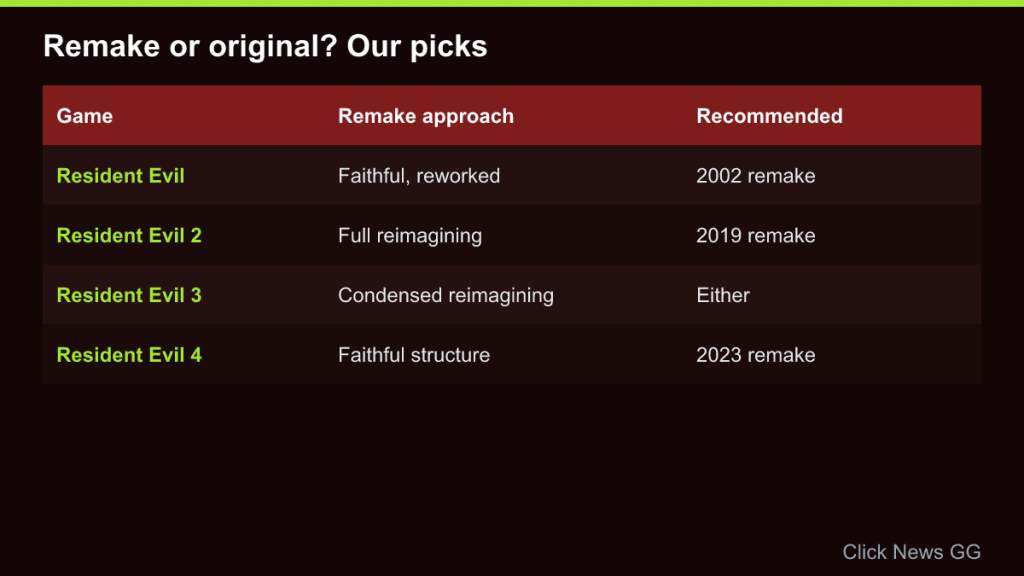
| Game | Remake approach | Biggest additions | Biggest losses | Recommended for most players |
|---|---|---|---|---|
| Resident Evil | Faithful presentation, reworked content | Lisa Trevor, Crimson Heads, new areas | Little of note | 2002 remake |
| Resident Evil 2 | Full reimagining | Modern camera, stalking Mr. X | Zapping System | 2019 remake |
| Resident Evil 3 | Condensed reimagining | Smarter Nemesis, counter-dodge | Locations, live selection, multiple endings | Either, depending on taste |
| Resident Evil 4 | Faithful structure, reworked details | Knife parry, crafting, darker tone | Several set pieces and bosses | 2023 remake, original also recommended |
What about Code: Veronica?
As of October 2026, Code: Veronica is the only major classic entry without a modern remake on the market. Capcom announced Resident Evil Veronica at Summer Game Fest in June 2026 for release in 2027. Until it arrives, there is nothing to compare, but expect the same question, faithful or reimagined, to dominate discussion.
Tips if you try an original after a remake
Going back from a modern remake to a 1990s original can be a shock. A few adjustments make the transition smoother:
- Give the controls an hour. Tank controls feel awkward at first but become natural quickly. Remember that “up” always means “forward for the character”, whatever the camera angle.
- Use the quick turn where available. Resident Evil 3: Nemesis added a 180-degree turn that makes escaping much easier.
- Expect fewer conveniences. Originals have tighter inventories, less map information and, in the classic games, ink ribbons for every save.
- Do not expect the same enemies to behave the same way. Zombies in the originals are slower and more predictable than in the remakes, so dodging around them is often the smart move.
- Enjoy the differences. Comparing how each version stages the same scene is part of the fun: you will see which moments the remakes expanded and which ones they compressed.
How to decide for yourself
- If you dislike tank controls, choose the 2019-2023 remakes; for the first game, try the HD Remaster’s alternative controls.
- If you care about completeness, play the originals of RE3 and RE4 at some point, since their remakes cut content.
- If you love atmosphere above all, the 2002 remake and the RE2 remake are the series at its most atmospheric.
- If you want to understand the series’ history, playing an original after its remake is an eye-opening way to see how design has evolved. Our horror glossary explains terms such as tank controls and fixed cameras if they are new to you.
There is no wrong answer here. The remakes have made these stories accessible to millions of new players, while the originals remain playable reminders of how the genre was born.