How to Play Horror Games If You Scare Easily
Practical tips for enjoying horror games when you scare easily: picking the right game, using settings, playing with friends and pacing yourself.
Plenty of people love horror stories but find horror games overwhelming. That is not a failing. Games put you in control of the character, so the monster is coming for you, and that sense of responsibility makes fear more intense than watching a film. The good news is that horror games offer far more ways to manage the experience than most players realize.
This guide collects practical, non-medical tips for enjoying horror games at a comfortable level. If anxiety or distress affects your daily life, that is a matter for a qualified professional; the advice here is about entertainment, not health.
Why horror games feel so intense
Understanding where the fear comes from makes it easier to manage. Horror games tend to rely on a few techniques:
- Anticipation. The quiet corridor before something happens is often scarier than the thing itself. Many games deliberately stretch out these moments.
- Sound. Footsteps above you, a door creaking somewhere, a radio crackling with static: audio tells you something is near before you can see it. Silent Hill‘s pocket radio, which hisses when monsters approach, is a famous example.
- Limited vision. Fog, darkness and narrow flashlight beams keep you from seeing what is ahead. Silent Hill‘s fog famously began as a way to hide hardware limits and became an atmospheric tool.
- Loss of control. When a game takes away weapons, as in Amnesia: The Dark Descent or Outlast, or introduces an enemy you cannot kill, like Mr. X in Resident Evil 2 (2019), you feel helpless.
- Sudden shocks. Jump scares combine a loud noise with an abrupt image. They are startling but brief.
Knowing which of these bothers you most helps you choose games and settings. Someone who hates jump scares may cope well with slow psychological dread; someone who dislikes being chased may be fine with a game where you can fight back.
Choose the right game
The single most effective step is picking a game that matches your tolerance. Horror games vary enormously in intensity.
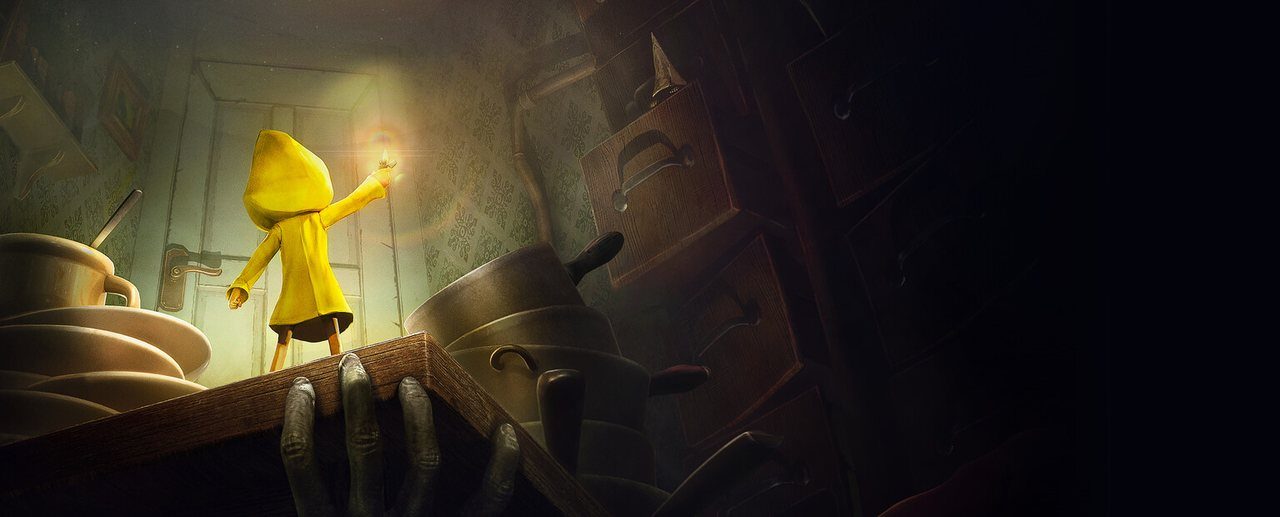
- Start with atmosphere, not threat. Games such as Oxenfree, with no combat and no game-over states, or Little Nightmares, a short puzzle-platformer, offer spooky stories without sustained pressure.
- Prefer games where you can fight back. Many nervous players find run-and-hide games more stressful than survival horror, because defending yourself restores a sense of control. Our guide to horror subgenres explains the differences.
- Try interactive dramas. Games like Until Dawn and The Quarry play like horror films. You make choices and press buttons in quick-time events, but you rarely have to explore dark corridors alone at your own pace.
- Check reviews for intensity, not just quality. Look for mentions of jump scares, gore and chase sequences.
For specific recommendations, see our list of the best horror games for beginners.
Use difficulty and accessibility settings
Modern horror games often include options that take the edge off without removing the story. Some verified examples:
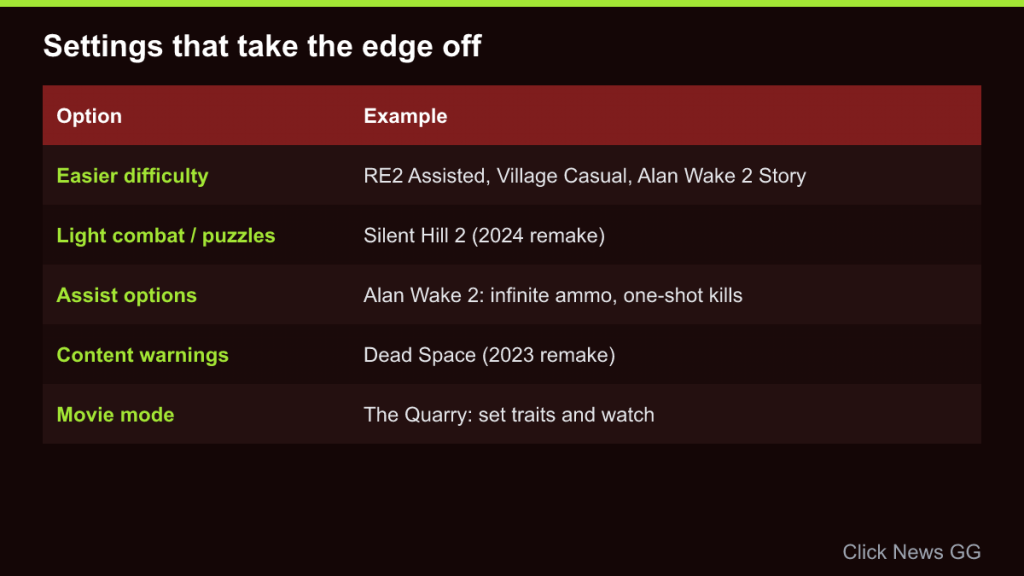
- Easier difficulty modes: Resident Evil 2 (2019) offers Assisted mode; Resident Evil Village offers Casual; Alan Wake 2 has a Story difficulty aimed at players who mainly want narrative and puzzles.
- Separate combat and puzzle settings: the 2024 Silent Hill 2 remake lets you choose Light combat, where James deals more damage and takes less, and Light puzzles with extra clues. Combat difficulty can be changed during a playthrough.
- Assist options: a 2024 update to Alan Wake 2 added options such as infinite ammo and one-shot kills.
- Content warnings: the 2023 Dead Space remake includes accessibility options to show a warning before particularly graphic scenes or to hide disturbing scenes entirely.
- Watching instead of playing: The Quarry has a Movie mode in which you set characters’ traits and watch the story unfold.
Easier modes are not “cheating”. Developers include them so that more people can experience the story. Lower difficulty also means fewer deaths, and repeating a frightening section many times is often the most stressful part of a horror game.
Change how and when you play
Play in daylight or with lights on
Darkness and isolation amplify atmosphere. Playing during the day or with a lamp on reduces immersion slightly, which is exactly the point when you want to dial things down.
Play with friends
Company changes horror. A friend on the couch can take over during a tough section, offer commentary or simply laugh with you. Many interactive dramas support couch play; The Quarry, for example, lets players take turns controlling characters. Co-op games such as Phasmophobia are built around groups, and the shared panic is often more funny than frightening.
Take turns as “navigator”
If you live with someone, try having one person hold the controller while the other reads the map, tracks items or looks up puzzle solutions. Splitting the job reduces the feeling of being alone with the danger.
Keep sessions short
Tension builds over time. Playing for an hour or less and stopping at a save point, ideally in a safe room, keeps the experience enjoyable. Stop when you are still having fun, not when you are frazzled.
Take breaks after big moments
Many games have natural pauses: safe rooms, chapter breaks, boss defeats. Use them to step away, stretch and come back later.
Adjust the audio carefully
Sound is one of the biggest sources of fear, so audio settings are powerful tools. A few tips:

- Lower the music, keep the sound effects. Music builds tension, but sound effects often warn you of danger. Muting everything can actually make games harder, which can increase stress.
- Use speakers instead of headphones. Headphones make positional sound feel close and personal. Speakers create a little more distance.
- Turn on subtitles. Knowing exactly what is being said removes some of the uncertainty in whispered or distorted dialogue, and many games also caption important sound effects.
- Lower the overall volume during a tense section. Jump scares rely on loud sounds; a quieter mix makes them less startling.
Reduce the unknown
Much of horror’s power comes from not knowing what will happen. If you want to reduce that, you have options:
- Watch a playthrough first. Watching someone else play a section, or the whole game, lets you see the scares in advance. Then you can play it yourself with far less tension, or decide the game is not for you.
- Use a guide. Walkthroughs tell you where items are and where enemies appear, so you are not wandering lost in a frightening space. Getting lost is one of the most stressful parts of survival horror.
- Read spoiler-free tips. Even general advice, such as which enemies to avoid, can make you feel more prepared.
Learn the game’s rules
Fear often comes from not understanding the threat. Once you know the rules, many games become far less frightening.
- Find out where the safe spaces are. In many games, including the Resident Evil remakes, safe rooms are truly safe; enemies such as Mr. X cannot follow you in.
- Learn what attracts enemies. In Alien: Isolation, the alien hunts by sight and sound, and using the motion tracker near it can give you away. Knowing that turns blind panic into strategy.
- Remember that stalkers are designed to be escaped. Persistent pursuers are meant to pressure you, not trap you forever. Keep moving toward your objective.
- Do not fight everything. In survival horror, dodging slow enemies saves resources and reduces stressful encounters.
Common mistakes nervous players make
- Starting with the most acclaimed game instead of the most suitable one. A game being a masterpiece does not make it a good first horror game.
- Refusing easier modes out of pride. No one is grading you.
- Playing late at night when tired. Fatigue makes everything feel more intense.
- Forcing yourself to continue. If a game is no longer fun, stop. There are many other horror games with different styles and intensity.
Frequently asked questions
Is it “wrong” to play horror games on the easiest setting?
No. Difficulty affects combat and resources, not the story. You will see the same places, characters and endings, just with fewer frustrating deaths along the way.
Are jump scares or slow dread easier to handle?
It depends on the person. Jump scares are startling but over quickly; slow dread lingers but rarely shocks. Many nervous players find atmospheric, story-led games easier than games built around sudden shocks, but the only way to know is to try a short, gentle game first.
Should I use a guide on my first playthrough?
If getting lost in a dark building is what stresses you most, yes. Many players use a walkthrough only for navigation and puzzles, which keeps story surprises intact while removing aimless wandering.
What if a game upsets me in a way that is not fun?
Stop playing. Horror games are entertainment, and there is no obligation to finish one. Content warnings, reviews and community discussions can help you check whether a game covers themes you would rather avoid before you start.
Building up your tolerance
Many horror fans started out nervous. The trick is gradual progress: begin with gentle, story-led games, move on to survival horror on easier settings, and only then try run-and-hide games or higher difficulties. Each step teaches you how horror games build tension, and understanding the tricks makes them easier to enjoy. Over time, the feeling of dread can become part of the fun rather than something to endure.