Ace Attorney Series Guide: Every Game and the Best Play Order
Every Ace Attorney game explained: the investigation and trial loop, mainline games, spin-offs, modern collections as of 2026 and the best play order.

Few games make you feel as clever as standing up in court, slamming the desk and shouting “Objection!” at exactly the right moment. Capcom’s Ace Attorney series has been doing that since 2001, with a cast of eccentric lawyers, witnesses and prosecutors, and mysteries that unfold across courtroom battles. Thanks to a run of modern collections, nearly the whole series is now easy to play on current consoles and PC. This guide explains how the games work, lists every entry and recommends the best order to play them — with no story spoilers.
What Is Ace Attorney?
Ace Attorney is a series of courtroom adventure games created by Shu Takumi, who wrote and directed the first three games. The first, Phoenix Wright: Ace Attorney, released in Japan on the Game Boy Advance on October 12, 2001. You play a defence attorney taking on seemingly hopeless cases, and your job is to prove your client innocent — usually by revealing who really did it.

Later entries were written and directed by Takeshi Yamazaki, beginning with Ace Attorney Investigations: Miles Edgeworth (2009), while Takumi directed the Great Ace Attorney duology. According to Capcom, the series had sold 15 million copies as of June 30, 2026.
How the Games Work: Investigation and Trial
Each case typically alternates between two phases.
Investigation
You visit locations, talk to your client, witnesses and police, examine the scene and collect evidence. Showing specific evidence to specific characters can unlock new information. This is classic adventure-game territory, and if you are new to the genre, our guide to point-and-click adventure games covers the basics.
Trial
In court, witnesses give testimony, and you cross-examine them statement by statement. You can press a statement for more detail or present evidence that contradicts it. Find the right contradiction and the testimony collapses, often revealing new information and shifting the case. Present the wrong evidence and you lose part of your penalty meter; lose it all and your client is found guilty.
The contradiction system is one of the most celebrated deduction mechanics in gaming. We compare it with other approaches in our explainer on detective game mechanics.
Every Ace Attorney Game
Mainline series
| Game | Original release (Japan) | Protagonist(s) |
|---|---|---|
| Phoenix Wright: Ace Attorney | 2001 (Game Boy Advance) | Phoenix Wright |
| Justice for All | 2002 (Game Boy Advance) | Phoenix Wright |
| Trials and Tribulations | 2004 (Game Boy Advance) | Phoenix Wright |
| Apollo Justice: Ace Attorney | 2007 (Nintendo DS) | Apollo Justice |
| Dual Destinies | 2013 (Nintendo 3DS) | Phoenix, Apollo and Athena Cykes |
| Spirit of Justice | 2016 (Nintendo 3DS) | Phoenix and Apollo |
The first three games originally launched on the Game Boy Advance in Japan, and the series’ later history spans the DS, 3DS, mobile and, through the collections below, current consoles and PC.
Spin-offs
- Ace Attorney Investigations: Miles Edgeworth (2009, DS) — you play as Phoenix’s rival, prosecutor Miles Edgeworth, investigating crimes outside the courtroom.
- Ace Attorney Investigations 2: Prosecutor’s Gambit (2011, DS) — the sequel, which stayed Japan-only until 2024.
- Professor Layton vs. Phoenix Wright: Ace Attorney (2012, 3DS) — a crossover with Level-5’s puzzle series.
- The Great Ace Attorney: Adventures (2015, 3DS) and The Great Ace Attorney 2: Resolve (2017, 3DS) — set in Meiji-era Japan and Victorian London, following Ryunosuke Naruhodo, with the great detective Herlock Sholmes (renamed from Sherlock Holmes for the international release) in a major supporting role. Both stayed Japan-only until 2021.
How to Play Ace Attorney in 2026
As of October 2026, four collections cover almost the entire series on modern platforms:
| Collection | Released | Platforms | Includes |
|---|---|---|---|
| Phoenix Wright: Ace Attorney Trilogy | 2019 | Switch, PS4, Xbox One, PC | Ace Attorney, Justice for All, Trials and Tribulations |
| The Great Ace Attorney Chronicles | July 2021 | Switch, PS4, PC | Adventures and Resolve (first official English release) |
| Apollo Justice: Ace Attorney Trilogy | January 25, 2024 | Switch, PS4, Xbox One, PC | Apollo Justice, Dual Destinies, Spirit of Justice |
| Ace Attorney Investigations Collection | September 6, 2024 | Switch, PS4, Xbox One, PC | Investigations 1 and 2 (Prosecutor’s Gambit’s first release outside Japan) |
The Investigations Collection also lets you switch between the original sprites and newly drawn character animations. The only notable game not included in a modern collection is Professor Layton vs. Phoenix Wright, which remains a 3DS title.
How the Mechanics Evolve
Pressing and presenting remain the foundation throughout, but the series keeps adding twists. A few verified examples:
- Perceive (Apollo Justice, 2007). Apollo can watch witnesses closely during testimony and spot nervous habits — a fidget or a twitch — much like a poker tell. Finding the tell and linking it to the right statement exposes a hidden lie.
- The Jurist system (Apollo Justice). The story introduces an experimental jury-style trial system organised by Phoenix, adding a different kind of courtroom to the series and raising questions about how justice should work.
- Logic and the Truth Gauge (Investigations). As Miles Edgeworth, you move around crime scenes directly in a mostly third-person view. Observations are stored as “thoughts”, and the Logic function lets you connect two of them to reach new conclusions. Instead of courtroom trials, you face rebuttal phases against suspects and rivals, and mistakes drain a Truth Gauge.
- Summation Examinations and Dances of Deduction (The Great Ace Attorney). The duology adds summation examinations and theatrical “Dance of Deduction” sequences alongside Herlock Sholmes, giving its Victorian setting mechanics of its own and making the detective work feel distinct from the main series.
None of these replace the basics: if you can spot a contradiction between a statement and a piece of evidence, you can play any Ace Attorney game. The additions simply keep long-time players on their toes.
Quick Answers
Do I need to play the Great Ace Attorney games to understand the main series?
No. They are self-contained prequels with their own cast. Playing the main series first simply lets you catch more references.
Can I play Ace Attorney on mobile?
Several entries have been released on iOS and Android over the years, including Dual Destinies and the first Investigations game. For most people, though, the console and PC collections are the simplest way to get everything.
How long is each game?
Each game contains several cases of increasing length, and the final case is usually the longest. Expect each one to take many hours, especially if you explore every conversation.
The Best Play Order
Recommended order (release order)
- Phoenix Wright: Ace Attorney
- Justice for All
- Trials and Tribulations
- Ace Attorney Investigations: Miles Edgeworth
- Ace Attorney Investigations 2: Prosecutor’s Gambit
- Apollo Justice: Ace Attorney
- Dual Destinies
- Spirit of Justice
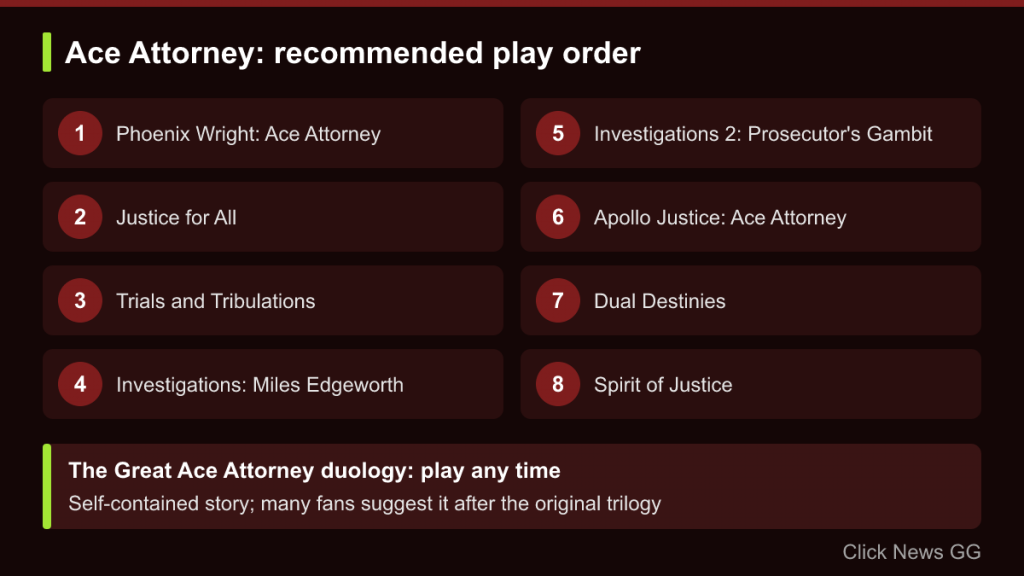
The Great Ace Attorney duology can be played at any point — it is a self-contained story with its own cast. Many fans recommend playing it after the original trilogy so you can appreciate the references. Professor Layton vs. Phoenix Wright fits anywhere after the first trilogy if you can access a 3DS.
Why release order works best
- Character development. Characters grow across the series, and later games assume you know their history.
- Escalating mechanics. Later games layer new systems on top of pressing and presenting, so playing in order introduces them gradually.
- Spoilers. Later games openly reference the outcomes of earlier cases. Playing out of order can ruin major twists.
A note on Investigations
The first Investigations game is set between Trials and Tribulations and Apollo Justice (which takes place seven years after Trials and Tribulations), so the order above follows the story too. If you are eager to meet Apollo, playing Investigations later will not hurt much, but it does fit most naturally right after the first trilogy, while Edgeworth’s arc is fresh.
Shortcut Routes
- Short on time: play the Phoenix Wright Trilogy. It tells a complete story and is the heart of the series.
- Want a standalone story: The Great Ace Attorney Chronicles. It needs no prior knowledge.
- Already finished the trilogy: go straight to the Investigations Collection, then the Apollo Justice Trilogy.
Whichever route you choose, give the first game time. Its opening case is a short tutorial, and the cases that follow grow steadily longer and more intricate. If the first trial feels simple, stick with it for a few more cases: the recurring characters and the rhythm of investigation and trial are what make the series special.
Tips for New Defence Attorneys
- Press every statement. Pressing is free and often reveals new statements or information you need.
- Read the Court Record. Evidence descriptions frequently contain the exact detail that contradicts testimony.
- Save before presenting. If you are unsure, save first. Mistakes cost penalty points, and running out means restarting from a save.
- Think about what the game wants. Sometimes several pieces of evidence seem to work. Ask which contradiction moves the argument forward.
- Talk to everyone twice. In investigation phases, new topics often appear after you find new evidence.
- Use a guide sparingly. If you are truly stuck, look up the single answer you need rather than the whole case.
What’s Next for the Series?
The last brand-new mainline game, Spirit of Justice, released in 2016. In December 2025, Capcom expressed interest in growing Ace Attorney into one of its “core” properties, and the series continues to sell through its collections. As of October 2026, however, Capcom has not officially announced a seventh mainline game, so we treat any reports about one as unconfirmed.