Tank Controls and Fixed Camera Angles: Why Classic Horror Played That Way
How tank controls and fixed camera angles worked in classic survival horror, why designers used them, and tips for playing old-school horror today.
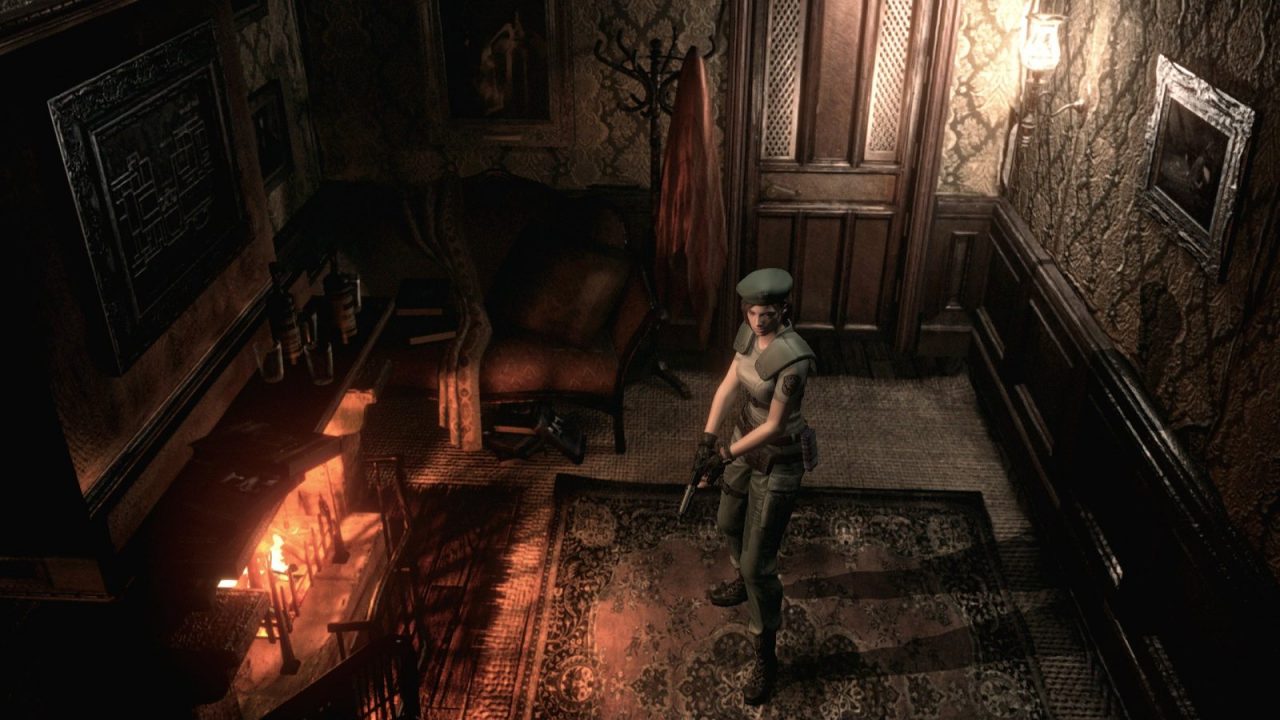
Pick up an original Resident Evil today and the first thing you notice is not the zombies. It is the controls. Push up and Jill or Chris walks forward in whatever direction they are facing, even if that means walking towards the bottom of the screen. Press left and they rotate on the spot like a turret. The camera, meanwhile, is bolted to the ceiling of each room, cutting to a new angle every time you cross an invisible line.
These two conventions, tank controls and fixed camera angles, defined a decade of horror games. They are often described as clunky relics, but they were also deliberate design choices that shaped how fear worked in the genre. This explainer covers how each system worked, why developers used them, how they create tension, how modern indie horror is bringing them back, and how to get comfortable with them if you are new to classic survival horror.
What Are Tank Controls?
Tank controls are a movement scheme in which directions are relative to the character, not to the camera. The name comes from how a tank steers:
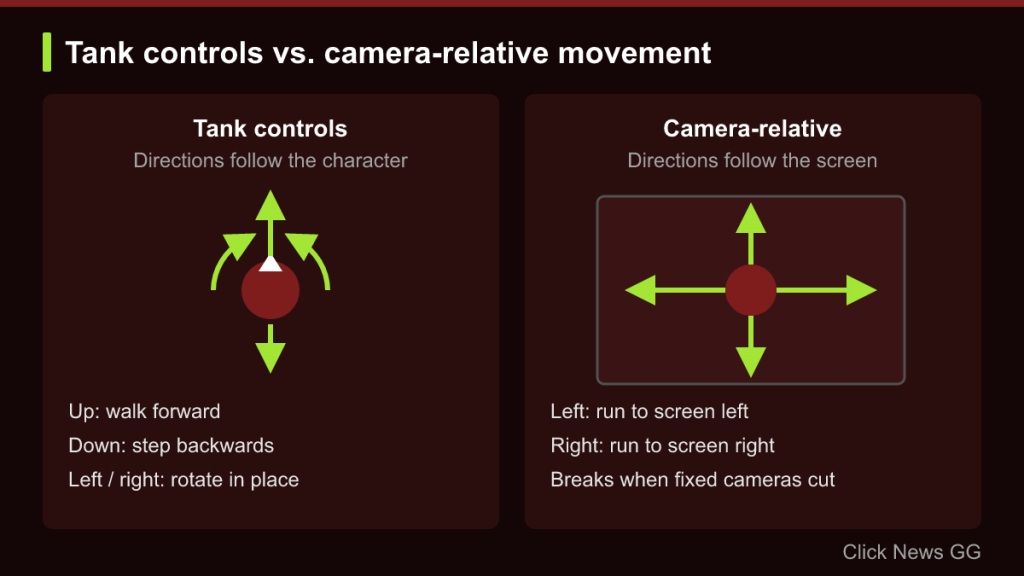
- Up moves the character forward, in the direction they are facing.
- Down moves them backwards (in many horror games, a slow backpedal).
- Left and right rotate the character in place, without moving them.
- A run button usually speeds up forward movement, and many games added a quick-turn input to spin 180 degrees.
The alternative, now standard, is camera-relative movement: push the stick left and the character runs towards the left of the screen, wherever the camera is. That feels intuitive when the camera follows the player, but it causes problems when the camera jumps between fixed angles, which is exactly what classic horror games did.
Tank controls were common in many 3D games of the 1990s, not just horror. The early Resident Evil and Tomb Raider games used them, as did LucasArts’ adventure Grim Fandango (1998). For a quick refresher on related terms, our horror game glossary defines tank controls alongside other genre jargon.
What Are Fixed Camera Angles and Pre-Rendered Backgrounds?
A fixed camera is placed at a chosen spot in a room, like a film director’s shot or a security camera, and stays there. When the player walks out of frame, the game cuts to another fixed shot. The developer, not the player, decides what you can see.
Many classic horror games paired fixed cameras with pre-rendered backgrounds. Instead of drawing the whole room in real time, the scenery was rendered ahead of time as a detailed image, and only the characters, enemies and interactive items were drawn live on top. On hardware like the original PlayStation, this let games like Resident Evil show far more detailed environments than the console could render in real time.
There is a technical catch. A pre-rendered background is effectively a picture taken from one point of view, so the camera cannot move freely within it. A game built this way is forced to use fixed camera angles. In other words, for many of these games the fixed camera was not only an artistic choice; it came with the technique used to make the rooms look good.
Where it started: Alone in the Dark
The template predates Resident Evil. Infogrames’ Alone in the Dark (1992), designed by Frederick Raynal for MS-DOS, rendered 3D polygon characters over 2D hand-drawn backgrounds viewed from fixed camera angles that limited what the player could see. Shinji Mikami, director of the first Resident Evil (1996), was inspired by this approach and adopted a similar fixed-view system, and he has said Resident Evil might otherwise have become a first-person game. Our explainer on what survival horror is covers that lineage in more detail.
Why Developers Paired Tank Controls With Fixed Cameras
The two systems solve each other’s problems.
Imagine camera-relative controls in a game with fixed angles. You are holding right to run down a corridor, the game cuts to a camera facing the opposite way, and suddenly “right” on screen means the opposite direction. Your character would spin around and run back the way they came. Tank controls avoid this: because “forward” always means the character’s forward, you can keep holding the same direction through any number of camera cuts.
Developers have been explicit about this. Tim Schafer chose tank controls for Grim Fandango so the team could use cinematic camera cuts without disrupting the controls. Shinji Mikami has said he felt fixed camera perspectives and tank controls made Resident Evil scarier. Both points matter: the controls kept movement consistent, and the restrictions they imposed were part of the horror.
How Tank Controls and Fixed Cameras Create Fear
The modern complaint about these systems is that they feel awkward. That is partly the point. Classic survival horror was built around limited control, and these conventions added to it in several ways.
Blind spots and off-screen sound
A fixed camera can be placed to hide a doorway, a corner or the far end of a corridor. You hear a groan or footsteps before you see the source, and you have to walk into an angle you cannot see. Designers used this to set up scares and to make familiar rooms feel uncertain.
Cinematic framing
Because the designer controls every shot, rooms can be framed like a horror film: a low angle that makes a hallway feel tall, a high angle that makes the character look small and exposed, a shot through a window that suggests you are being watched.
Commitment and vulnerability
Tank controls make turning, aiming and retreating take time. In early Resident Evil games, characters typically stop to aim, and backing away is slower than running forward. Every encounter forces a choice: stand and shoot, try to run past, or turn back. That friction is a big part of why a single zombie in a narrow corridor can feel threatening.
The trade-off
The same features can also feel unfair. Off-screen enemies hit you before you can react, camera cuts can disorient you mid-escape, and navigating tight spaces can be frustrating. Critical commentary on Silent Hill, for example, has described steering through difficult areas could be “an exercise in frustration.”
Silent Hill’s Different Approach
Not every classic horror game used pre-rendered rooms. Konami’s Silent Hill (1999) rendered its environments in real time in 3D, with a third-person camera that switched to other angles for dramatic effect in scripted areas. To work within the PlayStation’s limits and avoid objects popping into view, the developers filled the town with distance fog and darkness. That workaround became one of the most famous atmospheric choices in horror: the fog hides the draw distance and the threats inside it at the same time.
Silent Hill shows that the classic horror “feel” was never only about pre-rendered rooms. It was about limiting information, and developers found different technical routes to the same effect.
Why the Industry Moved On
As hardware improved, real-time 3D environments became detailed enough that pre-rendered rooms were no longer necessary, and free-roaming, player-controlled cameras became standard. Tank controls were increasingly described as stiff or cumbersome and gradually disappeared from mainstream games.
Resident Evil itself made the jump with Resident Evil 4 (2005), which moved the camera behind Leon’s shoulder. We explain that shift in why Resident Evil 4 changed horror games. Later re-releases of older games also added alternatives: remastered versions of Resident Evil and Grim Fandango include alternative control schemes, and Tomb Raider I-III Remastered offers tank controls as an option.
The Retro Revival: Fixed Cameras in Modern Indie Horror
Over the last several years, a wave of indie developers has returned to classic conventions, often as a deliberate homage:
- Tormented Souls (Dual Effect, published by PQube, 2021) is a third-person survival horror game with fixed camera angles and optional tank controls. A sequel, Tormented Souls 2, was released in 2025.
- Crow Country (SFB Games, 2024) models its look on 1990s PlayStation survival horror, including the first two Resident Evil games and Silent Hill. It originally used only tank controls, but after negative feedback during testing the developers added modern direct control on the analog stick, keeping tank controls on the D-pad. Unlike pre-rendered classics, it lets players rotate the camera.
Crow Country’s development is a neat summary of where the genre stands: many players love the look and feel of classic survival horror, but fewer want to fight the controls. Offering both schemes lets nostalgia and accessibility coexist.
Tips for Playing Classic-Control Horror Games Today
If you are trying an original Resident Evil, an older Silent Hill or a retro-styled indie for the first time, these habits help:
- Think from the character’s perspective. Ignore the screen directions. “Up” is always “walk where they are looking.” Many players find it easier after a few minutes of walking in circles in a safe area.
- Use the D-pad if available. Tank controls often feel more precise on a digital pad than on an analog stick.
- Learn the quick turn. Where the game supports a 180-degree turn, it is the fastest way out of a bad situation.
- Do not fight everything. Many classic encounters are meant to be avoided. Learn to time runs past enemies, especially in corridors.
- Hold direction through camera cuts. Keep holding forward when the angle changes; tank controls are built so your movement carries over.
- Listen. With fixed cameras, audio is often your first warning of an enemy off-screen.
- Check the options menu. Remasters and modern indies frequently offer an alternative control scheme. There is no shame in using it.
- Consider the remake instead. If the controls are a dealbreaker, modern remakes keep the story and much of the atmosphere with contemporary controls. Our Resident Evil remakes vs. originals guide helps you choose.
A Design Language, Not Just a Limitation
Tank controls and fixed cameras were born partly from technical necessity, but the best classic horror games turned them into a language. Framing told you where to look and where not to, movement made every confrontation a commitment, and the unseen corner became the genre’s most reliable source of dread. That is why, decades later, developers are still choosing to work within those same limits on purpose.