What Is a Walking Simulator? Narrative Exploration Games Explained
Where the "walking simulator" label came from, how these games tell stories through places and voices, and what sets them apart from adventure games.

Few genre names began as an insult. “Walking simulator” did. In the early 2010s, some players used it to dismiss first-person games in which you mostly walk, look and listen, with no combat, no puzzles to speak of and no way to fail. Over time the label lost its sting. Fans adopted it, storefronts turned it into a tag, and the genre produced some of the most celebrated narrative games of the last fifteen years.
This explainer covers where the term came from, how these games tell their stories, the landmark examples and how they differ from traditional adventure games.
Where the term came from
“Walking simulator” emerged as a pejorative in the late 2000s and early 2010s, especially in discussions of Dear Esther. Critics of the style argued that games without challenge or fail states were not “real” games. The argument became tangled in broader online culture wars in the mid-2010s, and games like Gone Home were caught up in those debates.
Developers pushed back. Dan Pinchbeck, co-creator of Dear Esther, has rejected the narrow idea that games must be defined by challenge. Meanwhile, players who loved these games began using “walking sim” affectionately, and the phrase became a common tag on Steam. Some critics praised the form highly; writing in Salon in 2017, Nicole Clark called walking simulators “the most artful and innovative genre within video gaming.”
Not everyone likes the label even now. Alternatives such as “exploration game”, “narrative exploration” or “first-person narrative game” are common, and you will see all of them used for the same titles.
Roots before the label
Games about walking through a place and absorbing it are older than the term. Wikipedia’s overview of the genre points to The Forest, an orienteering simulation for the ZX Spectrum, as an early example, and to art games such as Mary Flanagan’s [domestic] (2003), which reconstructed a childhood memory of a fire. Kikiyama’s Yume Nikki (2004) let players wander a dream world with almost no explanation. These works shared an idea that later became central: the space itself can be the story.
How walking simulators tell stories
Without combat or puzzles carrying the experience, these games rely on other tools.
Environmental storytelling
Rooms, objects and layouts carry the narrative. A half-packed suitcase, a note on a fridge, a bedroom sealed off for years: players piece together what happened by noticing details. Gone Home (2013) is built almost entirely this way, as you explore a family house and reconstruct events from what has been left behind.
Voice and audio
Narration, journal entries read aloud, recorded messages and radio conversations deliver story while you move. In Dear Esther, an unnamed man reads letters to his deceased wife as you explore an island, and the fragments you hear vary between playthroughs. In Firewatch, nearly all dialogue happens over a walkie-talkie.
Pacing through space
Designers control the rhythm of the story by controlling the route. A long walk to a lighthouse, a corridor that opens into a vista, a locked door that only opens after a key moment: the map is a timeline in disguise.
Interaction as expression
Many games use small, deliberate actions to make players complicit in the story: opening a drawer, choosing a reply, picking up a photograph. These moments are not puzzles; they are a way to make the player physically participate in a scene.
Four landmark games
Dear Esther (2012)
Dear Esther began in 2008 as a free mod for the Source engine, made while The Chinese Room was a research project at the University of Portsmouth. A commercial remake developed with artist Robert Briscoe followed in February 2012. You explore an uninhabited Hebridean island while a narrator reads letters to Esther, and the story is left open for players to interpret. Reviews were divided on whether it counted as a game, but it won awards, sold over 850,000 copies by September 2013 and is widely credited with popularizing the genre. Its spiritual successor, Everybody’s Gone to the Rapture, followed in 2015.

Gone Home (2013)
Made by The Fullbright Company, founded by Steve Gaynor, Karla Zimonja and Johnnemann Nordhagen after working on BioShock 2‘s Minerva’s Den expansion, Gone Home released in August 2013. Set in 1995, it has you return to your family’s rural Oregon house to find it empty. Through objects, notes and journal entries, the story of your younger sister Sam emerges. It won the 2013 BAFTA for Debut Game and was Polygon‘s 2013 Game of the Year.
Firewatch (2016)
Campo Santo’s first game, published with Panic and released on February 9, 2016, puts you in the boots of Henry, a fire lookout in Wyoming’s Shoshone National Forest in 1989. His only contact is his supervisor, Delilah, on the other end of a walkie-talkie. Dialogue choices shape the tone of their relationship, and the wilderness, with its trails, maps and changing light, is as much a character as either of them.
What Remains of Edith Finch (2017)
Developed by Giant Sparrow, directed by Ian Dallas and published by Annapurna Interactive on April 25, 2017, Edith Finch is an anthology of vignettes. As Edith explores her family’s home on Orcas Island, Washington, each sealed bedroom leads to a short story about a relative, and each story changes perspective, style and controls. In one acclaimed sequence, you control a cannery worker’s daydream with one hand while repeating his factory task with the other. It won the BAFTA Games Award for Best Game and Best Narrative at The Game Awards 2017.
Walking simulators vs. adventure games
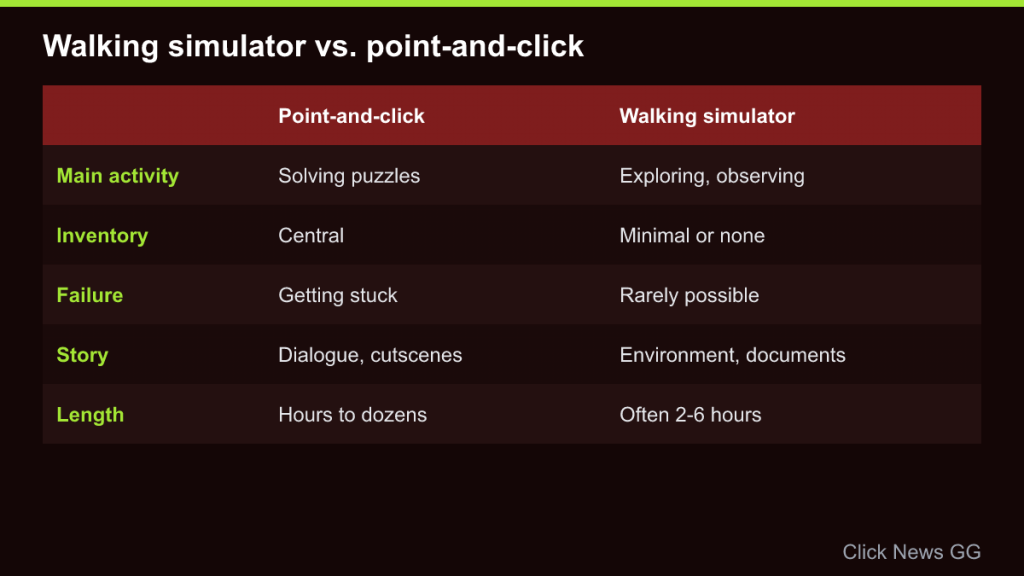
Walking simulators are often filed under adventure games, and the boundary is blurry. The main differences are emphasis and challenge:
| Point-and-click adventure | Walking simulator | |
|---|---|---|
| Main activity | Solving puzzles to progress | Exploring and observing |
| Inventory | Central, items combined and used | Minimal or none |
| Failure | Getting stuck on puzzles (deaths in some older games) | Rarely possible |
| Story delivery | Dialogue trees and cutscenes | Environment, narration, found documents |
| Typical length | Several hours to dozens | Often two to six hours |
A classic adventure, as described in our point-and-click guide, gates progress behind puzzles. A walking simulator gates progress behind attention and movement. Some games sit in the middle: Firewatch has light navigation challenges and dialogue choices; others add simple puzzles to give players something to do between story beats.
The horror connection
Walking simulators and horror share more DNA than you might think. Many first-person horror games, especially run-and-hide games like Outlast, are structured around walking through a space while the environment tells a story; Wikipedia’s article on the genre even discusses Outlast in this context. The difference is that horror games add threats. If you like the slow, atmospheric side of horror more than the chases, narrative exploration games may suit you; see our guide to horror subgenres for where that overlap lies.
Common criticisms and fair answers
- “There is nothing to do.” There is less to overcome, but the activity is attention: reading a room, listening, connecting details. Players who enjoy that find these games absorbing.
- “They are too short.” Many are short by design. A two-to-four-hour story that ends well can be more satisfying than a padded one.
- “They are just interactive movies.” Unlike a film, a walking simulator lets you choose what to examine and in what order, and the best ones use that freedom deliberately.
- “The term is an insult.” It started as one. Whether to use it is up to you; many fans and developers now use it neutrally.
Tips for getting the most out of the genre
- Slow down. These games reward looking closely. Read the notes, pick up objects, look out of windows.
- Play in one or two sittings. Many are short, and their atmosphere works best without long gaps.
- Use headphones. Narration, ambient sound and music carry a lot of weight.
- Avoid spoilers. Because the story is the main reward, reading about a twist beforehand removes much of the impact.
- Do not rush to finish. The genre’s best moments often come from exploring an optional room or path you could easily have skipped.
Frequently asked questions
Can you lose in a walking simulator?
Usually not. Most have no fail states at all, which is exactly what made the genre controversial. A few borrow light challenges, but the focus remains on exploration and story.
How long are they?
Many can be finished in one or two evenings. Dear Esther and Gone Home are famously compact, while games like Firewatch and What Remains of Edith Finch run a little longer. Short length is part of the appeal for players with limited time.
Are walking simulators horror games?
Some are unsettling, and many use horror techniques such as empty houses, distant sounds and unanswered questions. Gone Home, for instance, plays with the expectation of a haunted house. But most are melancholy, reflective or mysterious rather than frightening.
Do they have replay value?
Less than most genres, but not none. Dear Esther varies its narration between playthroughs, and players often return to games like Edith Finch to notice details they missed the first time.
Why the genre matters
Walking simulators proved that a game can be built entirely around place, voice and memory, and that many players want exactly that. They also influenced larger games: environmental storytelling and found documents are now standard tools across the industry, including in horror. Whatever you call them, these narrative exploration games broadened what players expect a game to be.