Danganronpa and Zero Escape: Mystery Adventure Visual Novels Explained
How Danganronpa's class trials and Zero Escape's escape rooms and flowcharts work, plus play order and what newcomers should expect.
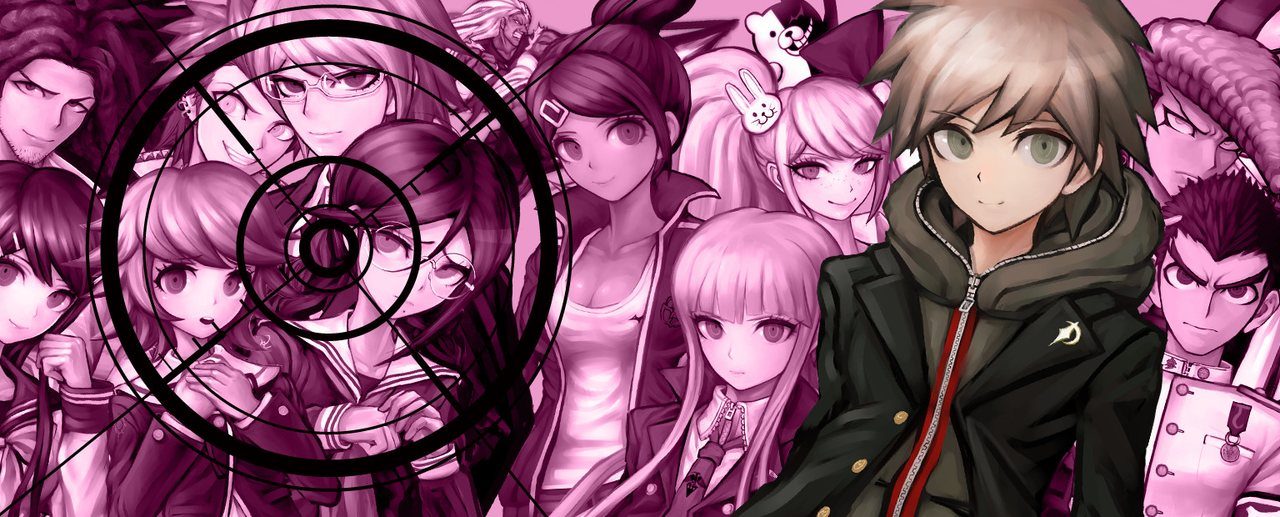
Few corners of narrative gaming are as easy to love and as hard to describe as the mystery visual novel. On paper these games are mostly text: long conversations, character portraits, and pages of internal monologue. In practice, the best of them are tense, twisty thrillers that turn the player into an investigator, a puzzle solver and occasionally a co-conspirator. Two series did more than any others to bring this hybrid to Western players: Kazutaka Kodaka’s Danganronpa and Kotaro Uchikoshi’s Zero Escape.
Both were developed in Japan by studios that are now part of Spike Chunsoft, both put a group of strangers into a deadly game run by a mysterious mastermind, and both reached English-speaking audiences on handheld consoles in the early 2010s. Yet they play very differently. This guide explains what each series actually asks you to do, how the visual novel format is mixed with adventure-game puzzles, the order to play them in, and what to expect before you commit dozens of hours. It stays spoiler-free, because both series depend on surprises.
What Is a Mystery Adventure Visual Novel?
A visual novel (VN) is a story-first game in which most of the experience is reading text over static or lightly animated art, usually with music, voice acting and occasional choices. The mystery adventure hybrid adds a game layer on top of that reading: investigation phases, logic puzzles, escape rooms, timed debates or branching decisions that change who lives and who dies.
If you have played Capcom’s courtroom series, you already know the basic rhythm. As we covered in our Ace Attorney series guide, those games alternate between gathering evidence and presenting it at the right moment. Danganronpa and Zero Escape take that structure somewhere darker, with trapped casts and life-or-death stakes.
What separates these games from a standard point-and-click adventure is mostly pacing and presentation. A classic adventure (see our explainer on point-and-click adventure games) spreads its story across a world you explore freely; a mystery VN keeps you on a tighter track and saves interaction for phases that test your reasoning.
Danganronpa: Murder, Monokuma and Class Trials
Danganronpa was created by writer Kazutaka Kodaka, with character designs by Rui Komatsuzaki and music by Masafumi Takada, and developed by Spike (later Spike Chunsoft). The first game, Danganronpa: Trigger Happy Havoc, launched in Japan on the PlayStation Portable on November 25, 2010. English-speaking players got it later, on PlayStation Vita in February 2014, published by NIS America.
The premise is deliberately outrageous. A group of gifted students, each labeled the “Ultimate” at some talent, wake up sealed inside their school. A sadistic two-tone robot bear called Monokuma explains the rules: the only way out is to murder a classmate and get away with it. After every killing, the survivors hold a class trial. If they vote correctly for the culprit, only the culprit is executed. If they vote wrong, everyone else dies and the killer goes free.
How a Danganronpa chapter plays
Each chapter follows a recognizable loop:
- Daily Life: story scenes and free movement around the school, where tension builds and relationships form.
- Free Time: optional hangouts with classmates that reveal backstories and unlock skills useful in trials.
- Deadly Life: after a body is found, you investigate crime scenes and question classmates, collecting clues as “Truth Bullets.”
- Class Trial: the main event, where the case is argued out in a series of minigames.
The signature trial mechanic is the Nonstop Debate. Classmates’ statements scroll across the screen in real time, and you have to load the right Truth Bullet and literally shoot the contradictory statement. Around it sit other minigames: spelling out a key word from floating letters, rhythm-based arguments against stubborn suspects, and a closing sequence where you assemble comic-book panels that reconstruct how the murder happened. They are not hard, but they make a trial feel like a fight rather than a menu.
It is worth being honest about the reasoning side. Danganronpa trials usually lead you step by step, so you are more often confirming a deduction the story is steering you towards than solving it from scratch. Players who want stricter logic may prefer the dedicated deduction games we discussed in our explainer on detective game mechanics. Danganronpa’s strength is drama: style, cast and the sense that anyone can die.
The Danganronpa Games and Where to Start
The core series is a trilogy plus a spin-off and a bonus game:
| Game | First release (Japan) | Notes |
|---|---|---|
| Danganronpa: Trigger Happy Havoc | 2010 (PSP) | English release on Vita in 2014 |
| Danganronpa 2: Goodbye Despair | 2012 (PSP) | English release on Vita in 2014 |
| Danganronpa Another Episode: Ultra Despair Girls | 2014 (Vita) | Spin-off third-person shooter |
| Danganronpa V3: Killing Harmony | January 2017 (PS4, Vita) | English release September 2017, also on Windows |
| Danganronpa S: Ultimate Summer Camp | 2021 (Switch) | Board-game style bonus mode in the Decadence collection |
For newcomers the order is simple: play Trigger Happy Havoc, then Goodbye Despair, then V3: Killing Harmony. Each game introduces a new cast, but the second builds directly on revelations from the first, and V3 plays with the series’ own conventions in a way that lands best when you know the earlier games. Ultra Despair Girls is optional; it is a shooter rather than a trial-based mystery, so pick it up only if you want more of the world.
There is also an anime. Danganronpa: The Animation (2013) adapts the first game, and Danganronpa 3: The End of Hope’s Peak High School (2016) continues the story after the second.
Platforms and collections as of 2026
The first two games were bundled as Danganronpa 1·2 Reload, and the whole trilogy came to Nintendo Switch in 2021 as Danganronpa Decadence, which also includes Anniversary Editions and the Ultimate Summer Camp bonus game. The individual games are also on Steam, and V3’s Anniversary Edition reached Windows and Xbox One in 2022. Spike Chunsoft has also announced Danganronpa 2×2, a reworked version of Goodbye Despair with updated visuals, the original scenario and an alternative “Slayhem” scenario with new victims and culprits. As of October 2026 it has not been released; it was delayed from 2026 and is dated for January 14, 2027 on Switch, Switch 2, PS5, Xbox Series X|S and PC.
Zero Escape: Escape Rooms, Bracelets and Branching Flowcharts
Zero Escape was written and directed by Kotaro Uchikoshi, with music by Shinji Hosoe. The first game, Nine Hours, Nine Persons, Nine Doors (usually shortened to 999), was developed by Chunsoft and released on Nintendo DS in Japan in December 2009, then in North America in November 2010 through Aksys Games.

The setup is a cousin of Danganronpa’s: nine strangers wake up on what appears to be a ship, wearing numbered bracelets, forced by a masked figure called Zero to play a lethal game to escape within a time limit. Where Danganronpa is loud and stylized, Zero Escape leans towards science fiction, philosophy and pseudo-science, with conversations about thought experiments and probability that turn out to matter.
Novel sections and Escape sections
Every Zero Escape game alternates between two modes:
- Novel sections carry the story. You read, make occasional choices (such as which door to take or which character to trust), and those choices send you down different branches.
- Escape sections are first-person escape-the-room puzzles. You search a locked room, collect items, combine them, decode notes and crack safes. They are closer to classic adventure games than anything in Danganronpa.
The defining feature is branching with multiple endings. Each game has several bad endings and one true ending, and you are expected to see many of them. Crucially, the bad endings are not just failure states; they often contain information you need for the true route. That is why players describe Zero Escape as a puzzle about the story as much as a story with puzzles.
The Zero Escape Games and the Right Order
The trilogy is short to list but long to play:
- Nine Hours, Nine Persons, Nine Doors (2009 in Japan, 2010 in North America): released on DS; you replay Escape sections when exploring new branches, which can feel repetitive.
- Zero Escape: Virtue’s Last Reward (2012): released on 3DS and PlayStation Vita. It introduced an interactive flowchart that lets you jump to any point you have already reached and try a different choice, which solved the first game’s repetition problem.
- Zero Time Dilemma (2016): developed by Chime, released on 3DS, Vita and Windows, and later ported to PlayStation 4 and Xbox One. It swaps visual novel scenes for animated cutscenes and splits the story into roughly 90-minute “fragments” you play out of order and place on a flowchart.
Play them in release order. Zero Time Dilemma is set between the first two games chronologically, but it was written for people who had finished both, and playing it early would spoil major reveals from Virtue’s Last Reward.
The easiest modern way in is Zero Escape: The Nonary Games, a 2017 bundle of 999 and Virtue’s Last Reward for Windows, PS4 and Vita, later brought to Xbox One. It includes an updated version of 999 alongside Virtue’s Last Reward. Zero Time Dilemma is sold separately.
If you finish the trilogy and want more from the same writer, Uchikoshi went on to make AI: The Somnium Files, a detective adventure announced in 2018 that mixes investigation with surreal dream-exploration puzzles.
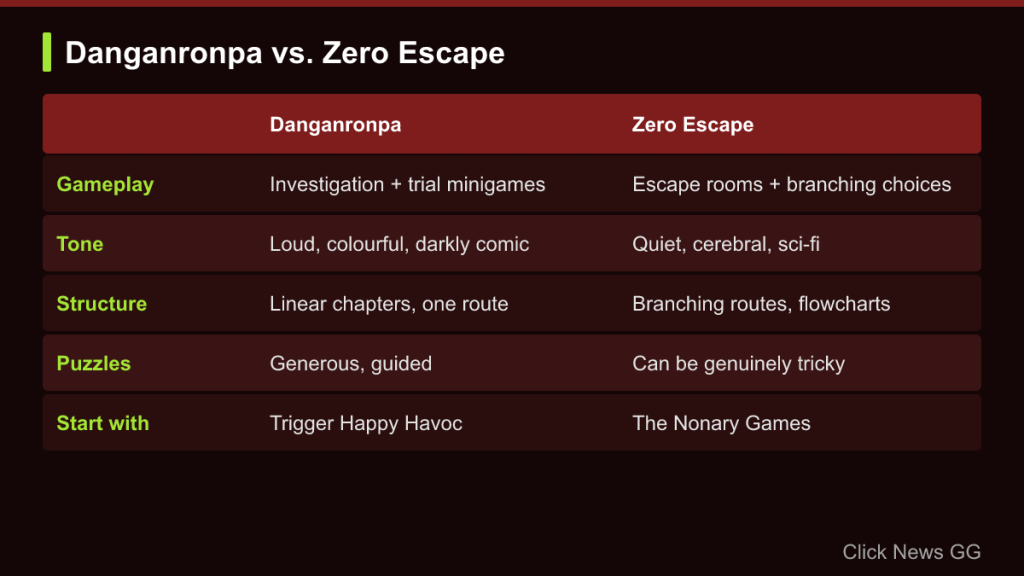
Danganronpa vs. Zero Escape: Which Should You Play First?
Both series reward different tastes:
| Danganronpa | Zero Escape | |
|---|---|---|
| Core gameplay | Investigation plus action-tinged trial minigames | Escape-room puzzles plus branching story choices |
| Tone | Loud, colorful, darkly comic, gory in a cartoonish way | Quieter, cerebral, science-fiction and philosophy heavy |
| Structure | Linear chapters, one route | Branching routes, multiple endings, flowcharts |
| Puzzle difficulty | Generous, guided | Room puzzles can be genuinely tricky |
| Best entry point | Trigger Happy Havoc | The Nonary Games |
If you like character drama, flashy presentation and courtroom-style showdowns, start with Danganronpa. If you prefer slow-burn mysteries, logic puzzles and stories that fold back on themselves, start with Zero Escape.
What Newcomers Should Expect
These games are not for everyone, and knowing their quirks up front avoids disappointment.
A lot of reading
Expect long stretches of text without gameplay, especially in the opening hours, and avoid the first Danganronpa anime until you finish the first game, since it adapts the whole mystery. If the first chapter feels slow, that is normal.
Dark themes delivered in different ways
Both series revolve around murder, death games and manipulation. Danganronpa’s executions are cartoonish but violent, and its humor can be crude; Zero Escape is less graphic but just as grim. Fans of dread and paranoia will feel at home.
Puzzles that test patience more than reflexes
Danganronpa’s trial minigames are forgiving. Zero Escape’s escape rooms can stump you, particularly the more mathematical puzzles. Taking notes on paper helps, and the games usually record important clues in a file or memo you can review.
Why These Series Still Matter
Danganronpa and Zero Escape showed that text-heavy Japanese mystery games could find a dedicated audience in the West, and they tackle the problem every narrative designer faces: how to make reading feel like playing. Danganronpa does it by turning arguments into action. Zero Escape does it by making the structure of the story itself the final puzzle. Either one is a great way to find out whether mystery visual novels are for you.