The LucasArts Adventure Games: From Maniac Mansion to Grim Fandango
The history of LucasArts' adventure era: SCUMM, Monkey Island, Day of the Tentacle, Full Throttle, Grim Fandango and the no-dead-ends philosophy.
For roughly a decade, from the late 1980s to the late 1990s, Lucasfilm Games, renamed LucasArts in 1990, produced a run of adventure games that still define the genre for many players. Witty writing, inventive puzzles, memorable music and a deliberately player-friendly design philosophy set them apart from their competitors. Many of the people involved went on to shape the industry well beyond adventure games.
This history follows the studio’s adventure output in order, from the engine that powered it to the modern remasters and the 2022 return to Monkey Island.
Lucasfilm Games and the birth of SCUMM
George Lucas founded Lucasfilm’s games group in 1982 as part of the company’s computer division. Its early releases were action games such as Ballblazer and Rescue on Fractalus!. The shift to adventures came with Maniac Mansion in October 1987, designed and written by Ron Gilbert and Gary Winnick.
To make Maniac Mansion efficiently, Gilbert built a scripting engine he named SCUMM: Script Creation Utility for Maniac Mansion. Instead of typing commands, players clicked on verbs, fifteen of them in Maniac Mansion, and then on objects in the scene. The game let you choose two of six teenagers to accompany protagonist Dave Miller into a mad scientist’s mansion, and different combinations of characters opened different solutions. Gilbert also coined the term “cutscene” for the game’s short non-interactive scenes.
SCUMM was reused and expanded for most of the studio’s later adventures. Its consistency let small teams build games quickly and port them to many computers. (For a general introduction to the genre, see our point-and-click explainer.)
The early classics (1988-1990)
Zak McKracken and Indiana Jones
Zak McKracken and the Alien Mindbenders (1988) followed on SCUMM with a tabloid journalist hero and a globe-trotting plot. In 1989, Indiana Jones and the Last Crusade: The Graphic Adventure adapted the film, the first of several Indiana Jones adventures.
Loom (1990)
Loom, designed by former Infocom writer Brian Moriarty and released for MS-DOS in 1990, was the studio’s most unusual adventure. It had no inventory at all. Instead, the hero, Bobbin Threadbare, casts spells by playing four-note musical “drafts” on his distaff, learned by observing the world. Some drafts could be played backwards for the opposite effect: “Dye” reversed became “Bleach”. Its music drew on Tchaikovsky’s Swan Lake. Critics loved it, but it did not sell well enough to justify sequels.
Monkey Island (1990-1991)
The Secret of Monkey Island, released in October 1990, became the studio’s signature. Ron Gilbert conceived and led it, working with Tim Schafer and Dave Grossman, who co-wrote much of the plot and dialogue. Its pirate world was full of jokes, anachronisms and puzzles that rewarded lateral thinking. Its most famous idea was insult swordfighting, in which duels are won by trading witty insults and comebacks, inspired by the banter in Errol Flynn’s swashbuckling films. The interface used twelve verbs.

Monkey Island 2: LeChuck’s Revenge followed in December 1991, again led by Gilbert with Schafer and Grossman. It was the first LucasArts game to use iMUSE, an interactive music system designed by Michael Land and Peter McConnell that smoothly changes music as the player moves between areas. It also offered a “Lite” mode that skipped many puzzles, jokingly marketed as being for video game reviewers. Gilbert left LucasArts in 1992 to co-found Humongous Entertainment.
The “no dead ends” philosophy
LucasArts adventures were known for treating players fairly. The competing style, popular in many Sierra games, allowed the player character to die frequently and sometimes let players become stuck without a needed item, often without realizing it. Ron Gilbert criticized those conventions in a widely cited 1989 essay, “Why Adventure Games Suck”, arguing that adventures should not punish players for exploring.
LucasArts’ games put that into practice. In The Secret of Monkey Island, the team made Guybrush nearly impossible to kill, shifting the focus to exploration and comedy; the main exception is a hidden drowning joke. Grim Fandango later carried the principle to its 1998 conclusion: the player cannot die or reach an unwinnable state. The result was a set of games where being stuck meant thinking harder, not restarting from an old save.
The golden age (1992-1995)
Indiana Jones and the Fate of Atlantis (1992)
An original Indiana Jones story rather than a film adaptation, Fate of Atlantis offered different paths through its middle section, letting players favor puzzles, teamwork with Indy’s companion Sophia, or action.
Day of the Tentacle (1993)
The sequel to Maniac Mansion, also known as Maniac Mansion II, was co-led by Tim Schafer and Dave Grossman, their first time directing. Bernard, Hoagie and Laverne try to stop the Purple Tentacle from taking over the world, and players switch between the three characters across different time periods, passing items through time to solve puzzles. In a famous bonus, the complete original Maniac Mansion is playable on a computer inside the game. Critics praised its cartoon visuals, humor and voice acting, and it still appears on lists of the best games ever made.
Sam & Max Hit the Road (1993)
Based on Steve Purcell’s comics about a dog detective and a hyperkinetic “rabbity thing”, Sam & Max Hit the Road was designed by Sean Clark, Michael Stemmle, Steve Purcell and Collette Michaud. Its road-trip plot sends the pair across American roadside attractions in search of a stolen bigfoot. It replaced the verb list with icon-based conversation menus and cursor-based verb selection. A planned sequel, Freelance Police, was cancelled in 2004, and the characters later found a home at Telltale Games.
Full Throttle (1995)
Tim Schafer’s first game as lead designer and head writer launched on May 19, 1995. Biker Ben, leader of the Polecats, must clear his name after being framed for the murder of a motorcycle magnate. It added on-motorcycle action sequences and used a contextual pie menu for interactions. It sold over one million units, an unusually high figure for a LucasArts adventure at the time.
The Dig (1995)
The Dig began as a story idea by Steven Spielberg, originally for television and then film, before being shelved as too expensive to shoot. It had the longest development of any LucasArts adventure: announced for 1992, it shipped in November 1995 after passing through several project leaders, including Noah Falstein, Brian Moriarty, Dave Grossman and finally Sean Clark. Its serious science-fiction tone, following Commander Boston Low’s crew to an alien world, stood apart from the studio’s comedies.
The late era (1997-2000)
The Curse of Monkey Island (1997)
The third Monkey Island game, made without Ron Gilbert, introduced a hand-drawn cartoon style and full voice acting, and is fondly remembered by many fans.
Grim Fandango (1998)
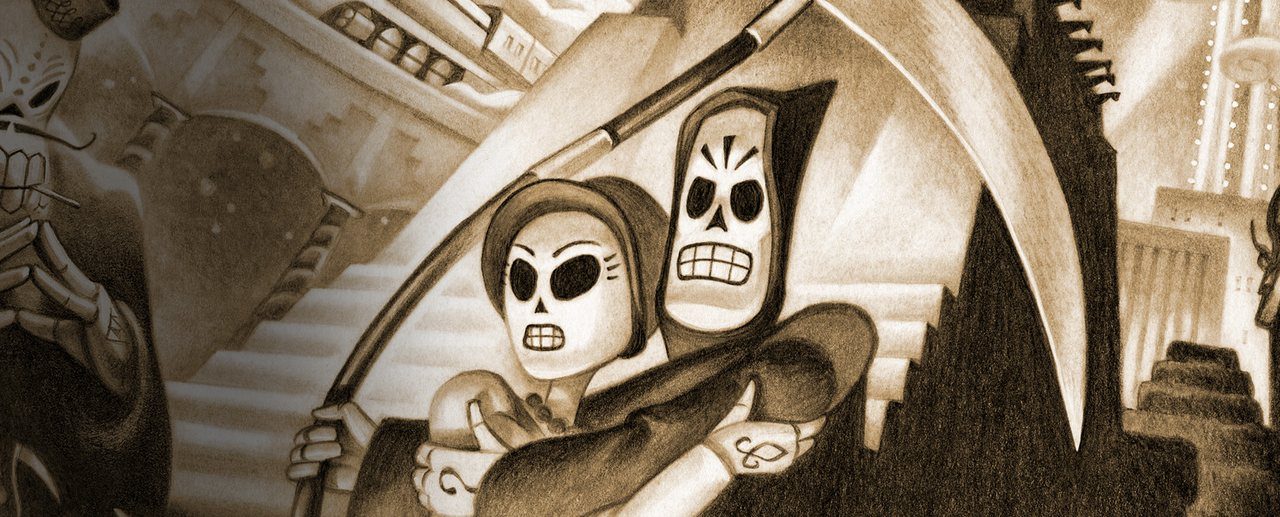
Tim Schafer’s Grim Fandango was the studio’s boldest swing. Set in a retro-futuristic, 1950s-styled Land of the Dead inspired by Mexican Day of the Dead imagery, Art Deco design and film noir classics such as Casablanca and The Maltese Falcon, it follows Manny Calavera, a travel agent for the Department of Death, across the four-year journey of the soul. It combined 3D characters with pre-rendered backgrounds. Critics adored it, giving it a Metacritic score of 94, but sales were modest. It is often described as a commercial disappointment and linked to LucasArts’ retreat from the genre.
Escape from Monkey Island (2000)
The fourth Monkey Island was LucasArts’ last original adventure game. As adventure games declined in popularity, the company focused increasingly on Star Wars and action titles.
Decline, closure and legacy
LucasArts continued as a publisher and developer for another decade, but its adventure days were over. After Disney acquired Lucasfilm in 2012, Lucasfilm closed LucasArts’ in-house development in 2013, keeping a small licensing team. The Lucasfilm Games brand was revived in 2021 as a licensor working with partner studios.
The adventure team’s alumni had long since scattered and flourished. Former LucasArts staff founded Telltale Games, whose story we cover in our Telltale history, and Tim Schafer founded Double Fine Productions. Ron Gilbert co-founded Humongous Entertainment and, much later, Terrible Toybox.
Remasters and Return to Monkey Island
From 2009 onward, many of the classics returned in updated form:
- The Secret of Monkey Island: Special Edition (July 2009) with hand-drawn visuals, remastered music and voice acting.
- Monkey Island 2 Special Edition (July 2010) with high-definition visuals.
- Grim Fandango Remastered (2015) by Double Fine, adding orchestrated music, developer commentary and mouse controls.
- Day of the Tentacle Remastered (March 22, 2016) by Double Fine.
- Full Throttle Remastered (April 18, 2017) by Double Fine.
The biggest surprise came in 2022. Return to Monkey Island, released on September 19, 2022, reunited Ron Gilbert and Dave Grossman, developed by Gilbert’s studio Terrible Toybox and published by Devolver Digital in association with Lucasfilm Games. It adopted a storybook, pop-up-book art style defined by art director Rex Crowle, included an in-game hint system designed to keep players away from online walkthroughs, and offered a simplified Casual mode for less experienced players. More than three decades after the first game, the series’ original creative leads had returned to it.
Timeline
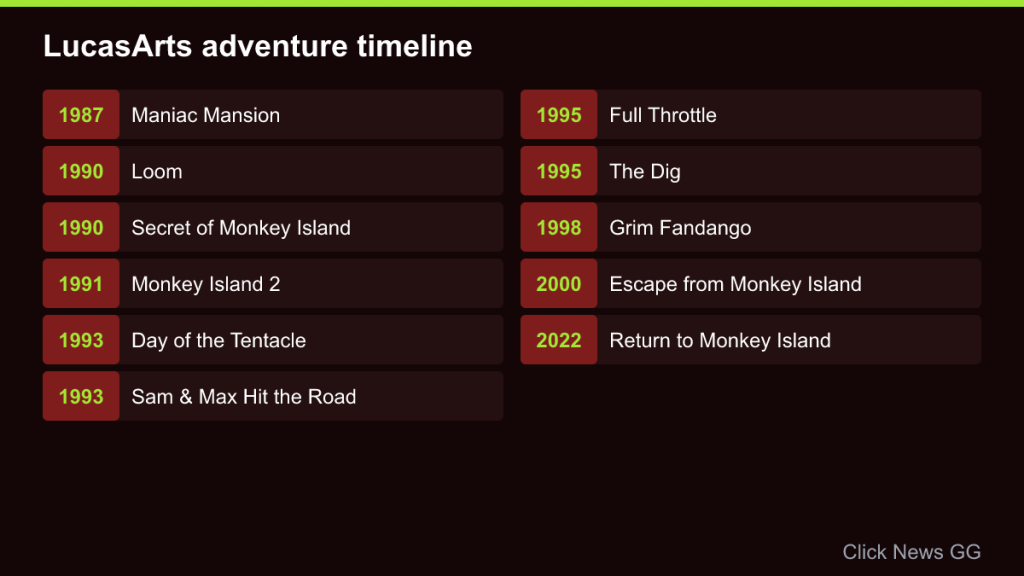
| Year | Game | Key creatives |
|---|---|---|
| 1987 | Maniac Mansion | Ron Gilbert, Gary Winnick |
| 1990 | Loom | Brian Moriarty |
| 1990 | The Secret of Monkey Island | Ron Gilbert, Tim Schafer, Dave Grossman |
| 1991 | Monkey Island 2: LeChuck’s Revenge | Ron Gilbert, Tim Schafer, Dave Grossman |
| 1993 | Day of the Tentacle | Tim Schafer, Dave Grossman |
| 1993 | Sam & Max Hit the Road | Sean Clark, Michael Stemmle, Steve Purcell, Collette Michaud |
| 1995 | Full Throttle | Tim Schafer |
| 1995 | The Dig | Sean Clark (final project leader) |
| 1998 | Grim Fandango | Tim Schafer |
| 2000 | Escape from Monkey Island | – |
| 2022 | Return to Monkey Island | Ron Gilbert, Dave Grossman (Terrible Toybox) |