Silent Hill Series History: Team Silent, the Western Era and the Revival
Konami's Silent Hill from Team Silent's classics through the Western-made sequels, the P.T. saga and the revival with SH2 remake, f and Townfall.
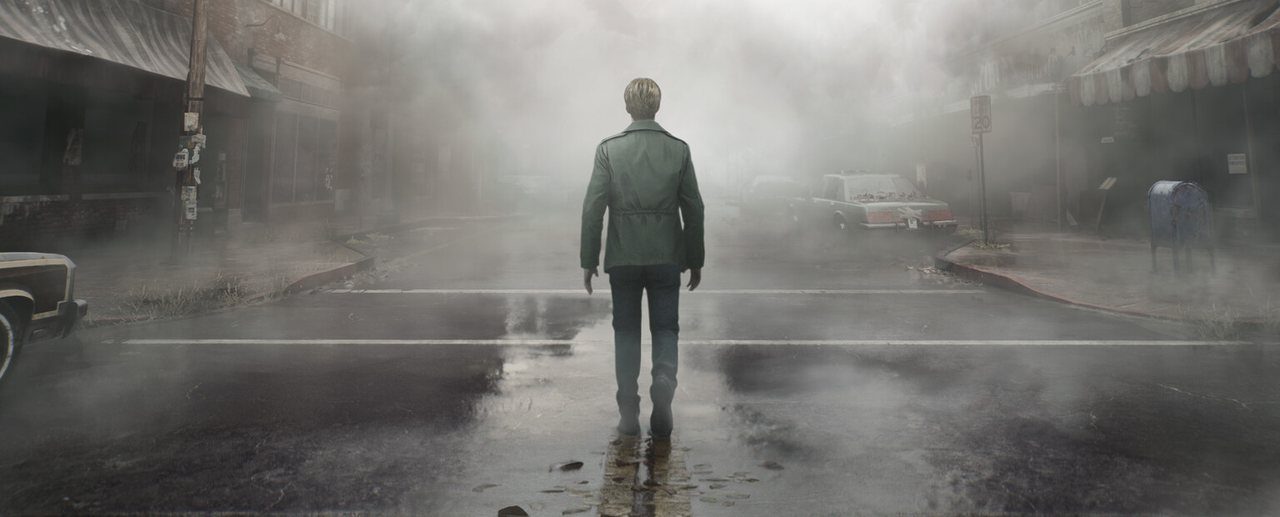
Silent Hill has had one of the strangest careers in gaming. Its first four games, made by a Konami team in Tokyo, set the standard for psychological horror. Then the series passed to Western studios, drifted, nearly returned in spectacular fashion through P.T., and went quiet for most of a decade. Since 2024 it has come back with a remake and two new entries from three different studios.
This history walks through each era in order. It sticks to premises and avoids major story spoilers.
Team Silent and the original game (1999)
The first Silent Hill launched on the PlayStation on February 23, 1999 in North America and March 4, 1999 in Japan. It was made by a group at Konami Computer Entertainment Tokyo later known as Team Silent. Keiichiro Toyama directed and wrote the scenario, Takayoshi Sato designed the characters, and Akira Yamaoka composed the music and handled sound effects.

Harry Mason searches the fog-bound American town of Silent Hill for his adopted daughter, Cheryl. Where Resident Evil used pre-rendered backgrounds, Silent Hill rendered its town in real-time 3D. The PlayStation could not draw distant objects well, so the developers filled the streets with fog and darkness, turning a technical limit into the series’ signature. A pocket radio that crackles with static when monsters are near, and a nightmarish “Otherworld” that periodically replaces the town, completed a formula built more on unease than on shocks.
The Team Silent sequels (2001-2004)
Silent Hill 2 (2001)
Released for the PlayStation 2 on September 25, 2001 in North America and directed by Masashi Tsuboyama, Silent Hill 2 abandoned the first game’s cult storyline for a self-contained tale. Widower James Sunderland receives a letter from his dead wife, Mary, saying she is waiting in their “special place” in Silent Hill. The town’s monsters, above all the helmeted executioner Pyramid Head, are tied to James’s guilt. Takayoshi Sato conceived the story. With six endings and separate difficulty settings for combat and puzzles, it is widely seen as the series’ high point and a landmark of psychological horror.
Silent Hill 3 (2003)
Directed by Kazuhide Nakazawa, Silent Hill 3 came out on the PlayStation 2 in 2003 (May in Europe, August in North America), followed by a Windows version. It is a direct sequel to the first game, set 17 years later, starring 17-year-old Heather Mason and returning to the town’s cult.
Silent Hill 4: The Room (2004)
Developed alongside Silent Hill 3 and released in 2004 for PlayStation 2, Xbox and Windows, The Room centered on a man trapped in his own apartment, with a strange hole leading to other worlds. It was the last game Team Silent made for the series. The group was effectively done with Silent Hill after this point, and Konami turned to outside developers.
The Western era (2007-2012)
From 2007 the series was handed to studios in the UK, the US and the Czech Republic. Akira Yamaoka continued to contribute music to several of these entries until he left Konami.
- Silent Hill: Origins (2007) by British studio Climax Studios, first on PSP and later PS2. A prequel to the first game starring trucker Travis Grady.
- Silent Hill: Homecoming (2008) by American studio Double Helix Games, on PS3 and Xbox 360 (Windows in 2009). It leaned more heavily into combat and divided fans.
- Silent Hill: Shattered Memories (2009), again by Climax Studios, released first on Wii with PS2 and PSP ports in early 2010. A reimagining of the first game’s premise with no combat in its nightmare chase sequences and a psychological profile that changes the game based on the player’s behavior. It is often cited as the boldest of the Western entries.
- Silent Hill: Downpour (2012) by Czech studio Vatra Games, on PS3 and Xbox 360, following a prisoner who escapes into the town after a bus crash.
The same year brought two side releases: Silent Hill: Book of Memories (2012), a dungeon-crawler for PlayStation Vita by WayForward, and the Silent Hill HD Collection for PS3 and Xbox 360, containing Silent Hill 2 and 3. The collection was criticized for technical problems and changes to the original presentation, and its reception reinforced the sense that the series had lost its way.
P.T. and the cancelled Silent Hills (2014-2015)
On August 12, 2014, a free horror demo appeared on the PlayStation 4, credited to an unknown studio called 7780s Studio. Announced at Gamescom 2014, P.T. (for “playable teaser”) confined players to a single suburban hallway that looped and changed each time they walked through it, haunted by a ghost named Lisa. Those who solved its cryptic final puzzle saw a trailer revealing the truth: it was a teaser for Silent Hills, directed by Hideo Kojima with filmmaker Guillermo del Toro, starring Norman Reedus. The studio name was a pseudonym for Kojima Productions.
The excitement did not last. In 2015 Konami confirmed Silent Hills was cancelled, days after del Toro’s departure from the project was revealed. P.T. was removed from the PlayStation Store on April 29, 2015, and could no longer be downloaded by new players. Its looping-corridor design nonetheless influenced a generation of first-person horror games and fan recreations.
The quiet years
The P.T. saga also became a cautionary tale about digital preservation. Because the teaser could no longer be downloaded, PlayStation 4 consoles with it still installed became sought-after items on resale sites, and fans built numerous recreations of the hallway to keep the experience accessible.
For most of the next seven years, the series had no new major game. Konami licensed characters such as Pyramid Head to other games, but fans had little more than the existing titles and the memory of P.T.. Many older entries also became hard to buy on modern platforms, a situation we cover in our separate guides.
The revival (2022 onward)
In October 2022, Konami announced several projects at once: a remake of Silent Hill 2, a new game titled Silent Hill f and another called Townfall. It also introduced the interactive streaming series Silent Hill: Ascension, which premiered in October 2023. In January 2024 Konami released Silent Hill: The Short Message, a free first-person game for PS5.
Silent Hill 2 remake (2024)
Polish studio Bloober Team, known for Layers of Fear and The Medium, developed the remake, which released on October 8, 2024 for PlayStation 5 and Windows. It rebuilt James Sunderland’s story with an over-the-shoulder camera and modern combat while retaining Akira Yamaoka’s involvement in the music. Its reception helped convince skeptical fans that the revival was serious. Bloober Team has since been announced as the developer of a remake of the first Silent Hill, with no release date as of October 2026.
Silent Hill f (2025)
Developed by NeoBards Entertainment and released on September 25, 2025 for PlayStation 5, Windows and Xbox Series X/S, Silent Hill f is a standalone entry set not in the American town but in Ebisugaoka, a fictional rural Japanese town in the 1960s. It was written by Ryukishi07, known for Higurashi When They Cry, and follows high school student Hinako Shimizu. Combat is melee-only, with no firearms. Akira Yamaoka scored part of the soundtrack. It received generally favorable reviews and, according to Konami, sold more than one million units on its first day, the fastest launch in the series.
Silent Hill: Townfall (2026)
The third revival project comes from Scottish studio Screen Burn Interactive (formerly No Code), co-published by Konami and Annapurna Interactive. It released on September 24, 2026 for PlayStation 5 and Windows. It is the first major Silent Hill game presented entirely in first person, set in 1996 in the fictional Scottish coastal town of St. Amelia and starring Simon Ordell. Early reviews have been generally favorable, with Metacritic scores of 80 on both platforms at the time of writing.
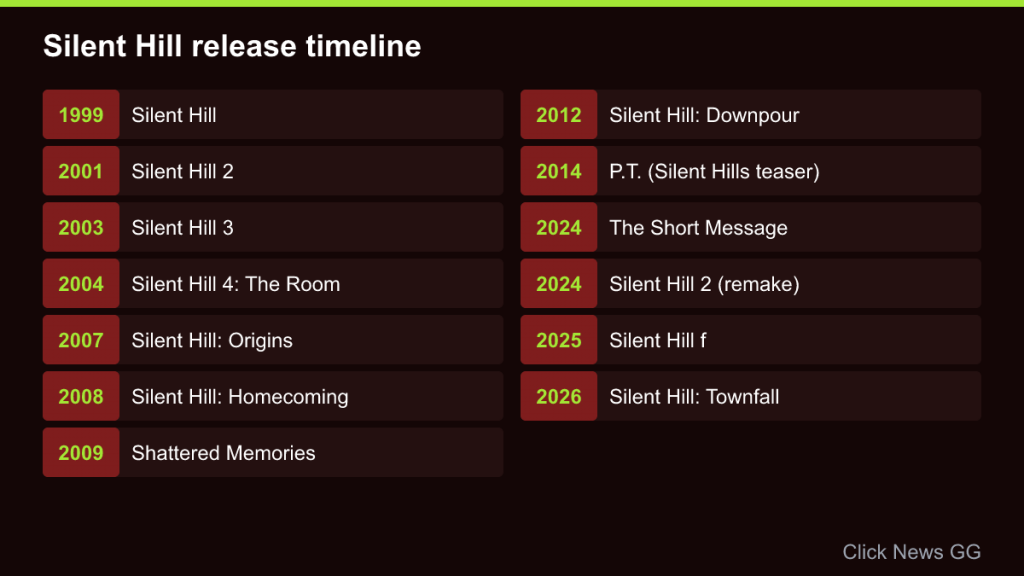
Release timeline
| Year | Game | Developer |
|---|---|---|
| 1999 | Silent Hill | Team Silent (Konami) |
| 2001 | Silent Hill 2 | Team Silent |
| 2003 | Silent Hill 3 | Team Silent |
| 2004 | Silent Hill 4: The Room | Team Silent |
| 2007 | Silent Hill: Origins | Climax Studios |
| 2008 | Silent Hill: Homecoming | Double Helix Games |
| 2009 | Silent Hill: Shattered Memories | Climax Studios |
| 2012 | Silent Hill: Downpour | Vatra Games |
| 2014 | P.T. (teaser for the cancelled Silent Hills) | Kojima Productions |
| 2024 | Silent Hill: The Short Message | Konami |
| 2024 | Silent Hill 2 (remake) | Bloober Team |
| 2025 | Silent Hill f | NeoBards Entertainment |
| 2026 | Silent Hill: Townfall | Screen Burn Interactive |
What makes Silent Hill distinctive
Across its many developers, a few ideas keep returning:
- The town as a mirror. Silent Hill’s monsters and places often reflect the inner lives of the people who arrive there. This is why the best entries feel personal rather than generic.
- Sound as a weapon. Akira Yamaoka’s industrial, melancholic music and the radio static that signals danger are as important to the series’ identity as any monster.
- Limited sight. Fog, darkness and a flashlight beam keep players uncertain about what is ahead, building dread instead of relying solely on jump scares.
- Ordinary protagonists. Harry, James and Heather are not soldiers or agents; their clumsiness in combat is part of the horror.
Even the revival’s experiments, a Japanese setting in f and a Scottish one in Townfall, keep those principles while moving away from the original town. Whether that broadening continues will shape the series’ next decade, but for now Silent Hill is more active than at any point since Team Silent’s era. For background on the genre conventions it shares with its great rival, see our Resident Evil series history.