Where to Start With Resident Evil: Best Play Order for Newcomers
New to Resident Evil? Release order vs. story order, which remakes replace originals, what you can skip and three routes into the series.

Resident Evil has been running since 1996, and the list of games is intimidating: numbered entries, remakes, a prequel, side stories and spin-offs, some of which share names with each other. The good news is that you do not need to play all of it, and you certainly do not need to start in 1996. This guide explains the difference between release order and story order, which versions to pick, what to skip and three practical routes in.
Platform notes reflect availability as of October 2026. Storefronts change, so double-check before buying.
First, a few things that simplify everything
- Most games stand on their own. Each mainline entry has its own setting and a mostly self-contained plot. Returning characters carry history, but the games explain what you need.
- Remakes replace originals for most players. Resident Evil 2, 3 and 4 have modern remakes (2019, 2020 and 2023). Unless you are curious about game history, the remakes are the natural versions to play. The 2002 remake of the first game likewise replaces the 1996 original for most people.
- There are two “sagas”. Games 1 through 6 follow characters like Chris Redfield, Jill Valentine, Leon S. Kennedy and Claire Redfield. Resident Evil 7 and Village follow Ethan Winters. Requiem brings Leon back alongside a new lead, Grace Ashcroft.
- Spin-offs are optional. The Revelations games add side stories but are not required to understand the main plot.
If you want the full development history first, see our Resident Evil series history.
Release order vs. story order
Release order is simply the order the games came out. Story order (chronological order) arranges them by when their events take place. They differ mainly at the start: Resident Evil Zero (2002) is a prequel set just before the first game, and Resident Evil 3 overlaps with Resident Evil 2, beginning before it and ending after it.
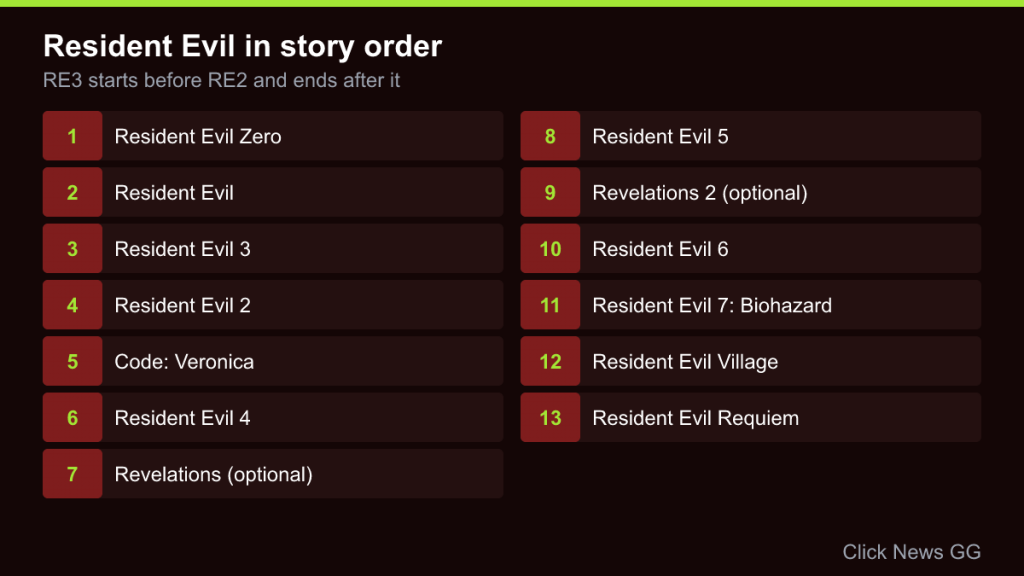
| Story order | Game | Version most players should choose |
|---|---|---|
| 1 | Resident Evil Zero | HD Remaster |
| 2 | Resident Evil | 2002 remake (HD Remaster) |
| 3 | Resident Evil 3 (starts before RE2) | 2020 remake or 1999 original |
| 4 | Resident Evil 2 | 2019 remake |
| 5 | Resident Evil – Code: Veronica | Code: Veronica X (remake announced for 2027) |
| 6 | Resident Evil 4 | 2023 remake |
| 7 | Resident Evil: Revelations (optional) | Current release |
| 8 | Resident Evil 5 | Current release |
| 9 | Resident Evil: Revelations 2 (optional) | Current release |
| 10 | Resident Evil 6 | Current release |
| 11 | Resident Evil 7: Biohazard | Current release |
| 12 | Resident Evil Village | Current release |
| 13 | Resident Evil Requiem | Current release |
Story order is satisfying for completionists, but it is not the best way for a newcomer to begin, because it starts with Zero, one of the more awkward entries to play today, and leaves the most polished games until later.
Which versions to play
Resident Evil 1: the 2002 remake
The 2002 GameCube remake, directed by Shinji Mikami, rebuilt the original with new areas, a subplot involving Lisa Trevor and new mechanics such as “Crimson Head” zombies. Its HD Remaster (2015) is the standard way to play the first game on modern systems. If you want the 1996 version for historical interest, GOG.com re-released the original PC port in 2024 with Windows 10/11 compatibility and modern controller support, and the original trilogy has since appeared on Steam too.
Resident Evil 2, 3 and 4: the remakes
The RE Engine remakes modernize controls and cameras while keeping each game’s structure. Resident Evil 2 (2019) is often cited as the best starting point in the whole series. Resident Evil 3 (2020) is shorter and cuts some locations and the original’s branching choices, so purists sometimes recommend the 1999 original alongside it. Resident Evil 4 (2023) keeps the original’s structure but adds a knife parry, crafting and more fluid movement.
Code: Veronica: the awkward one
Code: Veronica is the only major story entry without a modern remake yet. Capcom announced Resident Evil Veronica at Summer Game Fest in June 2026 for release in 2027 on PS5, Xbox Series X|S, Nintendo Switch 2 and PC. Until then, the Code: Veronica X version can be played on PlayStation 4 and 5 as a PS2 Classic and on Xbox One and Series X|S via backward compatibility with the Xbox 360 HD version. It is not on Steam. Many newcomers wait for the remake or read a summary.
Route 1: Modern-first (recommended for most newcomers)
This route starts with the most approachable games and works backward only if you get hooked.

- Resident Evil 2 (2019) – a modern, self-contained introduction to Leon, Claire and Raccoon City.
- Resident Evil 4 (2023) – more action, a new setting and a fan-favorite tone.
- Resident Evil 7: Biohazard – first-person horror and a fresh protagonist, Ethan Winters.
- Resident Evil Village – Ethan’s sequel, with gothic villains and more action.
- Resident Evil Requiem – the newest game, which ties classic Raccoon City history to new characters.
Optional additions: Resident Evil 3 (2020) after 2, and the HD Remaster of the first game if you want to see where Chris and Jill began.
Route 2: Classic-first (for players who like old-school design)
If you enjoy fixed camera angles, puzzles and careful inventory management, start with the classic-styled games before moving to modern ones.
- Resident Evil HD Remaster (the 2002 remake)
- Resident Evil Zero HD Remaster
- Resident Evil 2 (2019)
- Resident Evil 3 (2020)
- Code: Veronica X or wait for the 2027 remake
- Resident Evil 4 (2023), then continue in release order
Note that Zero plays well after the first game even though it is a prequel: its partner-swapping mechanic and lack of item boxes make more sense once you know the classic formula.
Route 3: Story-complete (for completionists)
For players who want everything in chronological order, follow the story table above, including the two Revelations games. Expect a long journey: thirteen games, several of them action-heavy. A good compromise is to play the numbered games in story order and add Revelations and Revelations 2 only if you are enjoying the side characters.
What you can skip
- The 1996 original and the 1998 originals of 2 and 3, unless you want history: the remakes cover the same stories.
- Resident Evil 6, if you dislike action-heavy games. Its four campaigns received mixed reviews, though it does continue several characters’ arcs.
- Spin-offs like Outbreak, Umbrella Chronicles and Survivor. Some are not available on modern platforms, and none are essential.
- Multiplayer side projects such as Resident Evil: Resistance, which was bundled with the 2020 RE3 remake.
Where to play (as of October 2026)
- PC (Steam): Steam lists the HD Remaster of the first game, Zero, the 2005 Resident Evil 4, 5, 6, 7, Village, Requiem, both Revelations games and the 2019-2023 remakes, plus the original 1996-1999 trilogy. Code: Veronica is not on Steam.
- PlayStation 5 and Xbox Series X|S: the remakes, 7, Village and Requiem have current-generation versions. Older entries are available through PS4 and Xbox One releases that run on the newer consoles.
- Nintendo Switch 2: Requiem launched on Switch 2, and Village received a Switch 2 version in February 2026. Switch 2 versions of the Resident Evil 2, 3 and 4 remakes were scheduled for October 16, 2026 at the time of writing.
- Mac and iPhone/iPad: several modern entries, including Village and the RE2, RE3 and RE4 remakes, have Apple versions, with hardware requirements on mobile.
Common newcomer questions
Do I need to play RE7 before Village?
Yes, ideally. Village is a direct sequel and assumes you know Ethan’s earlier ordeal.
Can I start with Requiem?
You can, and many players will. Half of it follows a brand-new protagonist, Grace Ashcroft, which gives newcomers a fresh point of entry, but references to Raccoon City and Leon’s past will land harder if you have played the Resident Evil 2 remake first.
Are the remakes too scary for beginners?
They are tense, but each offers an easier difficulty mode. Resident Evil 2 (2019), for example, includes an Assisted mode designed to reduce pressure.
Is the first-person view in RE7 a problem if I get motion sick?
Some players find first-person games uncomfortable. Village received an optional third-person mode, and Requiem lets you switch between first and third person for both protagonists.
Mistakes newcomers often make
- Starting with the 1996 original out of a sense of duty. It is historically important, but its tank controls and fixed cameras can put off players used to modern games. The 2002 remake or the Resident Evil 2 remake are kinder introductions.
- Confusing the two versions of the same title. “Resident Evil 4” on a store page might be the 2005 original or the 2023 remake; “Resident Evil 2” might be the 2019 remake or the 1998 original. Check the release year before buying.
- Treating Resident Evil 6 as essential. It continues several characters’ stories, but newcomers who dislike action-heavy games can read a summary and move on to Resident Evil 7 without missing anything crucial.
- Skipping the Ethan Winters games because they “are not the real story”. Resident Evil 7 and Village connect to the wider series in ways that matter for later games.
- Burning out on a marathon. Playing a dozen horror games back to back is tiring. Mixing in other genres between entries keeps the series fresh.
The short answer
If you only remember one thing: start with Resident Evil 2 (2019). It is modern, self-contained and represents the classic survival horror formula at its best. If it clicks, move to Resident Evil 4 (2023) and then the Ethan Winters games, and fill in older entries whenever curiosity strikes.