Outlast Series History: Red Barrels and the Rise of Run-and-Hide Horror
How a tiny Montreal studio built Outlast: the camcorder, the defenceless reporter, Whistleblower, Outlast 2 and the co-op Outlast Trials.
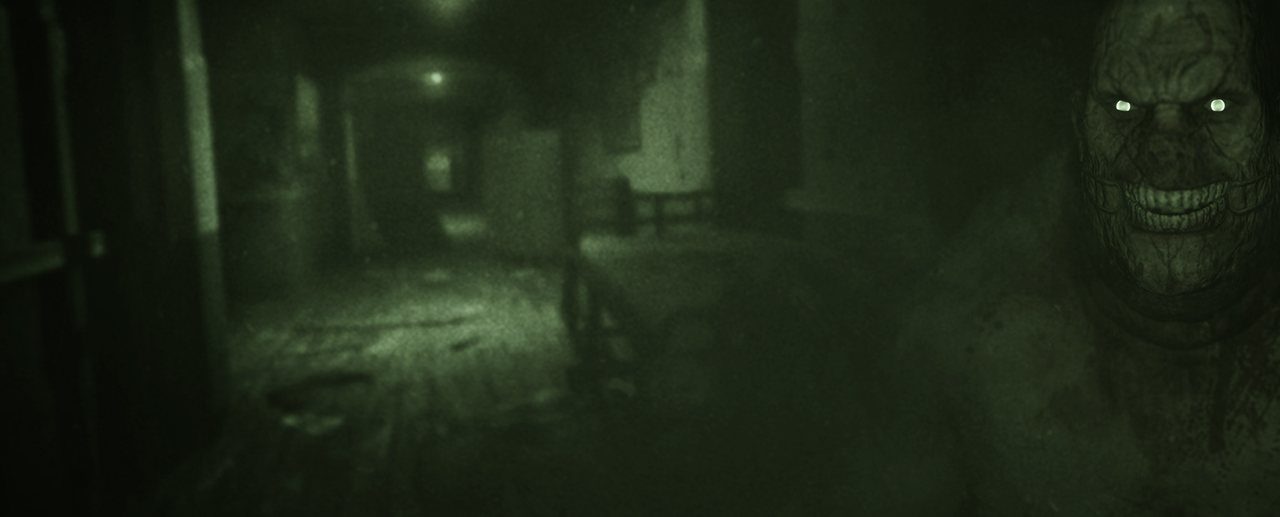
A green-tinted camcorder screen, a battery indicator blinking low, and the sound of heavy footsteps on the other side of a locker door. Few horror images from the 2010s are as recognisable as Outlast‘s. Made by a small independent studio that nearly ran out of money before it shipped, the game became one of the defining titles of the run-and-hide era and grew into a series spanning a sequel, a prequel DLC, a co-op spin-off, comics and a planned film. This is how it happened.
Red Barrels: Veterans Go Independent
Red Barrels is based in Montreal and was started in 2011 by Philippe Morin, David Chateauneuf and Hugo Dallaire. All three came from big-budget development. In a detailed account of the studio’s early years written for Game Developer, Morin explained that he had shipped Uncharted: Drake’s Fortune at Naughty Dog and worked as a creative director at Ubisoft Montreal before joining an EA Montreal project that was later cancelled. Chateauneuf had worked on Prince of Persia: The Sands of Time and the first Assassin’s Creed, while Dallaire had been an art director on Splinter Cell and Army of Two.
After leaving their jobs in early 2011, the three decided to start their own company. They chose horror partly because Chateauneuf had long wanted to make a horror game, and partly because a small team on a modest budget would not need blockbuster revenue to succeed.
Nearly not making it
Funding was a struggle. The team estimated it needed around $1.5 million, but no publisher would commit. Valve offered distribution but not financing, and the founders turned down investors who wanted ownership. A first application to the Canada Media Fund was rejected because the studio lacked a distribution deal and full financing. Morin described the low point bluntly: “Twelve months without a salary, no publishers, no money, nothing.”
For a second application, the founders put in roughly $360,000 of their own money, from savings, credit, their homes and family. Once Valve agreed to distribute the game, the fund approved up to $1 million in June 2012. Red Barrels stayed independent and self-published the game.
Designing a Defenceless Hero
Outlast’s core design choices came from a few simple decisions:
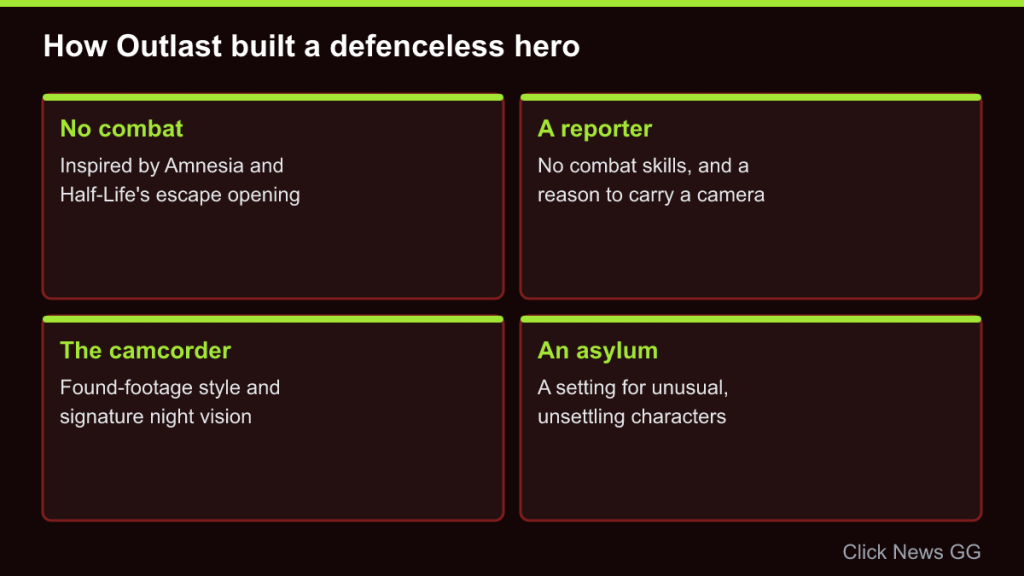
- No combat. In Morin’s words, “We decided to go with no combat because it would allow us to build a more focused experience.” The team took inspiration from the escape-focused opening of Half-Life and the no-combat approach of Amnesia (whose story we cover in our Frictional Games history).
- A reporter as protagonist. As Morin put it, “a reporter doesn’t usually have combat skills, and has a good reason to be carrying a camcorder.”
- The camcorder. It justified the found-footage style the team wanted and gave the game its signature night vision.
- An asylum setting, chosen because it allowed for unusual, unsettling characters. Research into real-world Cold War-era human experimentation programmes informed the story.
Outlast (2013)
Outlast released for Windows on September 4, 2013, followed by PlayStation 4 in February 2014, Xbox One in June 2014, Linux and OS X in 2015 and Nintendo Switch in February 2018 as Outlast: Bundle of Terror.
Freelance journalist Miles Upshur investigates Mount Massive Asylum, a remote psychiatric hospital in Colorado run by the shadowy Murkoff Corporation, and finds it overrun by violent inmates. You cannot attack anyone, and there is no health bar on screen. You hide in lockers and under beds, sneak past patrols and run when spotted.
The camcorder is the game’s masterstroke. Night vision is the only way to see in total darkness, but it drains batteries you must scavenge. That turns the camera into both a lifeline and a ticking clock: every moment you spend seeing in the dark costs you, and running out means stumbling blind. The found-footage framing also means you often watch horror through a small, grainy screen, heightening the sense of documenting something you should not be seeing.
Reviews were generally positive, with praise for atmosphere and tension, and Metacritic scores in the high 70s to around 80 depending on platform.
Outlast: Whistleblower (2014)
The Whistleblower DLC arrived on May 6, 2014, for Windows and PS4, with other platforms following. It follows Waylon Park, the anonymous tipster who contacted Miles in the first place, and works as a prequel that overlaps with the main story. On Switch, it is included with the main game in Outlast: Bundle of Terror.
Outlast 2 (2017)
Outlast 2 released on April 25, 2017, for Windows, PlayStation 4 and Xbox One, with a Switch version in March 2018. It moves away from the asylum entirely. Cameraman Blake Langermann and his journalist wife, Lynn, are investigating the murder of a pregnant teenager when their helicopter crashes in a remote part of Arizona. Separated from Lynn, Blake must search for her while evading a cult in a town called Temple Gate that believes the end of the world is near.
The camcorder returns with an addition: a sensitive microphone that can pick up distant footsteps and voices, letting you track threats by sound. The larger, more open environments made the chases more frantic and the hiding spots less predictable.
Outlast 2 is considerably more extreme in its themes. In Australia, the Classification Board initially refused it a rating, citing sexual violence, before reversing that decision within days without changes to the game. Critics were generally positive about its visuals, sound design and atmosphere, while criticism focused on its gore, themes and difficulty. IGN said it “keeps the scares coming at a relentless pace.”
The Outlast Trials (2023–2024): Horror Goes Co-op
For its third project, Red Barrels did something few expected: it made Outlast multiplayer. The Outlast Trials entered early access on Windows on May 18, 2023, and fully launched on March 5, 2024, on Windows, PS4, PS5, Xbox One and Xbox Series X/S.
Set in 1959, during the Cold War, it serves as a prequel to both main games. Murkoff runs experiments at the Sinyala Facility, forcing test subjects called Reagents through sadistic trials. Up to four players can cooperate, or you can play solo. The series’ defenceless DNA remains — you mostly hide, sneak and run — but each player chooses a Rig, a device granting one ability, such as seeing enemies through walls, healing allies, placing smoke-bomb mines, stunning enemies or barricading doors.
The game has been updated regularly since launch. In 2025 alone, Red Barrels added a sixth trial with a new ending, a variant option designed to make the game feel closer to the original Outlast, and an “Invasion” mode in which some players act as imposters working against the Reagents. As of October 2026, the studio’s official site continues to focus on Trials updates and has not announced a new single-player Outlast game.
Comics, Lore and a Film
The series has grown beyond games. Two comic series, The Murkoff Account and The Murkoff Collections (the latter published from October 2024), expand the story of the Murkoff Corporation. On October 30, 2024, Lionsgate announced a film adaptation, with Roy Lee producing and J. T. Petty writing the screenplay. As of October 2026, we found no confirmed release date.
Why Outlast Mattered
Outlast was not the first run-and-hide horror game, but it became one of the most recognisable examples of the style. Its influence can be seen in several design choices that became common afterwards:
- A camera as a core mechanic, tying the act of seeing to a limited resource.
- Hiding spots as safe-but-not-safe spaces, where you watch an enemy search for you through a gap.
- A protagonist who is explicitly not a fighter, which justifies the lack of combat within the story.
- Corporate conspiracy as an overarching thread, letting standalone stories share a world.
For how run-and-hide sits alongside survival horror and other subgenres, see our horror subgenre comparison.
Survival Tips for New Players
- Conserve batteries. Use night vision when you genuinely need it, and switch it off in lit areas. Running out in the wrong place is one of the most common causes of panic.
- Learn to look behind you while running. Both main games let you glance back during a chase. Knowing how close a pursuer is helps you decide whether to keep running or duck into a hiding spot.
- Break line of sight before hiding. Hiding while an enemy is watching rarely works. Turn a corner or close a door first.
- Listen. Footsteps, breathing and voices tell you where threats are. In Outlast 2, the camcorder’s microphone exists precisely for this.
- Accept a few deaths. Dying returns you to a checkpoint. Chases often take a couple of attempts to learn, and that is part of the design.
Playing the Series Today
Release order works best: Outlast and Whistleblower, then Outlast 2, then The Outlast Trials if you have friends to play with (or want a different kind of challenge solo). Be prepared for extremely graphic violence and disturbing themes throughout, especially in Outlast 2. If you want to try the series but worry about intensity, our guide to playing horror games if you scare easily has practical tips — though Outlast is, by design, one of the more intense series out there.