Frictional Games History: Penumbra, Amnesia and SOMA
How a small Swedish studio shaped modern horror: Penumbra, Amnesia: The Dark Descent, SOMA, Rebirth, The Bunker and what comes next.
If you have ever cowered in a cupboard in a first-person horror game, holding your breath while something shuffles past, you have felt the influence of Frictional Games. The small Swedish studio did not invent defenceless horror, but with Amnesia: The Dark Descent it turned “run and hide” into one of the dominant styles of the 2010s. Its later work, particularly SOMA, showed that horror games could also be serious science fiction. This is the studio’s history, from a tech demo to a planned game set on the Moon.
Founding and the HPL Engine
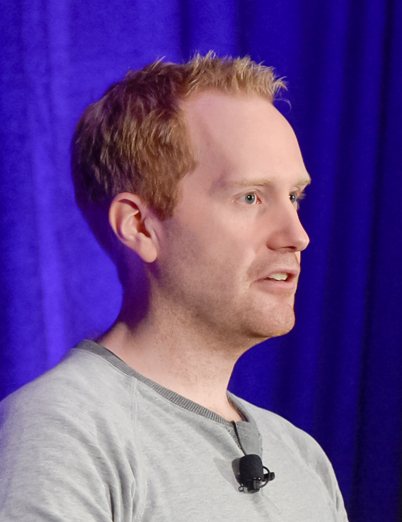
Frictional Games was founded on 1 January 2007 in Helsingborg, Sweden, by Thomas Grip and Jens Nilsson. The company later moved to Malmö, in August 2017. From the start, it specialised in horror games with little or no combat.
Its games run on an in-house technology called the HPL Engine, named after the horror writer H. P. Lovecraft — a fitting tribute, given how much cosmic and existential dread runs through the studio’s stories. The engine has evolved through several versions:
- HPL Engine 1 powered the Penumbra games and was released as open source in May 2010.
- HPL Engine 2 powered Amnesia: The Dark Descent and A Machine for Pigs, and was open-sourced in September 2020.
- HPL Engine 3 was built for SOMA and later evolved into the version used for Rebirth and The Bunker.
Penumbra (2007–2008): Physics and Fear
Frictional’s first commercial game grew out of a 2006 tech demo called Penumbra, built to show off the first HPL Engine. The demo was well received, and the team expanded it into Penumbra: Overture, released for Windows on 30 March 2007.
Set in 2001, it follows Philip, a physicist who, after his mother’s death, receives a letter from his apparently dead father and travels to an abandoned mine in northern Greenland. The game’s signature was physics-based interaction: you physically drag doors open, stack boxes and barrels to climb, and manipulate objects in real time with the mouse. There are no firearms; combat relies on melee weapons and thrown objects, with an emphasis on stealth.
Overture was planned as the first of three episodes. The second, Penumbra: Black Plague (2008), responded to criticism of the first game’s clumsy fighting by removing combat and most enemies and making the game more stealth-based. An expansion, Penumbra: Requiem (2008), effectively added a third chapter. The decision to strip out combat would prove pivotal.
Amnesia: The Dark Descent (2010): The Breakthrough
Released on 8 September 2010 for Windows, Mac OS X and Linux, Amnesia: The Dark Descent took everything Frictional had learned and refined it. Daniel, an archaeologist, wakes up in Brennenburg Castle in 1839 with no memory of who he is.
Three design pillars made it a landmark:
- No combat at all. Daniel cannot fight. He must hide, flee, or block doors and barricade paths.
- A sanity system. Daniel’s sanity drops when he stays in the dark too long, witnesses disturbing events or looks directly at monsters. Low sanity causes hallucinations and makes monsters more likely to find him. Light restores it, but light sources are limited.
- Darkness as an enemy. Thomas Grip described the core idea as making “the darkness itself” an enemy. You need darkness to hide, but darkness also erodes your mind — an elegant trap.
The physics interaction from Penumbra remained, so opening a door slowly with the mouse to peek through a gap became one of the game’s most tense actions. Amnesia became a phenomenon, and its defenceless, first-person format influenced a wave of later games, from Outlast to countless indie projects. For how that style compares with other horror approaches, see our horror subgenre guide.
Amnesia: A Machine for Pigs (2013)
For the follow-up, Frictional acted as publisher while The Chinese Room, the British studio behind Dear Esther, developed the game, with Dan Pinchbeck credited as writer. It released on 10 September 2013 for Windows.
Set in London on New Year’s Eve 1899, it follows industrialist Oswald Mandus, who wakes from a fever and descends beneath his home to save his sons from a machine he built. The Chinese Room made significant changes: the inventory and sanity mechanic were removed, light no longer required oil or tinderboxes, and health regenerated automatically. Reviews were mixed. Critics praised the atmosphere and writing, while some felt the streamlined design made it less frightening. It remains an interesting example of a horror sequel choosing narrative over systems.
SOMA (2015): Horror as Philosophy
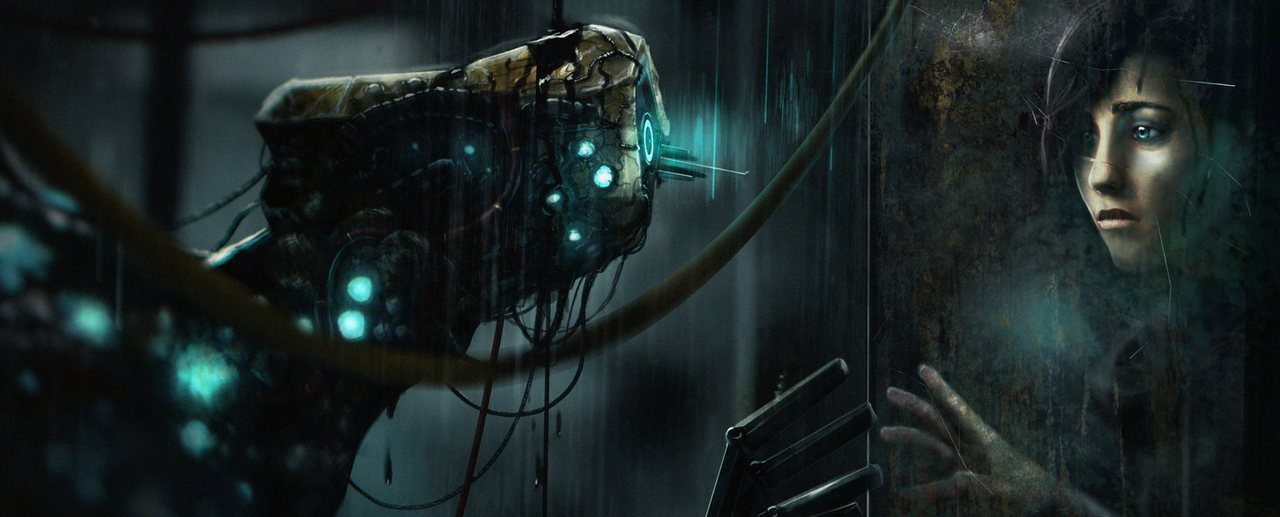
Frictional self-released SOMA on 22 September 2015 for Windows, macOS, Linux and PlayStation 4. After a severe car accident and an experimental brain scan, Simon Jarrett wakes in 2104 at PATHOS-II, a crumbling undersea research station in the North Atlantic, where the machines seem to have minds of their own.
SOMA kept the studio’s defenceless design but used it in service of big questions: what is consciousness, does a copy of you count as you, and what makes a life worth preserving? Many players consider it Frictional’s finest work precisely because the ideas linger longer than the scares. A later update added a Safe Mode in which monsters remain present but cannot kill you, opening the game to players who want the story without the stress. Xbox One and Switch versions followed in 2017 and 2025 respectively. We include it in our list of the best psychological horror games.
Amnesia: Rebirth (2020)
Returning to the Amnesia name, Amnesia: Rebirth launched on 20 October 2020 for Windows, Linux and PlayStation 4, with Xbox versions following in 2022. It is a sequel to The Dark Descent, set in 1937. Tasi Trianon, a French drafter, survives a plane crash in the Algerian desert and searches caves and ancient tombs for her missing companions.
Rebirth replaced sanity with fear: walking in complete darkness makes Tasi hallucinate and hear whispers, and fear is managed by finding light, solving puzzles and hiding from monsters. As before, there is no combat. Compared with The Dark Descent, it places much more weight on its protagonist’s personal story and on exploring wide, alien spaces.
Amnesia: The Bunker (2023): Systems Over Scripts
Amnesia: The Bunker released on 6 June 2023 for Windows, PlayStation 4, Xbox One and Xbox Series X/S. A prequel to Rebirth, it puts you in the boots of French soldier Henri Clément during World War I, trapped in an underground bunker with a creature known as the Beast.
The Bunker marked a striking change in philosophy:
- A semi-open, systemic design with few scripted moments. The game reacts to what you do, rather than leading you through set pieces.
- A weapon, finally — a revolver that is deliberately awkward and slow to reload.
- A generator you must keep fuelled. When the power fails, the bunker goes dark and the Beast hunts more actively. Fuel is limited, and the fallback is a noisy dynamo flashlight.
- A persistent stalker. The Beast is a threat throughout the game.
Critics generally praised it, with GameSpot highlighting how every finite resource forces careful decisions — an idea we unpack in our explainer on survival horror resource management.
What’s Next: Ontos
At The Game Awards in December 2025, Frictional and publisher Kepler Interactive announced Ontos, described as a spiritual successor to SOMA. It follows engineer Aditi Amani as she explores Samsara, a hotel on the Moon, to learn the truth about her estranged father. It is planned for PlayStation 5, Xbox Series X/S and Windows. As of October 2026 it has not been released, and current listings point to 2027.
Frictional’s Design Signatures
Across almost two decades, a handful of ideas recur in nearly every Frictional game:
- Physical interaction. From Penumbra onwards, you open doors, drawers and valves with mouse or stick movements rather than a single button press. It slows you down at exactly the moments you most want to hurry, and makes the world feel tangible.
- Vulnerability over power. Combat is minimal or absent in most of the studio’s games. Even The Bunker’s revolver is deliberately clumsy. Your main tools are hiding, light and your own nerve.
- Light as a resource. Tinderboxes, lamp oil, generator fuel: almost every game asks you to ration light, tying atmosphere directly to decision-making.
- Mind as mechanic. Sanity in The Dark Descent and fear in Rebirth turn the protagonist’s mental state into something the player must manage, not just observe.
- Stories told through documents and the environment. Notes, diaries, recordings and the spaces themselves carry much of the narrative, rewarding players who explore.
These signatures explain why Frictional’s influence is so visible elsewhere: they are simple, transferable ideas that smaller teams can build on.
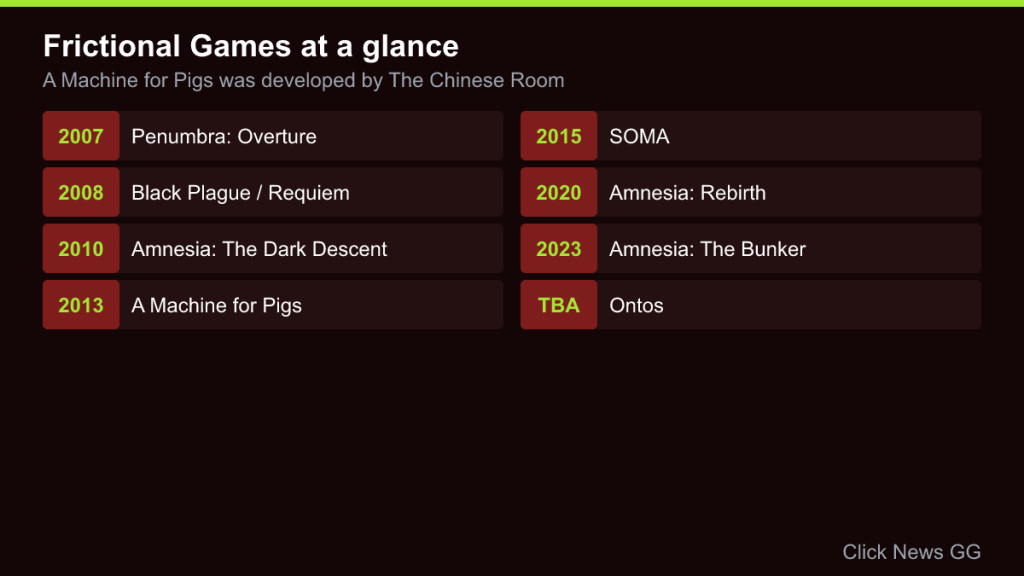
Frictional’s Games at a Glance
| Year | Game | Notes |
|---|---|---|
| 2007 | Penumbra: Overture | Physics-based interaction; limited combat |
| 2008 | Penumbra: Black Plague / Requiem | Combat removed; stealth focus |
| 2010 | Amnesia: The Dark Descent | Sanity system; defining run-and-hide game |
| 2013 | Amnesia: A Machine for Pigs | Developed by The Chinese Room |
| 2015 | SOMA | Sci-fi horror about consciousness |
| 2020 | Amnesia: Rebirth | Fear system; story focus |
| 2023 | Amnesia: The Bunker | Systemic design; persistent stalker |
| TBA | Ontos | Announced December 2025 |
Where to Start
For most new players, Amnesia: The Dark Descent is still the best introduction: it is short, influential and pure in its design. If you prefer story and ideas over scares, start with SOMA, using Safe Mode if needed. If you enjoy emergent, replayable tension, The Bunker is the most modern and systemic of the studio’s games. Whichever you choose, play with headphones and the lights low — Frictional’s games are built to be heard as much as seen.