Resident Evil Series History: From the Spencer Mansion to Requiem
Every mainline Resident Evil game from 1996 to Requiem (2026): the classic era, the action years, the first-person reboot and the modern remakes.

Few horror series have changed shape as often as Resident Evil, known as Biohazard in Japan. Capcom’s franchise has gone from fixed-camera mansion crawls to co-op action blockbusters, then to first-person horror and back to remakes of its own classics. Through all of it, it has remained one of gaming’s biggest names: the series’ Wikipedia entry puts sales above 213 million copies as of June 2026.
This is a release-order history of the mainline games and remakes, with directors and original platforms, plus a brief look at the spin-offs. Story details are kept light, but expect premise-level information about each game.
The classic era (1996-2002)
Resident Evil (1996)
The first game launched on the PlayStation on March 22, 1996 in Japan and April 1, 1996 in North America. Shinji Mikami directed, and Tokuro Fujiwara produced. The project grew out of Fujiwara’s 1989 Famicom horror game Sweet Home, which inspired its mansion setting, inventory management, puzzles and door-opening loading screens.

Players control S.T.A.R.S. members Chris Redfield or Jill Valentine, trapped in the Spencer Mansion in the Arklay Mountains. Jill has a lockpick and more inventory space; Chris can take more damage. Fixed camera angles over pre-rendered backgrounds, tank controls, item boxes and ink ribbons for saving at typewriters defined the template. Capcom marketed it as “survival horror”, and the label became a genre. (Our survival horror explainer covers that history.)
Resident Evil 2 (1998)
The sequel arrived on January 21, 1998 in North America, directed by Hideki Kamiya with Mikami as producer. It moved the action to Raccoon City, following rookie police officer Leon S. Kennedy and college student Claire Redfield. An earlier version, nicknamed “Resident Evil 1.5”, was scrapped late in development because Mikami judged it dull. The released game’s “Zapping System” let events in one character’s scenario affect the other’s.
Resident Evil 3: Nemesis (1999)
Directed by Kazuhiro Aoyama and released in Japan on September 22, 1999, Nemesis brought Jill back for her escape from Raccoon City. Its title creature repeatedly pursued the player across the city, and “live selection” moments asked players to make split-second choices that changed scenes and endings. A dodge and a quick 180-degree turn were added to help players evade attacks.
Resident Evil – Code: Veronica (2000)
Released for the Sega Dreamcast in February 2000 in Japan and directed by Hiroki Kato, Code: Veronica split its story between Claire and Chris, moving from a prison on Rockfort Island to an Umbrella facility in Antarctica. It replaced pre-rendered backgrounds with real-time 3D environments and a more dynamic camera.
The GameCube years: REmake and Zero (2002)
Mikami then made the series exclusive to Nintendo’s GameCube for a time. The first result was a ground-up remake of the original, released on March 22, 2002 in Japan and directed again by Mikami. Often called “REmake”, it added a subplot involving Lisa Trevor, “Crimson Head” zombies that revive if not destroyed, and defensive items for escaping grabs. Later that year came Resident Evil Zero, directed by Koji Oda. It paired medic Rebecca Chambers with convict Billy Coen, let players swap between them in real time and replaced item boxes with the ability to drop items anywhere.
The action era (2005-2012)
Resident Evil 4 (2005)
Resident Evil 4 had one of gaming’s most famous troubled developments. Work began in 1999, and several versions were discarded. One prototype, directed by Hideki Kamiya, strayed so far that it became a separate series: Devil May Cry (2001). Mikami eventually took over as director, and the game launched on the GameCube on January 11, 2005 in North America, with a PlayStation 2 port in October 2005 that added the Ada Wong side story “Separate Ways”.
Leon, now a U.S. government agent, travels to rural Spain to rescue the President’s daughter, Ashley Graham, facing villagers infected by the Las Plagas parasite. The new over-the-shoulder camera and faster, more aggressive enemies transformed the series and influenced action games for years.
Resident Evil 5 (2009)
Directed by Yasuhiro Anpo and produced by Jun Takeuchi, Resident Evil 5 launched on PlayStation 3 and Xbox 360 in March 2009. It was the first mainline entry designed for two-player co-op, pairing Chris Redfield with new BSAA agent Sheva Alomar in the fictional West African region of Kijuju, and it brought long-time villain Albert Wesker’s story to a head.
Resident Evil 6 (2012)
Released on October 2, 2012 and directed by Eiichiro Sasaki, Resident Evil 6 offered four interwoven campaigns starring Leon, Chris, newcomer Jake Muller and Ada Wong. Reviews were mixed; critics praised its production values but criticized its campaigns and its distance from survival horror. That reaction shaped what came next.
The first-person reboot (2017-2021)
Resident Evil 7: Biohazard (2017)
Released on January 24, 2017 for PlayStation 4, Windows and Xbox One, Resident Evil 7 was directed by Koshi Nakanishi and was the first full-length game on Capcom’s new RE Engine. It was also the first mainline entry played in first person. Ethan Winters searches for his missing wife, Mia, at a derelict plantation in Dulvey, Louisiana, owned by the infected Baker family. The game returned to a single main location, puzzles and resource management, and supported PlayStation VR. Its earlier playable teaser, Beginning Hour, was a standalone experience rather than part of the game.
Resident Evil Village (2021)
Directed by Morimasa Sato and released on May 7, 2021, Village continued Ethan’s story as he searches for his kidnapped daughter, Rose, in a European village ruled by Mother Miranda. Lady Dimitrescu, a towering vampire aristocrat, became a viral sensation before launch. The Winters’ Expansion (October 28, 2022) added a third-person mode and Shadows of Rose, starring Rose herself.
The modern remakes (2019-2023)
Alongside the new numbered games, Capcom rebuilt its classics on the RE Engine:
- Resident Evil 2 (2019), released January 25, 2019 and directed by Kazunori Kadoi and Yasuhiro Anpo. It replaced fixed cameras and tank controls with a third-person camera, made Mr. X a persistent stalker who cannot be killed, and became one of the most acclaimed games in the series.
- Resident Evil 3 (2020), released April 3, 2020 and directed by Kiyohiko Sakata. It redesigned Nemesis and added a dodge-and-counter mechanic, but removed areas such as the clock tower and park as well as live selections and multiple endings. Critics often faulted its short length.
- Resident Evil 4 (2023), released March 24, 2023 and directed by Yasuhiro Anpo and Kazunori Kadoi. It added a knife parry, crafting and movement while aiming, and reduced quick-time events. The “Separate Ways” DLC followed on September 21, 2023.
As of October 2026, the next remake has been announced: Resident Evil Veronica, a remake of Code: Veronica, revealed at Summer Game Fest in June 2026 and scheduled for 2027 on PS5, Xbox Series X|S, Nintendo Switch 2 and PC. No exact date had been confirmed at the time of writing.
Resident Evil Requiem (2026)
The ninth numbered entry, Resident Evil Requiem, launched on February 27, 2026 for PlayStation 5, Xbox Series X/S, Nintendo Switch 2 and Windows. Koshi Nakanishi, director of Resident Evil 7, returned to direct. Development was confirmed in July 2024, and the game was formally revealed at Summer Game Fest in June 2025. According to its Wikipedia article, it began life as an online open-world multiplayer project before being reworked into a single-player game.
Requiem alternates between two protagonists: FBI analyst Grace Ashcroft, whose chapters lean toward survival horror, and DSO agent Leon S. Kennedy, whose chapters are more action-oriented. It returns to the ruins of Raccoon City, 28 years after its destruction. Both characters can be played in first or third person, with Grace defaulting to first person and Leon to third. Critics responded very positively, and sales reached eight million copies by July 2026, making it the fastest-selling game in the series.
In a sense, Requiem sums up the series’ history: one half honors the vulnerable survival horror of the 1990s and Resident Evil 7, while the other embraces the action legacy of Resident Evil 4.
Spin-offs worth knowing
The spin-offs are numerous, and quality varies. A few notable ones:
- Resident Evil Survivor (2000): a first-person light-gun-style game that received mediocre reviews.
- Resident Evil Outbreak (2003): a PlayStation 2 online game and the first in the series with cooperative play, followed by File #2 in 2004.
- Resident Evil: The Umbrella Chronicles (2007): an on-rails shooter for the Wii retelling earlier events.
- Resident Evil: Revelations (2012): a Nintendo 3DS survival horror game set largely on a ship, directed by Koshi Nakanishi, followed by Revelations 2 in 2015.
Release timeline at a glance
| Year | Game | Director(s) |
|---|---|---|
| 1996 | Resident Evil | Shinji Mikami |
| 1998 | Resident Evil 2 | Hideki Kamiya |
| 1999 | Resident Evil 3: Nemesis | Kazuhiro Aoyama |
| 2000 | Resident Evil – Code: Veronica | Hiroki Kato |
| 2002 | Resident Evil (remake) | Shinji Mikami |
| 2002 | Resident Evil Zero | Koji Oda |
| 2005 | Resident Evil 4 | Shinji Mikami |
| 2009 | Resident Evil 5 | Yasuhiro Anpo |
| 2012 | Resident Evil 6 | Eiichiro Sasaki |
| 2017 | Resident Evil 7: Biohazard | Koshi Nakanishi |
| 2019 | Resident Evil 2 (remake) | Kazunori Kadoi, Yasuhiro Anpo |
| 2020 | Resident Evil 3 (remake) | Kiyohiko Sakata |
| 2021 | Resident Evil Village | Morimasa Sato |
| 2023 | Resident Evil 4 (remake) | Yasuhiro Anpo, Kazunori Kadoi |
| 2026 | Resident Evil Requiem | Koshi Nakanishi |
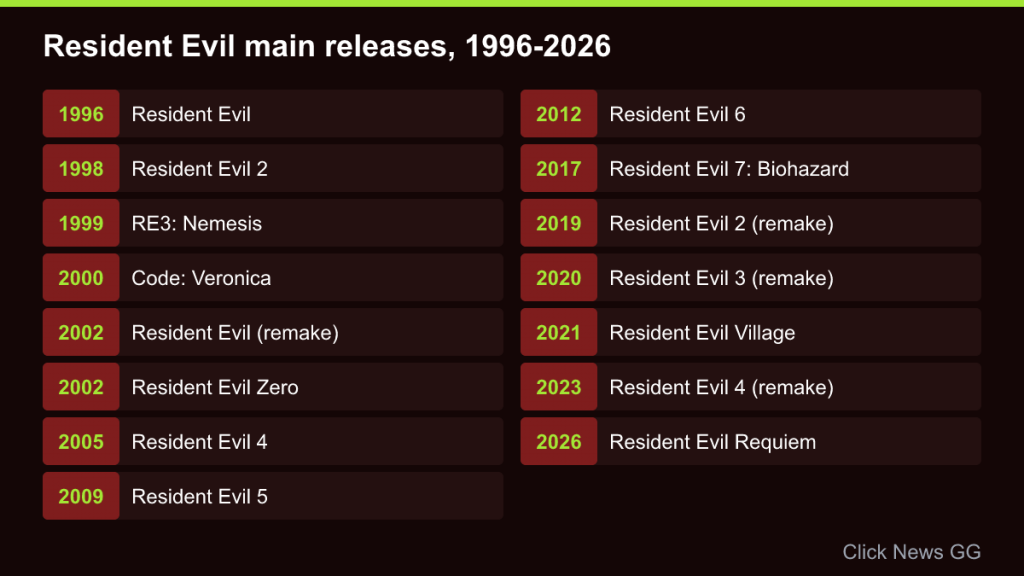
What thirty years of Resident Evil adds up to
Looking at the series as a whole, a pattern appears. Each time Resident Evil drifted too far in one direction, it corrected course. The action of Resident Evil 6 led to the stripped-back horror of Resident Evil 7; the success of that reboot gave Capcom the confidence to revisit its classics with modern controls. The remakes, in turn, have kept older stories alive for new players while letting the numbered games explore new characters.
That willingness to reinvent itself, while keeping recognizable ingredients such as item management, puzzles, stalker enemies and a cast of returning heroes, is why Resident Evil remains the reference point for horror games three decades after the first door creaked open in the Spencer Mansion.