How Sound Design Creates Fear in Horror Games
How horror games use silence, static, positional audio and dynamic music to scare you, with examples from Silent Hill, Dead Space and Alien: Isolation.
Try a simple experiment: play a horror game you know well with the sound muted. The monsters are still there, the corridors are still dark, but most of the fear drains away. Sound is the part of horror design players notice least and feel most. It tells you something is near before you can see it, fills silence with dread, and turns ordinary rooms into places you do not want to enter.
This explainer breaks down the main audio techniques horror games use, with examples from Silent Hill, Dead Space, Alien: Isolation, Resident Evil and others, and ends with practical tips for setting up your audio to get the most out of the genre.
Why Sound Matters More Than Graphics for Fear
Vision is precise but narrow: you only see what is in front of you. Hearing covers every direction at once, including behind you and through walls. Horror designers exploit that gap. A sound with no visible source creates a question, and the player’s imagination supplies the answer, usually something worse than what the game would show.
Sound also controls pacing. Music can rise to tell you danger is coming, cut out to make you wonder whether it has passed, or never arrive at all, leaving you unsure. Because audio often works below conscious attention, it can make players tense without them realizing why. In our guide on playing horror games if you scare easily, turning down audio is one of the simplest ways to make a game less intense, which says a lot about how much of the fear lives there.
Silence and Anticipation
The most underrated tool in horror audio is silence. A quiet corridor makes every small noise, a creak, a drip, a distant thud, feel significant. It also creates anticipation: when there is no music telling you what to feel, you stay alert and start listening for threats yourself.
Designers use silence in several ways:
- Before a scare: dropping ambient sound just before something happens heightens the shock.
- After a scare: sudden quiet after a loud encounter leaves you wondering whether it is really over.
- As environment: some spaces are deliberately quiet so that your own footsteps become unnerving.
Dead Space (2008) used a striking version of this. In zero-gravity and vacuum areas, the sound team muted and muffled outside sound and emphasized noises from inside Isaac Clarke’s suit, such as his breathing. Losing the familiar soundscape makes those sections feel isolating and dangerous.
Diegetic Sound Cues: Static, Footsteps and Trackers
Diegetic sound comes from inside the game world: things the characters themselves would hear. Horror games often turn diegetic sounds into gameplay information, which makes them doubly effective, because you have to listen to survive.
Silent Hill’s radio
The most famous example is the pocket radio in Silent Hill (1999). It alerts Harry Mason to nearby creatures with bursts of static. In a town filled with fog, where you often cannot see far, that static becomes both warning and source of dread. It tells you something is close, but not exactly where or what. Players can switch the radio off, but most quickly learn they would rather know. Our Silent Hill series history covers how this and other ideas carried through the franchise.
Footsteps
Stalker enemies often announce themselves with footsteps. In the 2019 Resident Evil 2 remake, the Tyrant known as Mr. X follows the player through the police station, and the sound of his heavy steps through walls and floors becomes a constant pressure. You hear him long before you see him, which forces you to guess where he is and plan routes around him. We cover how this works as a design tool in our explainer on stalker enemies.
The motion tracker
In Alien: Isolation (2014), the motion tracker’s ping, taken from the films, signals movement nearby. It is information you depend on, but it also makes noise, and the xenomorph can hear the tracker when you are close. The creature itself hunts using sound, reacting to running footsteps and gunfire. That turns audio into a two-way system: you listen for the alien, and it listens for you.
Positional and Binaural Audio
Positional (or spatial) audio places sounds in 3D space around the player, so you can tell whether a noise is to your left, behind you, above or below. Good positional audio lets a game say “something is in the vents behind you” without any visual cue.
Binaural recording goes a step further. It records sound with microphones arranged to capture how human ears hear direction and distance, so on headphones, sounds can seem to come from specific points around your head.
A well-known example from narrative horror-adjacent games is Hellblade: Senua’s Sacrifice (2017) by Ninja Theory. The team used binaural recording for the voices that Senua hears, capturing the 3D position of sound so voices seem closer or farther depending on where the actor stood during recording. Ninja Theory worked with academics and people with lived experience of hearing voices during development. The game won Best Audio Design at The Game Awards 2017 and the Audio Achievement award at the British Academy Games Awards, and many reviewers highlighted how powerful the voices were on headphones.
Music: Yamaoka’s Industrial Scores and Dynamic Soundtracks
Akira Yamaoka and Silent Hill
For Silent Hill, Akira Yamaoka was the sound director, responsible for the soundtrack, sound effects and audio mastering. He chose industrial music to give the game “a cold, rusty feel,” mixing it with dark ambient textures, and has cited Angelo Badalamenti, composer of Twin Peaks, as an influence. When he first presented some of his compositions, staff reportedly mistook the noise for a bug in the game. That reaction captures exactly why it works: the sound is unsettling because it does not behave like normal game music.

Silent Hill’s audio blurs the line between score and sound effect. Metallic scraping, distorted rhythms and droning noise feel like they could be coming from the world itself, which makes it hard to tell what is music and what is a threat.
Dynamic music and Dead Space’s Fear Emitters
Many horror games use dynamic music, which changes in response to gameplay. Rather than a fixed track, layers fade in and out as danger approaches or recedes.
Dead Space’s sound team, led by audio director Don Veca, built a tool called Fear Emitters, which adjusted music and sound-effect volume based on the player’s distance from threats or key events. The closer you got to danger, the more the audio intensified. The team also built tools to layer randomized sounds and place effects in specific areas. Veca even used recordings of a Bay Area Rapid Transit train for one enemy-free area, which creator Glen Schofield called a “horrible sound,” exactly the effect intended.
Dead Space’s audio was widely recognized. It won the Game Developers Choice Award for Audio, BAFTA awards for Use of Audio and Original Score, and the D.I.C.E. Award for Outstanding Achievement in Sound Design.
Safe-room themes
Music can also reassure. Classic Resident Evil games are known for calm, melancholy safe-room themes that signal a moment of rest. The contrast makes the return to danger sharper, and many fans remember those themes vividly years later.
Awards and Recognition for Horror Audio
Horror games have a strong record at audio awards, which reflects how central sound is to the genre:
| Game | Notable audio recognition |
|---|---|
| Dead Space (2008) | Game Developers Choice Award for Audio; BAFTA Use of Audio and Original Score; D.I.C.E. Outstanding Achievement in Sound Design |
| Alien: Isolation (2014) | Game Developers Choice Award for Best Audio (2015); BAFTA Audio Achievement |
| Hellblade: Senua’s Sacrifice (2017) | The Game Awards Best Audio Design; BAFTA Audio Achievement |
Silent Hill’s audio, too, was praised at release. Reviewers described its ambient music as “engrossing” and said the sound and music “effectively set players on edge,” even while criticizing the voice acting.
Common Horror Audio Techniques at a Glance
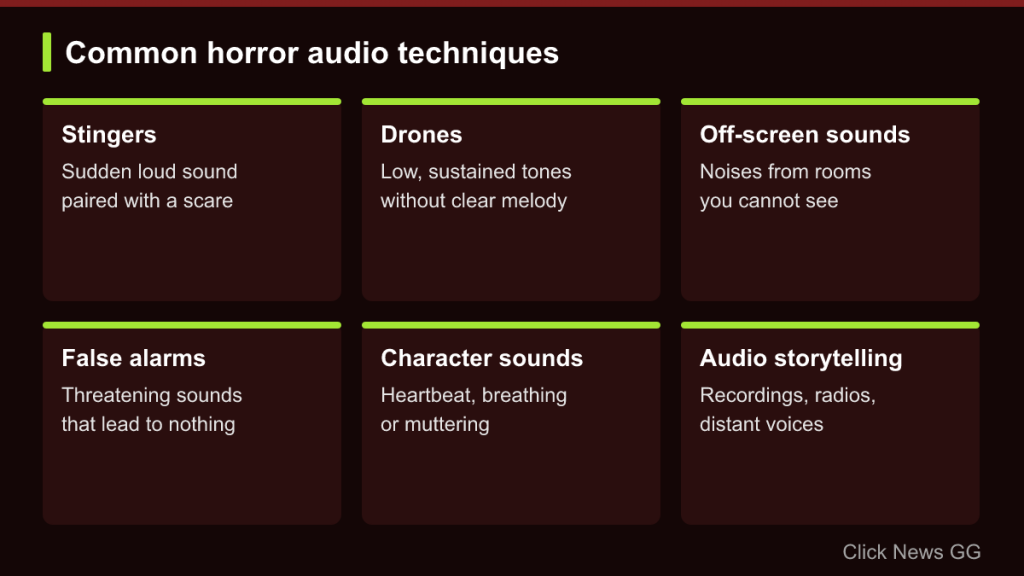
- Stingers: sudden loud sounds paired with a scare. Effective, but overuse makes them feel cheap.
- Drones: low, sustained tones that create unease without obvious melody.
- Off-screen sounds: noises from rooms you cannot see, which make you imagine threats.
- False alarms: sounds that seem threatening but lead to nothing, keeping you on edge.
- Character sounds: heartbeat, heavy breathing or muttering from the protagonist that reflect stress.
- Environmental storytelling through audio: recordings, radios and distant voices that reveal what happened before you arrived.
Tips: Setting Up Your Audio for Horror Games
- Use headphones if you can. They make positional audio far more precise, which matters in games where hearing an enemy’s location is part of the gameplay. Over-ear headphones are usually better for comfort in long sessions.
- Check the game’s audio options. Many games offer presets for headphones, TV speakers or home theater systems. Choose the one that matches your setup.
- Avoid aggressive “night mode” compression if you want the full effect. Dynamic range compression flattens the difference between quiet and loud sounds, which makes silence less tense and scares less sharp. If you find a game too intense, though, compression is a handy way to soften it.
- Balance music, effects and voice. If dialogue is hard to hear, raise voice volume rather than overall volume, so you are not blasted by stingers.
- Keep the volume comfortable. You do not need it loud to be effective; a moderate level in a quiet room is enough.
- Turn on subtitles and sound cues if needed. Many modern games offer subtitles for important sounds or visual indicators, which help players who are hard of hearing or playing quietly.
- Play somewhere quiet. Background noise masks the subtle cues that horror relies on.
Listening as Survival
The best horror sound design does two jobs at once. It makes you afraid, and it teaches you how to survive. The static of Silent Hill’s radio, the footsteps of Mr. X, the ping of a motion tracker and the silence of a vacuum are all atmosphere and information in one. Once you start listening for how a horror game uses sound, you will notice how often your fear starts in your ears long before anything appears on screen.