Why Resident Evil 4 Changed Horror Games: The Legacy Explained
How Resident Evil 4's camera, aiming and enemy reactions reshaped action and horror games, and why fans still argue about what it did to survival horror.
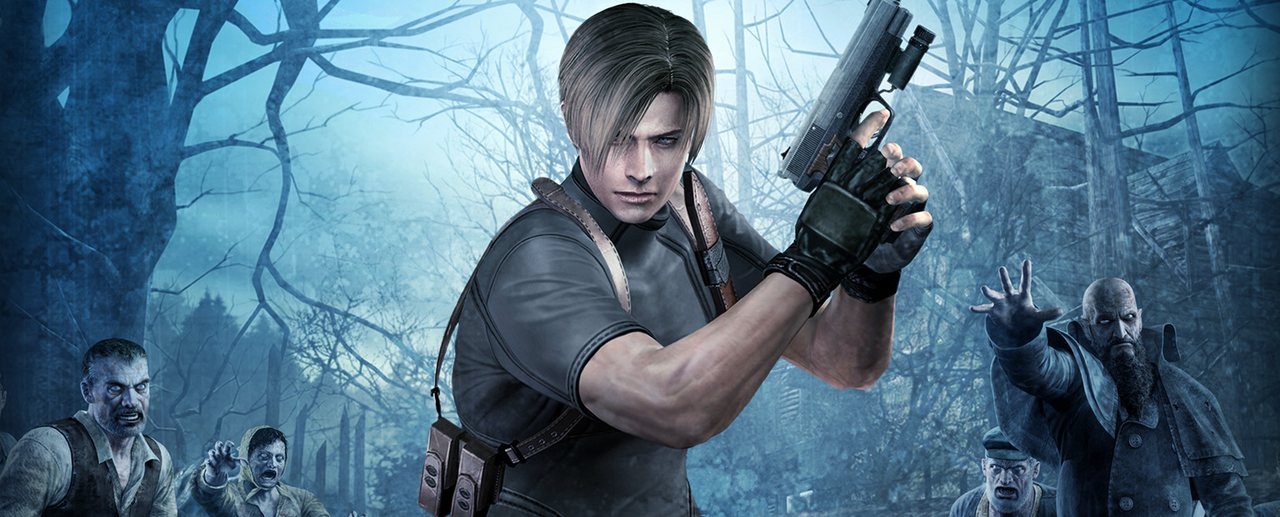
Some games are good. A few change what everyone else makes. Resident Evil 4, released on the Nintendo GameCube on January 11, 2005, belongs firmly in the second group. Its over-the-shoulder camera became the default for third-person games, its enemies reacted to where you shot them, and its pacing showed that a horror game could also be a relentless action set-piece machine. It is also one of the most argued-about games in horror history, because the same changes that made it a landmark pulled Resident Evil away from the slow, fragile survival horror that defined the first three games.
This explainer covers what Resident Evil 4 actually changed, the long development that produced it, its influence on games like Dead Space and Gears of War, the “is it still horror?” debate, and how the 2023 remake revisited it.
A Troubled Development: Four Versions Before the Final Game
Resident Evil 4 is famous for how many times it was restarted. Development began in 1999, originally targeting the PlayStation 2.
- The Kamiya version: Hideki Kamiya’s early take on the project grew so action-heavy and stylish that it was spun off into a different series altogether: Devil May Cry (2001).
- The “fog” version: a darker, more supernatural build with zombies, directed by Hiroshi Shibata and announced in 2002 as a GameCube exclusive.
- The “Hook Man” version: shown at E3 2003, with a haunted-building setting and hallucination-style horror. It was also scrapped.
- The final version: series creator Shinji Mikami took over as director, rewrote the story, and built the game that shipped in 2005, with Hiroyuki Kobayashi as producer.
That history explains a lot about the final game. After years of experiments that did not work, Mikami’s team chose to rethink the series’ foundations rather than refine the old formula. The result kept Resident Evil’s DNA, including scarce resources, item management and grotesque enemies, but replaced almost everything about how the player sees and moves through the world.
The Camera That Changed Third-Person Games
To understand why Resident Evil 4 mattered, remember how the earlier games played. As covered in our Resident Evil series history, the originals used fixed camera angles over pre-rendered backgrounds and “tank” controls. You often could not see what was attacking you, and aiming meant picking a direction and hoping auto-aim helped.
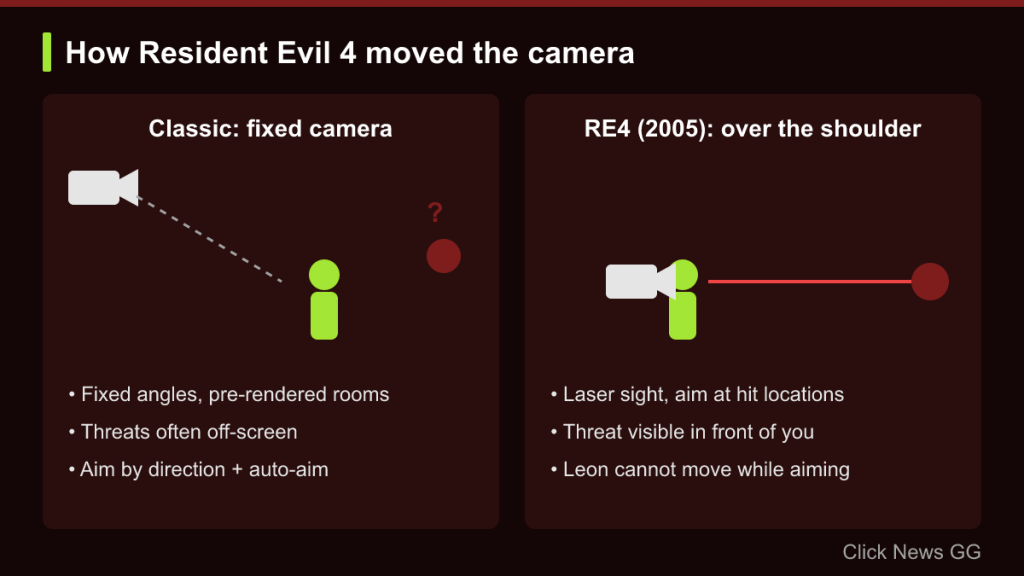
Resident Evil 4 placed the camera just behind and over the shoulder of Leon S. Kennedy. When you aimed, the view tightened and a laser sight appeared on the weapon instead of a crosshair. This did several things at once:
- Precision: you could choose exactly where to shoot, which mattered because enemies reacted to hit locations.
- Visible threat: enemies were in front of you and approaching, so tension came from crowds closing in rather than from hidden angles.
- A body in the world: keeping Leon on screen made the player feel physically present in the space, not watching from a security camera.
The trade-off was deliberate: Leon could not move while aiming. You had to plant your feet, line up a shot and trust your positioning. That restriction kept a sense of vulnerability, even though the player was far more capable than in earlier entries.
Enemies That Reacted, Not Just Absorbed Damage
Classic Resident Evil zombies were mostly bullet sponges. Resident Evil 4 replaced them with the Ganados, infected villagers who talk, use tools, open doors, climb ladders and coordinate. More importantly, they respond to where you hit them:
- Shoot a Ganado in the leg and it stumbles or drops to one knee.
- Shoot it in the arm and it may drop its weapon.
- Stagger it and a context-sensitive melee prompt appears, letting Leon kick or suplex nearby enemies.
This locational damage system turned every encounter into a series of small decisions: stun the one in front, kick to knock back a group, save ammo by using melee. It made combat expressive and readable, and almost every third-person action game since has borrowed some version of it.
Contextual actions and quick-time events
Resident Evil 4 also used context-sensitive buttons heavily. One button handled jumping through windows, kicking down ladders, climbing and melee depending on the situation. It added quick-time events (QTEs) to cutscenes and boss fights, where a sudden button prompt decides whether Leon survives. Some of these, such as the knife fight with Krauser, became infamous. QTEs spread rapidly through action games afterwards, for better or worse.
Scarcity Reinvented: The Attache Case and the Merchant
Resident Evil 4 did not drop resource management; it changed the flavor. The old item boxes and tiny inventories gave way to the attache case, a grid where items take up different amounts of space and must be arranged like a puzzle. Ammo and health remained limited, but enemies dropped supplies more generously, and money could be spent at the Merchant, a cloaked trader who sells and upgrades weapons.
That shift moved the game’s tension from “do I have enough bullets to survive?” towards “how do I spend what I have most efficiently?” It is a different kind of pressure, and we compare it with other approaches in our explainer on resource scarcity in survival horror. The attache case in particular became one of the most imitated inventory designs in the genre.
The Influence: Dead Space, Gears of War and Beyond
Resident Evil 4 was a critical and commercial triumph. The GameCube and PlayStation 2 versions scored 96 out of 100 on Metacritic and won numerous Game of the Year awards. But its real legacy is in how other games were built.
Gears of War and the over-the-shoulder standard
The close third-person camera became standard across the industry in the following years. Gears of War (2006) and The Last of Us (2013) are among the games commonly cited as following Resident Evil 4’s camera model, and today it is hard to find a third-person action game that does not use some variation of it.
Dead Space
The clearest horror descendant is Dead Space (2008). According to accounts of its development, creator Glen Schofield’s concept drew on Resident Evil 4 and the Silent Hill series, and he often described the project as “Resident Evil in space.” Co-designer Ben Wanat has said the team initially considered a new System Shock game, but when Resident Evil 4 came out, they decided to make their own property built around similar gameplay. Not everyone at the studio tells the story the same way: another Visceral developer, Michael Condrey, has credited System Shock as the main influence. Either way, Dead Space’s over-the-shoulder aiming and targeted dismemberment are recognizably in Resident Evil 4’s family. Schofield also wanted the player to keep moving, since stopping to shoot in Resident Evil 4 broke immersion for him. Our Dead Space series history covers how that grew into strategic dismemberment.
Resident Evil itself
The most direct influence was on Capcom’s own series. Resident Evil 5 (2009) and Resident Evil 6 (2012) pushed further into action, co-op and spectacle. Many fans felt this went too far, and the series’ later return to first-person horror with Resident Evil 7 (2017) was widely seen as a correction.
The Big Debate: Did Resident Evil 4 Kill Survival Horror?
Resident Evil 4 has a strange double reputation. It is regularly named among the most influential games ever made, and yet some critics and fans argue that its action focus moved the series, and mainstream horror in general, away from survival horror roots.
The case against it:
- Enemies are plentiful and the player is powerful, so fear is often replaced by adrenaline.
- Puzzles are lighter and less central than in the first three games.
- Its success led publishers to push horror franchises towards action, including Resident Evil’s own fifth and sixth entries.
The case for it:
- The opening village siege is still one of the most tense sequences in the genre, precisely because you are overwhelmed.
- Resource management never disappears; it just shifts from survival to optimization.
- Its grotesque bosses and unsettling regenerating enemies remain horror at heart.
A useful way to frame it: Resident Evil 4 is an action-horror game, and it is excellent at that. The problem was not the game itself but the industry’s attempt to copy its action without its pacing, which produced a wave of shooters with horror trappings. Many of the survival horror games made since, from Amnesia’s defenseless player to modern retro-style indies, define themselves partly in reaction against that shift.
Ports, Remasters and the 2023 Remake
Resident Evil 4 has been released on a remarkable number of platforms. The PlayStation 2 version (2005) added Separate Ways, a side story starring Ada Wong. Later versions included PC, Wii (with pointer aiming), mobile, HD remasters, Nintendo Switch and a VR version in 2021.
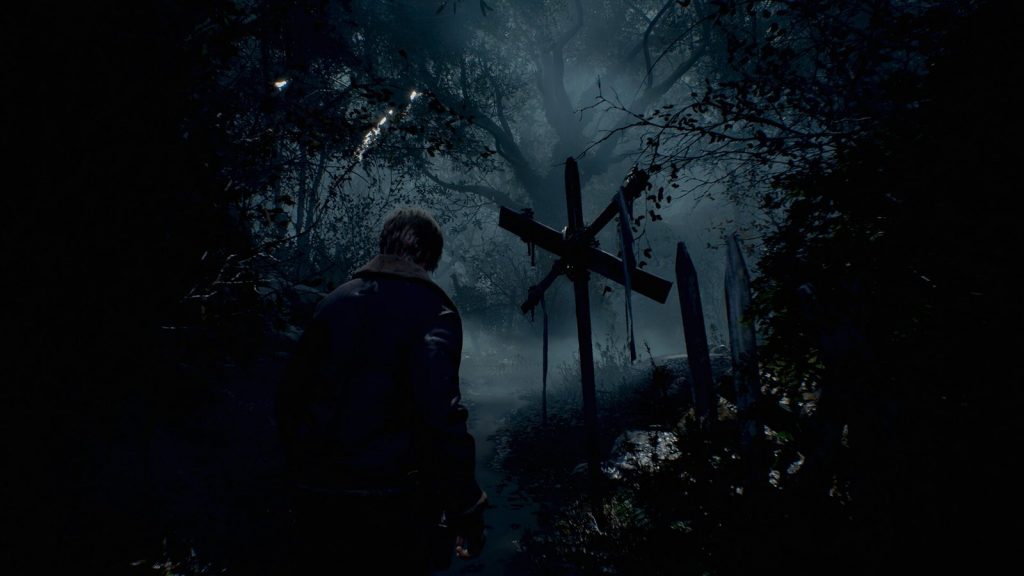
On March 24, 2023, Capcom released a full remake for PlayStation 4, PlayStation 5, Windows and Xbox Series X|S, directed by Yasuhiro Anpo and Kazunori Kadoi. It keeps the structure and spirit of the original while modernizing the controls:
- Leon can move while aiming and reloading.
- A knife parry lets him block and counter attacks, but knives now have durability and can break.
- Quick-time events were reduced; the Krauser knife fight became a fully playable battle.
- Ashley no longer has a health bar; she can be downed and must be revived, and she can be told to stay close or keep her distance.
- The Merchant offers new side requests alongside the main story.
The remake was widely acclaimed and nominated for Game of the Year at The Game Awards. The Separate Ways expansion followed on September 21, 2023. If you are deciding between versions, our guide to Resident Evil remakes vs. originals breaks down who should play which.
Why It Still Matters
Resident Evil 4’s legacy is not one feature but a philosophy: put the camera close, give enemies believable reactions, make every encounter a small tactical puzzle and never let the pace drop for long. Horror games still argue with that philosophy, either by embracing its action or by deliberately rejecting it. Either way, almost every third-person horror game made in the last two decades exists in its shadow.