The Best Story-Driven Adventure Games to Play
Twelve standout story-driven adventure games across eras and styles, from Monkey Island to Edith Finch, with who each one suits. Spoiler-free.
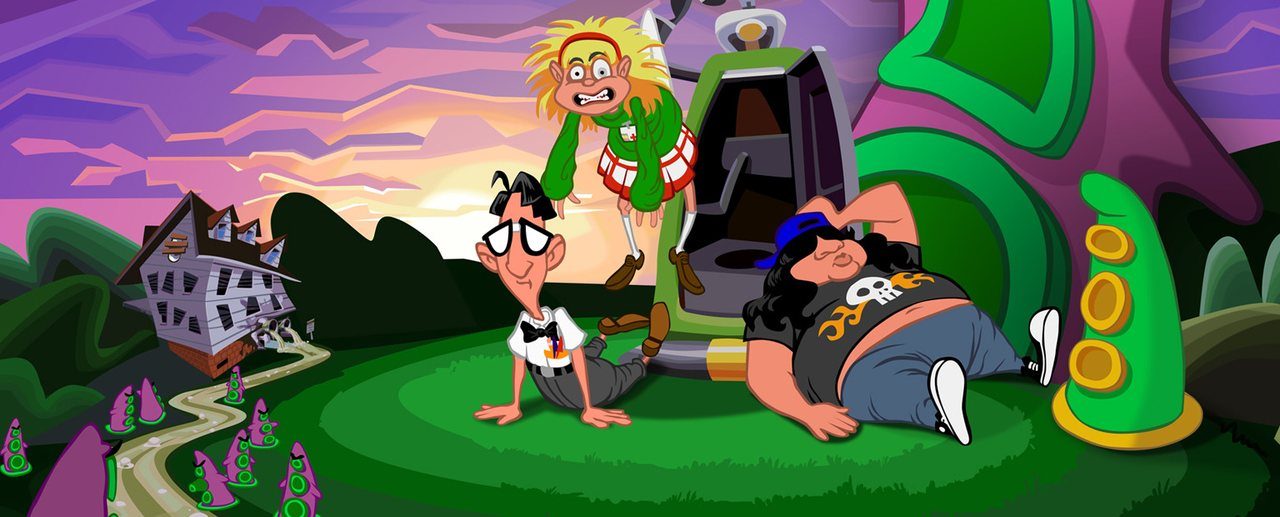
Story-driven adventure games come in many shapes. Some ask you to combine a rubber chicken with a pulley; others hand you a walkie-talkie and a forest; others still give you a police database and nothing else. What unites them is that the story is the point — not a wrapper around combat or progression systems.
This list picks twelve standouts from more than three decades of the genre, spread across point-and-click classics, walking simulators, interactive dramas and detective games. Each entry explains what makes it special and what kind of player it suits. Everything here is spoiler-free: we only describe the setup.
How We Chose
The goal is range rather than a strict ranking. We looked for games that are still playable on current or widely available platforms, that represent a distinct style of storytelling, and that hold up for new players today. The list is roughly chronological so you can see how the genre evolved. For background on the styles mentioned, see our explainers on walking simulators and the LucasArts adventure era.
A few qualities came up again and again while putting the list together. The best narrative games give the player a meaningful role in how the story unfolds, even when the plot itself is fixed: you might be solving the puzzle that moves events forward, choosing what a character says, or simply deciding where to look. They have a strong sense of place, whether that is a pirate island, a fire lookout tower or a crumbling family house. And they trust the player — to read between the lines, to remember details, to sit with an uncomfortable moment rather than skip it. Length matters less than you might think; several of the most memorable picks here can be finished in an afternoon or a single evening.
The Classic Point-and-Click Era
1. The Secret of Monkey Island (1990)
Developer: Lucasfilm Games. Designers: Ron Gilbert, Dave Grossman and Tim Schafer.

Guybrush Threepwood arrives on Mêlée Island wanting to become a pirate, and must pass a series of trials to prove himself — including sword duels won with insults rather than steel. It remains one of the funniest games ever made, and its puzzles are generally fair by the standards of its era. The 2009 Special Edition added hand-drawn art, voice acting and a hint system, and lets you switch between the new and original presentation.
Best for: anyone curious about where the comedy adventure began, and players who want laughs more than scares.
2. Gabriel Knight: Sins of the Fathers (1993)
Developer: Sierra On-Line. Designer: Jane Jensen.
A struggling novelist and bookshop owner in New Orleans starts researching a series of killings dubbed the “Voodoo Murders” for his next book, and finds himself pulled into something far older and darker. The CD-ROM version features Tim Curry as Gabriel. It is a mature, atmospheric mystery that blends history, the occult and romance. A 20th Anniversary Edition with new puzzles and a remastered soundtrack was released in 2014.
Best for: players who like supernatural mysteries and are patient with old-school puzzle design.
3. Grim Fandango (1998)
Developer: LucasArts. Director: Tim Schafer.
Set in a Land of the Dead styled like a retro-futuristic 1950s, it follows travel agent Manny Calavera as he guides a newly departed soul, Meche, on a four-year journey through the afterlife. Noir dialogue, Mexican folklore imagery and a big-band soundtrack make it one of the most stylish games of its decade. Double Fine’s 2015 remaster brought it to modern systems, with later versions for Switch and Xbox One.
Best for: fans of film noir and anyone who wants a story with genuine emotional weight wrapped in sharp comedy.
The Episodic and Indie Revival
4. The Walking Dead (2012)
Developer: Telltale Games.
Released in five episodes between April and November 2012, Telltale’s adaptation follows Lee Everett, a convicted criminal, and Clementine, a young girl he takes under his protection, through a zombie outbreak. Puzzles are light; the focus is on tense conversations and hard choices under time pressure. It won multiple Game of the Year awards and reshaped narrative game design for years afterwards.
Best for: players who want character drama and difficult decisions more than puzzles. Expect intense, sometimes upsetting content.
5. Kentucky Route Zero (2013–2020)
Developer: Cardboard Computer.
Released in five acts from January 2013 to January 2020, this “interactive screenplay” follows Conway, a delivery driver, and his dog as they search for a mysterious highway in Kentucky to make a final delivery for an antiques shop. It is dreamlike, literary and melancholy, with dialogue choices that shape tone and character rather than plot. The complete TV Edition is available on consoles.
Best for: readers of literary fiction and magical realism. Not for anyone who wants clear goals or puzzles.
6. Her Story (2015)
Developer: Sam Barlow.
You sit at an old desktop computer with a police database of 271 short video clips from interviews with a woman named Hannah. You search by keywords from the transcripts, piecing together what happened. There is no traditional ending screen; the story forms in your head. It is short, inventive and unlike anything else on this list. (We explain how its search-based deduction works in our guide to detective game mechanics.)
Best for: armchair detectives and fans of crime dramas who like making their own theories.
7. Life Is Strange (2015)
Developer: Dontnod Entertainment. Publisher: Square Enix.
Released episodically through 2015, it follows Max Caulfield, a photography student in Arcadia Bay, Oregon, who discovers she can rewind time. She uses the ability to investigate the disappearance of a student named Rachel Amber. The rewind mechanic lets you test choices before committing, which makes decisions feel more personal rather than less. A remastered version arrived in 2022.
Best for: fans of coming-of-age stories and teen drama with a supernatural twist. Handles some heavy themes.
8. Oxenfree (2016)
Developer: Night School Studio.
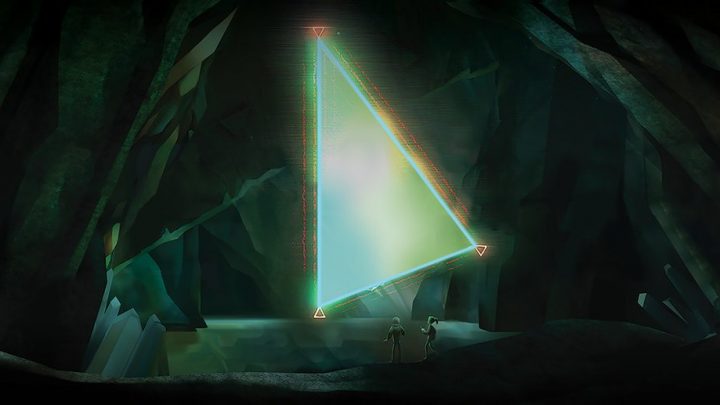
Teenager Alex travels with friends to an island for an overnight party, and things quickly turn supernatural. Its “walk and talk” dialogue system lets conversations play out in speech bubbles while you move, with two or three response options, so the story never stops for menus. It is spooky without being a horror game, making it a good bridge for players who want light chills. A sequel, Oxenfree II: Lost Signals, released in 2023.
Best for: players who enjoy naturalistic dialogue and a ghost story that is eerie rather than frightening.
9. Firewatch (2016)
Developer: Campo Santo. Publisher: Panic.
In 1989, Henry takes a job as a fire lookout in Wyoming’s Shoshone National Forest, where his only contact is his supervisor Delilah over a walkie-talkie. Over one summer, the two are drawn into a mystery. The relationship between the two leads, built entirely through radio conversation, is the heart of the game. It is available on PC, PlayStation, Xbox and Switch.
Best for: anyone who enjoys character-driven stories, beautiful landscapes and a slow-building mystery.
10. Thimbleweed Park (2017)
Developer: Terrible Toybox. Designers: Ron Gilbert and Gary Winnick.
Funded through Kickstarter, this is a deliberate return to the verb-based point-and-click style, which Gilbert described as feeling like “an undiscovered LucasArts adventure game you’ve never played before.” Set in 1987, it begins with two FBI agents investigating a murder in a strange small town, and grows into something much odder. It is widely available across PC, consoles and mobile.
Best for: veterans who miss the classics, and newcomers who want a modern game with an authentic retro feel.
11. What Remains of Edith Finch (2017)
Developer: Giant Sparrow. Publisher: Annapurna Interactive.
A 17-year-old returns to her family’s ancestral home on Orcas Island, Washington, after seven years away. Exploring the strange, stacked house, she uncovers the stories of her relatives, each told as a separate vignette with its own style and mechanics. It is one of the most celebrated narrative games of its generation and short enough to finish in an evening.
Best for: players who want something moving and inventive in a single sitting. Deals with death throughout, so be prepared for sad moments.
12. Return of the Obra Dinn (2018)
Developer: Lucas Pope.
Boarding a ghost ship with a pocket watch that reveals the moment of each death, you must determine the fate of all 60 people aboard. Its distinctive one-bit visual style and logical rigour make it a modern classic. Because correct fates are only confirmed in groups, guessing gets you nowhere — you have to reason it out.
Best for: puzzle lovers and note-takers who enjoy the satisfaction of genuine deduction.
Picking the Right Game for You
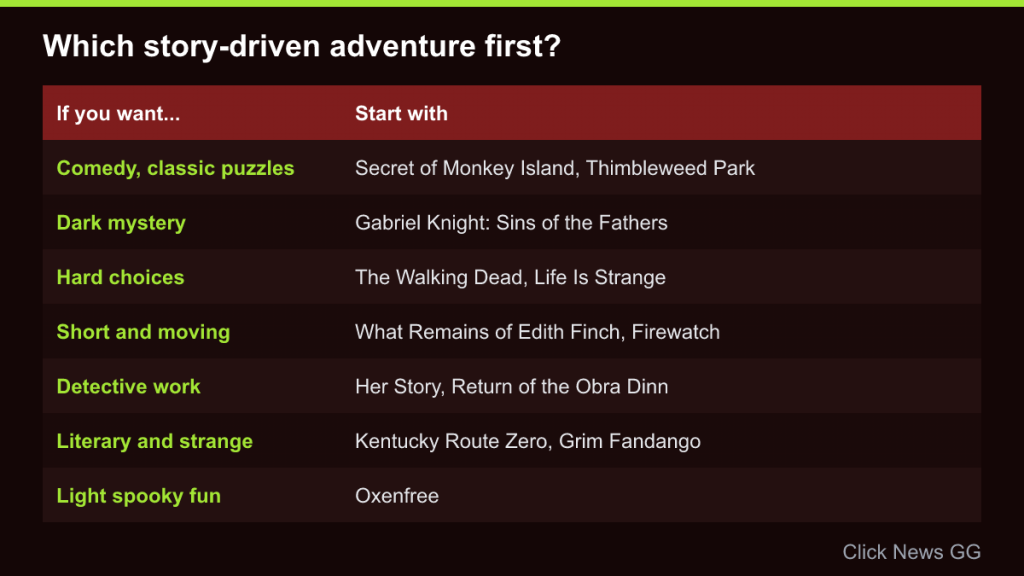
| If you want… | Start with |
|---|---|
| Comedy and classic puzzles | The Secret of Monkey Island, Thimbleweed Park |
| Dark mystery | Gabriel Knight: Sins of the Fathers |
| Hard choices and drama | The Walking Dead, Life Is Strange |
| Something short and moving | What Remains of Edith Finch, Firewatch |
| Detective work | Her Story, Return of the Obra Dinn |
| Literary and strange | Kentucky Route Zero, Grim Fandango |
| Light spooky fun | Oxenfree |
Tips for Getting the Most From Narrative Games
- Play at your own pace. Many of these games reward reading every note and listening to every conversation.
- Avoid spoilers before you start. Twists and reveals are a big part of the experience, especially in Her Story, Edith Finch and Firewatch.
- Use hints rather than full walkthroughs in the classic point-and-click games. A small nudge preserves the satisfaction of solving the rest yourself.
- Do not reload every choice in choice-driven games. Living with an imperfect decision is often more memorable than optimising.