Alien: Isolation Explained: Why the Xenomorph Still Scares Players
Why Creative Assembly's Alien: Isolation still terrifies: its 1979-inspired look, the xenomorph's AI, the motion tracker, and the sequel's status in 2026.

For decades, Alien games mostly made the same choice: hand the player a pulse rifle and send in waves of xenomorphs. Creative Assembly’s Alien: Isolation (2014) went back to the source. Inspired by Ridley Scott’s 1979 film rather than James Cameron’s action-heavy Aliens, it gives you one creature, no way to kill it, and a sprawling space station to survive in. More than a decade later, it is still one of the most frequently recommended horror games ever made, and in 2026 its sequel was finally revealed.
This explainer looks at what makes Alien: Isolation work: its faithful retro-futuristic world, the AI behind the xenomorph, its tools and crafting, how its reputation changed after launch, and the status of Alien: Isolation 2 as of October 2026. It avoids story spoilers beyond the opening setup.
The Setup: Amanda Ripley on Sevastopol
Alien: Isolation was developed by Creative Assembly, a British studio best known until then for the Total War strategy series, and published by Sega. It launched on October 7, 2014 for PlayStation 3, PlayStation 4, Windows, Xbox 360 and Xbox One.
The game is set fifteen years after the events of Alien. You play as Amanda Ripley, daughter of the film’s protagonist Ellen Ripley, who travels to the Sevastopol space station because it holds information about her missing mother. When she arrives, the station is in chaos, and something is hunting in its corridors.
The premise is deliberately small. There is no squad of marines and no army of aliens. Amanda is an engineer, not a soldier, and that vulnerability defines how the game plays.
Faithful to 1979: The Lo-Fi Future
The game’s most immediate achievement is its look and feel. Creative Assembly modeled it on the original film, and Fox supplied the studio with around three terabytes of production material from its archives. The team built a “lo-fi” 1970s vision of the future: chunky keyboards, CRT monitors, flickering lights, hissing doors and analog hardware.
This matters for more than nostalgia. A world full of clunky technology makes every action feel slower and more physical. Terminals take time to boot, doors take time to open, and your tools beep and crackle. That friction is perfect for horror, where every second spent interacting with the environment is a second the creature might find you.
The game also stuck with the film’s tone. The xenomorph is not a disposable enemy but a single, intelligent, almost mythical predator, which is exactly how it felt to audiences in 1979.
The Xenomorph’s AI: Why It Feels Alive
The heart of the game is the alien itself. It cannot be killed, nearly all of its attacks are instantly fatal, and it roams large parts of the station rather than appearing only in scripted scenes. What makes it terrifying is how believable its hunting feels.
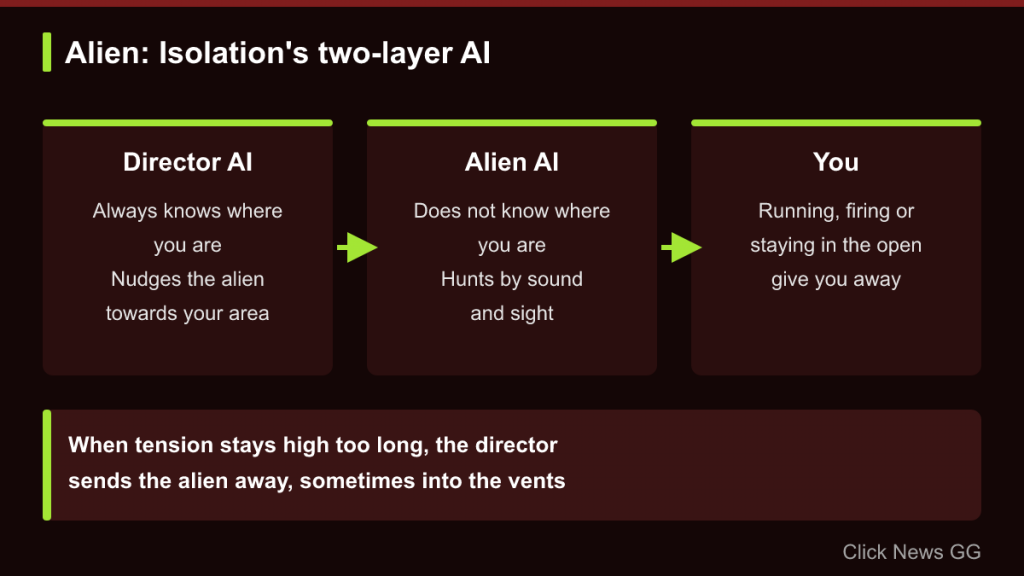
As described in detail in our explainer on stalker enemies in horror games, the creature runs on a two-layer system:
- A director AI always knows where the player is and periodically nudges the alien towards their general area.
- The alien AI does not know where the player is and must find them using sound and sight.
The result is a monster that is always nearby but never omniscient. When it catches you, you usually know why: you ran when you should have walked, fired a weapon, or stayed in the open too long. The director also tracks how much pressure the player is under and sends the alien away, sometimes into the vents, when tension has stayed high too long. That rhythm of approach and retreat stops the experience from becoming exhausting.
Parts of the alien’s behavior also unlock as the campaign progresses, so it seems to learn: hiding spots that worked early become riskier later. That illusion of adaptation is one reason players describe the creature as feeling alive.
Tools of Survival: Motion Tracker, Hiding and Crafting
Alien: Isolation is a first-person stealth game. Amanda’s main tools are information and distraction rather than firepower.
The motion tracker
Taken straight from the films, the motion tracker shows movement nearby with an iconic pinging sound. It is essential, but it comes with a cost: using it pulls your focus to a small screen, and its noise can give away your position when the alien is close. On the hardest difficulty, Nightmare, the tracker becomes unreliable and the mini-map is removed.
Hiding
Amanda can hide in lockers and under tables, desks and beds. Lockers are not foolproof. When the alien investigates, you have to lean back and hold your breath, and staying hidden too long or in the same place too often can still get you caught.
Crafting and distraction
Scavenged components let Amanda craft items such as noisemakers, which lure the creature away, and molotov cocktails. Fire is especially valuable: it cannot kill the xenomorph, but it can make it retreat. Later tools give more options, but none of them turn the game into a shooter. The alien is something you manage, not something you beat.
Other threats
The alien is not the only danger. Hostile human survivors and the station’s androids add other pressures, and they also react to noise. A careless fight with a human can attract the creature, turning a manageable situation into a disaster.
Saving: The Three-Second Wait
Alien: Isolation’s save system has become almost as famous as its monster. There is no constant autosave to lean on in the way modern players expect. Instead, you save manually at save stations by inserting Amanda’s access card, and there is a short pause of about three seconds before the save completes. During that wait, you are vulnerable.
It is a small detail with a big effect. Reaching a save station feels like relief, but you still have to stand still in the open, listening. If you die, you return to your last manual save, which can mean losing a long stretch of progress. We cover how this compares with typewriters and checkpoints in our guide to horror game save systems.
Initial Reception vs. Later Reputation
At launch, Alien: Isolation received generally favorable reviews, with Metacritic scores ranging from the high 70s to low 80s depending on platform. Critics praised its atmosphere, art direction, sound design and the alien’s AI. The main complaints were that it was too long, that the constant tension became repetitive, and that the supporting characters were underdeveloped. Some reviewers also criticized trial-and-error sections and long gaps between save points.
The game nonetheless found its audience. It sold more than 2.1 million copies by spring 2015 and won awards for its sound, including Best Audio at the 2015 Game Developers Choice Awards and an Audio Achievement BAFTA.
Over time its reputation rose further. As more players discovered it through sales and later ports, it became a fixture on lists of the best horror games and a reference point for discussions of enemy AI. Many of the criticisms, especially length and repetition, are still debated, but the core experience of being hunted by a single intelligent creature has rarely been matched.
DLC and ports
Two downloadable missions, Crew Expendable and Last Survivor, recreate scenes from the 1979 film and reunite members of its original cast. Five Survivor Mode packs added challenge maps. The game later reached Linux and macOS (2015), Nintendo Switch (2019), Android and iOS (2021), and Amazon Luna (2021).
Why It Still Scares Players
Several design choices explain why the game has aged so well:
- One enemy, done right. Focusing on a single creature lets every encounter carry weight.
- Fair but relentless AI. Because the alien hunts by sense rather than cheating, deaths feel earned, which makes avoiding them more satisfying.
- Sound as gameplay. The creature’s footsteps, vent noises and the motion tracker’s pings are both atmosphere and information. Headphones change the experience dramatically.
- No escape through power. You never get strong enough to stop being afraid. Even late-game tools only buy time.
- A believable world. The analog, lived-in station grounds the horror in a place that feels real.
It is also a landmark for stealth horror more broadly. If you enjoyed the run-and-hide styles described in our horror subgenres explainer, Alien: Isolation is a natural next step, with a smarter enemy than most.
Tips for New Players
- Walk, do not run. Running is loud. Crouch-walk whenever the alien could be nearby.
- Use the tracker sparingly. Check it, then put it away so you can see your surroundings.
- Do not live in lockers. Hiding works, but staying put too long can be riskier than moving.
- Save at every station you pass after checking it is quiet.
- Treat fire as an emergency button. Save it for moments when the creature has already found you.
- Avoid fights with humans. Gunfire draws the alien.
- Pick your difficulty honestly. Lower difficulties still deliver the atmosphere with less punishment.
Alien: Isolation 2: Status as of October 2026
On October 7, 2024, the game’s tenth anniversary, Creative Assembly announced that a sequel was in early development. After a teaser in April 2026, Alien: Isolation 2 was formally revealed with a trailer at Summer Game Fest in June 2026. Reports from the reveal list PlayStation 5, Xbox Series X|S, PC via Steam and Nintendo Switch 2 as platforms, and the game follows a new protagonist who avoids confrontation, hiding and fleeing rather than fighting the creature.
As of October 2026, no release date has been announced. Until Sega and Creative Assembly share more, anything beyond the official reveal, including story details, setting specifics and gameplay changes, should be treated as unconfirmed.