Stalker Enemies Explained: Nemesis, Mr. X, the Alien and Other Pursuers
How horror games build persistent pursuers, from Clock Tower's Scissorman to Nemesis, Mr. X and the xenomorph, plus tips for surviving them.
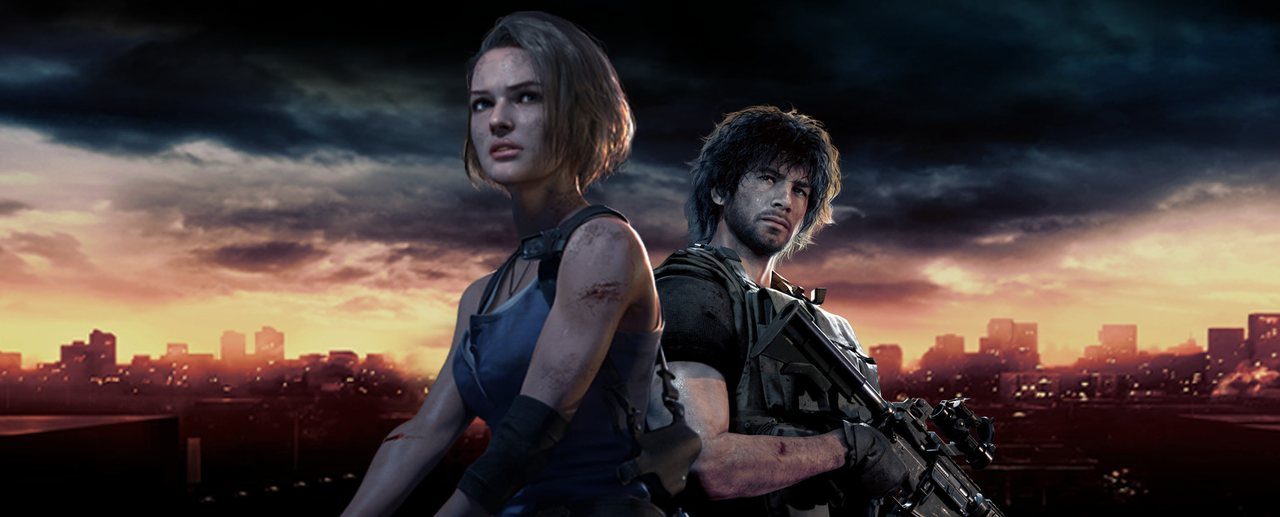
Most horror enemies wait for you. They sit in a room, shamble down a corridor or spring out of a closet, and once you deal with them, that space is safe. Stalker enemies break that contract. They follow you between rooms, reappear when you least expect them, and often cannot be killed at all. Their footsteps become the soundtrack of the game, and every decision you make, from which route to take to when to open the map, is shaped by the fear that they are getting closer.
This explainer covers how stalker enemies work, the difference between scripted and systemic pursuers, how Alien: Isolation’s two-layer AI turned the idea into a full game, and the most famous stalkers in horror history. It finishes with practical tips for surviving them. Light details about the enemies’ roles are discussed, but no major plot twists.
What Makes an Enemy a “Stalker”?
A stalker (also called a pursuer) is an enemy designed to hunt the player across a large part of the game rather than a single encounter. Most share a few traits:
- Persistence: they return repeatedly and can follow you from area to area.
- Resilience: they are unkillable, or can only be stunned or driven off temporarily.
- Presence: footsteps, music or sound cues announce them before you see them.
- Disruption: they interrupt exploration, puzzle-solving and backtracking, so even “safe” tasks become tense.
The design flips the usual power fantasy. Instead of clearing threats, you manage one. As our guide to horror subgenres explains, this is the heart of stealth and run-and-hide horror, but stalkers also appear in more combat-focused games, where they puncture the player’s growing confidence.
Scripted vs. Systemic Stalkers
Pursuers broadly come in two forms, and many games mix them.
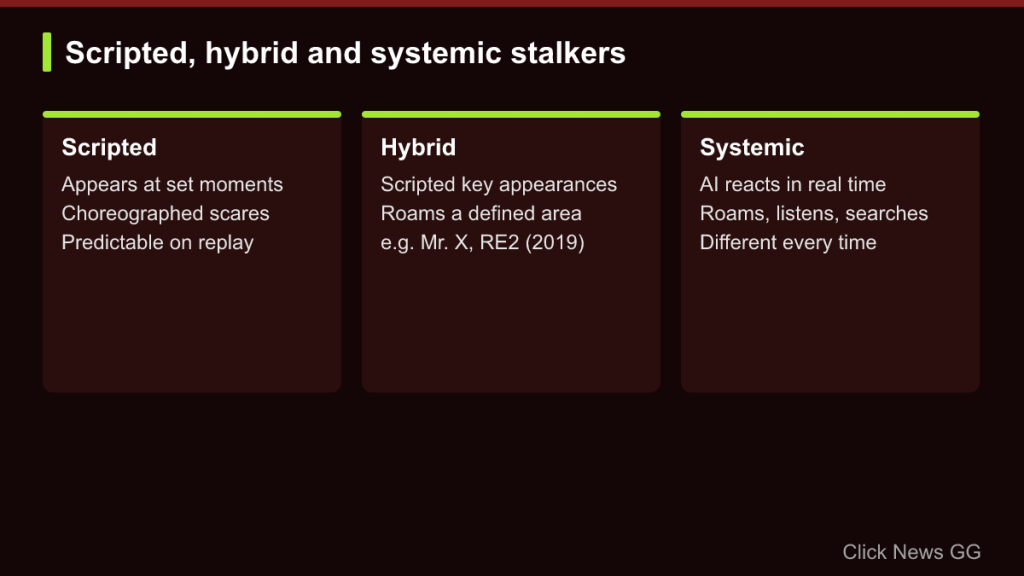
Scripted stalkers
A scripted stalker appears at predetermined moments. The designer decides when it bursts through a wall, how a chase plays out and where it ends. This allows for carefully choreographed scares and cinematic set-pieces, but on a second playthrough you know exactly when it is coming.
Systemic stalkers
A systemic stalker is driven by AI that reacts to the player in real time. It roams, listens, searches and responds to what you do, so encounters differ each time. This is harder to build and balance, but it can create a feeling of being genuinely hunted rather than following a script.
The hybrid approach
Most famous stalkers sit somewhere in between. They have scripted introductions and key appearances, plus systemic behavior that lets them roam a defined area and react to noise or line of sight. Mr. X in the 2019 Resident Evil 2 remake is a good example: his appearances are tied to story progress, but once he is active he moves through the police station on his own.
Clock Tower’s Scissorman: The Early Blueprint
One of the earliest influential stalkers comes from Clock Tower, a point-and-click survival horror game developed by Human Entertainment and released on the Super Famicom in Japan on September 14, 1995. Directed by Hifumi Kono and heavily inspired by Dario Argento’s film Phenomena, it follows Jennifer Simpson, an orphan trapped in a mansion with a killer called Scissorman, who carries a giant pair of shears.
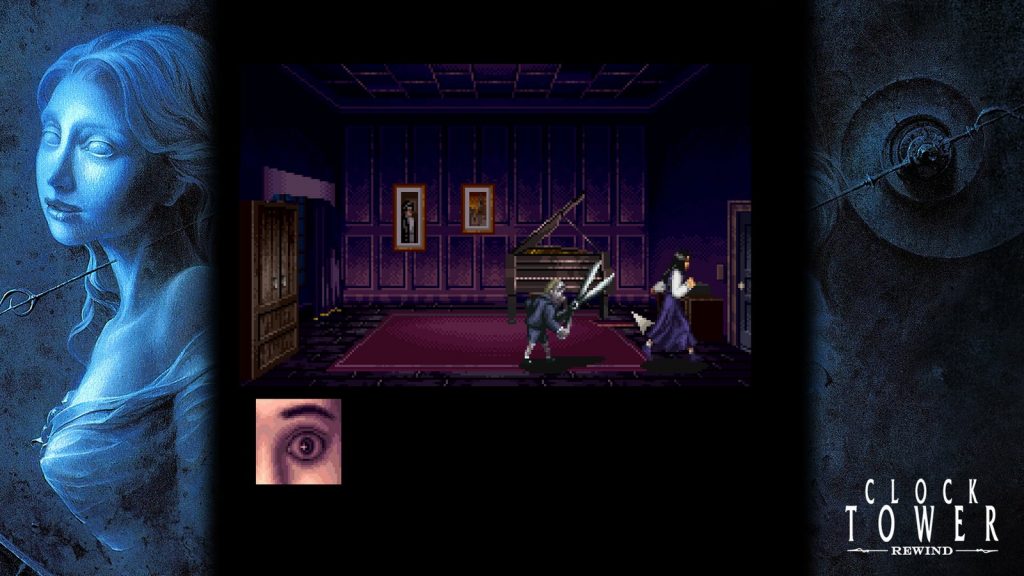
Clock Tower’s design contained most of the stalker template:
- Jennifer cannot fight back, so she must hide or use traps.
- Running drains her stamina, and she has to rest to recover.
- When Scissorman confronts her, the game enters “panic mode,” where she can be caught.
Because Clock Tower was only officially released in Japan for decades, many Western players knew it only by reputation until Clock Tower: Rewind arrived on modern consoles and PC in October 2024 as the first official release outside Japan. Its DNA is visible in the run-and-hide games that followed, including the Outlast series.
Nemesis: The Stalker as Headline Act
Resident Evil 3: Nemesis was released on the PlayStation in Japan in September 1999 and in North America that November. Its title character made the stalker a franchise centerpiece. Nemesis pursues Jill Valentine from one area of Raccoon City to the next and can be encountered repeatedly as a boss.
The original game used several ideas to keep Nemesis unpredictable:
- Some encounters are mandatory, while others depend on earlier choices.
- In some encounters you can choose to fight or simply run until he gives up.
- Even if you evade or defeat him, he keeps pursuing you later.
- Live selection moments ask you to choose between two actions under pressure, with penalties, including death, for hesitation or bad choices.
Nemesis showed how a pursuer could turn a familiar Resident Evil structure into something tense even for veterans. Our Resident Evil series history places it in the wider arc of the franchise.
Mr. X: Footsteps in the Police Station
The 2019 remake of Resident Evil 2, released on January 25, 2019, reinvented a stalker from the original game. The Tyrant, nicknamed Mr. X by fans, is a huge bioweapon in a trench coat and hat. In the remake he cannot be killed, only stunned or brought down temporarily, and he follows the player through the environment, with one key exception: he cannot enter safe rooms.
What made Mr. X so memorable was how he changed the Raccoon Police Department. Before his arrival, the station is a puzzle box you learn room by room. After he appears, every trip across the building becomes a risk. His heavy footsteps echo through walls, warning you he is near and making you guess where. Players learned to listen, plan routes, and use safe rooms as anchors, which ties stalker design closely to the save-room rhythm described in our explainer on how horror games handle saving.
Alien: Isolation’s Two-Layer AI
If Mr. X is the best-known hybrid stalker, the xenomorph in Creative Assembly’s Alien: Isolation (2014) is the best-known systemic one. It is a single creature that hunts the player across most of the game, and nearly all of its attacks are fatal.
A widely cited breakdown published by Game Developer, based on a talk and comments from Creative Assembly’s Andy Bray, explains that the creature runs on two layers of AI:
- The director (macro AI) always knows where the player is. It periodically sends the alien towards the player’s general area so the creature is never too far away.
- The alien (micro AI) does not get that information. It has to find the player itself using its senses: sound from footsteps, gunshots and the motion tracker at close range, and sight via short-range checks.
This split is what makes the alien feel fair but relentless. It is always nearby, but when it catches you, it is because it heard or saw you.
Menace and backing off
The director also tracks a “menace” gauge, which rises when the alien is close to the player, visible, or near on the motion tracker. When menace stays high for too long, the director pulls the alien back to neighboring areas or into the vents to give the player a breather. This is crucial: a stalker that never leaves becomes exhausting rather than scary.
Behaviors that unlock over time
Parts of the alien’s behavior tree start locked and unlock as the campaign progresses, such as searching more thoroughly. This creates the impression that it is learning your tricks. According to the same analysis, unlocks were not triggered by player deaths, which would have felt unfair. Andy Bray has described the design goal as a kind of “psychopathic serendipity,” where the alien always seems to be in the right place at the right time.
Jack Baker, Lady Dimitrescu and the Modern Stalker
Capcom’s first-person Resident Evil games kept the idea alive. In Resident Evil 7: Biohazard (2017), Ethan Winters is repeatedly confronted by Jack Baker, the head of the family holding him captive, who can regenerate from fatal wounds. Jack’s appearances turn the Baker house into a cat-and-mouse space where hiding and route planning matter more than firepower.
Resident Evil Village (2021) brought Lady Alcina Dimitrescu, a towering vampiric aristocrat whose castle is one of the game’s most memorable areas. She became so popular before release that she was heavily featured in marketing and later won a D.I.C.E. Award for Outstanding Achievement in Character. Both characters show how a stalker can also be a personality, with dialogue, motive and presence, rather than just an unstoppable threat.
Why Stalkers Work, and When They Do Not
Stalker enemies succeed because they attack the player’s sense of control:
- Anticipation: sound cues create dread before any confrontation.
- Uncertainty: you never know exactly where they are, so every decision feels risky.
- Disruption: they turn routine tasks like backtracking into tense missions.
- Relief: escaping one, or reaching a safe room, delivers a release that makes the next encounter sharper.
They fail when they become predictable or simply annoying. A stalker that appears too often stops being scary and becomes an obstacle. One that is too easy to outwit loses its menace. Good designs, like Alien: Isolation’s menace gauge, deliberately give players breathing room so the fear can rebuild.
Tips for Dealing With Stalker Enemies
- Listen first. Footsteps, music changes and vent noises usually tell you where the stalker is. Headphones help a lot.
- Learn safe zones. In the Resident Evil 2 remake, Mr. X cannot enter safe rooms. Knowing where these are gives you somewhere to reset.
- Plan routes before moving. Check the map in a safe spot, then move with purpose. Hesitating in corridors is how you get caught.
- Use loops. Many stalkers are slower around corners or furniture. Looping around a table or through a circuit of rooms can buy time.
- Do not waste resources. When a stalker cannot be killed, ammo spent on it is usually ammo lost. Stun only when you need to get past.
- Make less noise. In systemic games like Alien: Isolation, walking and crouching instead of running keeps you off the creature’s radar.
- Accept some deaths. Stalker sections often involve learning. If a chase goes wrong, treat it as information for the next attempt.
From Clock Tower’s scissors to the xenomorph’s tail, stalker enemies remain one of horror’s most reliable tools because they make the whole map dangerous, not just the next room. The best of them prove that the scariest thing in a horror game is not what jumps out at you, but what you know is still looking.