Sierra On-Line’s Adventure Games: King’s Quest, Gabriel Knight and Phantasmagoria
The history of Sierra On-Line's adventure games: Ken and Roberta Williams, Mystery House, King's Quest, Space Quest, Gabriel Knight and Phantasmagoria.
Before LucasArts made the adventure game friendly, Sierra On-Line made it famous. For roughly two decades, the company founded by Ken and Roberta Williams produced some of the best-selling and most ambitious adventure games ever made: fairy-tale quests, sci-fi comedies, police procedurals, role-playing hybrids, Gothic mysteries and a horror game shipped on seven CDs. Sierra’s games could also be famously unforgiving. This is the story of the studio, its series and the design philosophy that set it apart.
From a Kitchen Table to Oakhurst
Ken and Roberta Williams founded On-Line Systems in 1979, reportedly in Simi Valley, California. In May 1980 they released Mystery House by mail order. Designed by Roberta, it is often cited as the first computer adventure game with graphics — simple line drawings accompanying a text parser, at a time when adventure games were usually pure text.
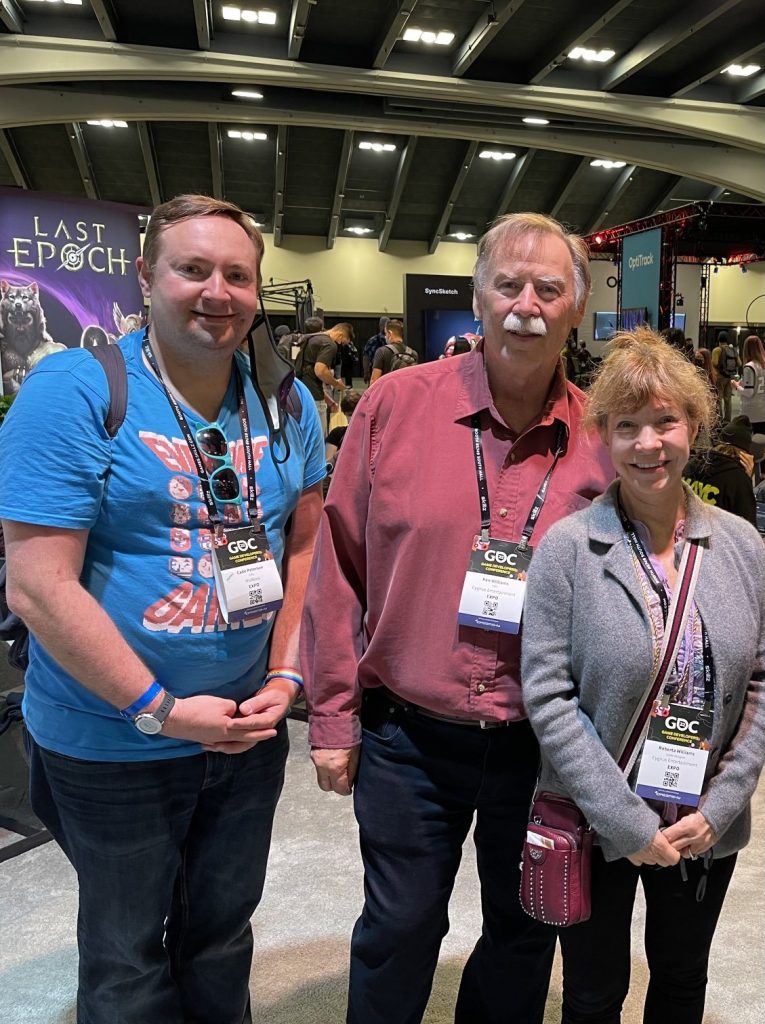
In 1982 the company was renamed Sierra On-Line and moved to Oakhurst, California, near Yosemite. Its biggest breakthrough was two years away.
King’s Quest and the AGI Engine (1984)
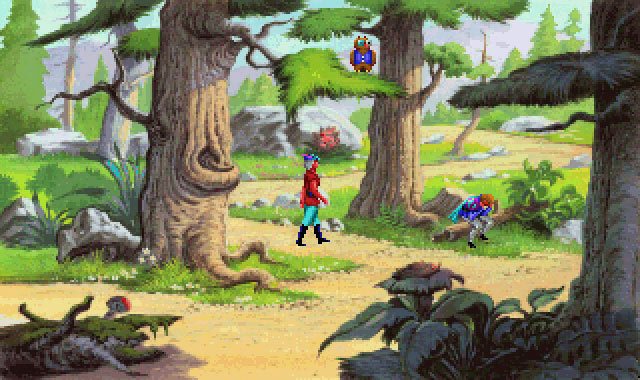
IBM wanted a showcase title for its new home computer, the PCjr, and Sierra delivered King’s Quest: Quest for the Crown in 1984. Designed by Roberta Williams, it followed Sir Graham, a knight of the kingdom of Daventry, , whom the dying King Edward sends on a quest that will decide the kingdom’s future.
What made it remarkable was its presentation. Instead of static pictures, King’s Quest showed an animated character you could walk around the screen, moving in front of and behind objects in a “pseudo-3D” space. Commands were still typed into a text parser. The PCjr flopped commercially, but the game became a best-seller on other systems.
The technology behind it, the Adventure Game Interpreter (AGI), became Sierra’s engine for the rest of the decade. Fourteen AGI games were published between 1984 and 1989, launching several of Sierra’s most important series.
Sierra’s Great Series
King’s Quest (1984–1998)
Roberta Williams designed every King’s Quest game from 1984 to 1998. The series followed Graham’s royal family across eight main games, with each entry often highlighting a different family member: Graham himself, his son Alexander, his daughter Rosella and his wife Valanice. King’s Quest VIII: Mask of Eternity (1998) broke with tradition as a real-time 3D action adventure starring a new hero, Connor, and underperformed. An episodic reboot by The Odd Gentlemen followed in 2015–2016.
Space Quest (1986–1995)
Created by Mark Crowe and Scott Murphy, who called themselves the “Two Guys from Andromeda”, Space Quest starred Roger Wilco, a clumsy janitor who keeps saving the universe more or less by accident. The six games parodied Star Wars, Star Trek and pop culture with puns and farce. Death was frequent, but Murphy’s philosophy was that “if the player is gonna die or fail, they should at least get a laugh out of it.”
Police Quest (1987–1998)
Designed for its first three games by former police officer Jim Walls, Police Quest followed Sonny Bonds of the fictional town of Lytton, California. Its puzzles required following proper police procedure, making the first game the most realistic of Sierra’s late-1980s output. The series later evolved into the SWAT franchise.
Quest for Glory (1989–1998)
Husband-and-wife designers Lori Ann and Corey Cole created a hybrid of adventure and role-playing game. Originally titled Hero’s Quest, the series was renamed because Sierra had not secured the trademark, and Milton Bradley held one for an electronic version of the board game HeroQuest. Players chose to be a fighter, magic user or thief, and each class solved puzzles differently, with stats such as strength and agility improving through practice. (Because it is an RPG hybrid, we only mention it briefly here.)
SCI and the Move to Point-and-Click
In 1988, King’s Quest IV: The Perils of Rosella debuted the Sierra Creative Interpreter (SCI), a more sophisticated engine with an object-oriented scripting system, double the horizontal resolution of AGI (320×200 versus 160×200), support for more sound cards and, in later versions, a point-and-click interface that replaced the text parser. Because SCI required a more powerful computer, Sierra also released an AGI version of King’s Quest IV; the final AGI game, Manhunter 2: San Francisco, arrived in 1989.
SCI carried Sierra through its golden age in the early 1990s. The company went public in 1989 and moved its headquarters to Bellevue, Washington, in 1991, while the Oakhurst studio continued as a development site.
Gabriel Knight: Jane Jensen’s Gothic Mysteries
Jane Jensen created, directed and wrote Gabriel Knight: Sins of the Fathers (1993). A struggling novelist and bookshop owner in New Orleans researches the “Voodoo Murders” for his next book and is drawn into voodoo and his own family’s history as supernatural hunters. The CD-ROM version featured Tim Curry as Gabriel. Computer Gaming World’s Johnny L. Wilson wrote that its opening was “the first time I’ve actually experienced fear when viewing a computer game.”
The series continued with The Beast Within: A Gabriel Knight Mystery (1995), a full-motion video game featuring werewolves, and Gabriel Knight 3: Blood of the Sacred, Blood of the Damned (1999), a 3D game involving vampires. Gabriel’s assistant, Grace Nakimura, became a playable partner in the sequels. A 20th Anniversary Edition of the first game was released in 2014.
Phantasmagoria: Sierra Goes Full Horror
Roberta Williams’ most ambitious project was Phantasmagoria (August 1995), a point-and-click interactive film in which live actors, filmed against blue screen, were placed into 3D-rendered environments. It shipped on seven CDs. Novelist Adrienne Delaney, played by Victoria Morsell, moves into a haunted mansion, and things go very wrong. Williams explained her motivation: “I felt I had more to offer than fairy stories.”
The game was a commercial hit — Sierra’s best-selling computer game up to that point, eventually selling more than a million copies — and deeply controversial. Critics focused on its graphic violence and a sexual assault scene. CompUSA declined to stock it, it was refused classification in Australia, and it was spotlighted in US Senate hearings about software content. A sequel, Phantasmagoria: A Puzzle of Flesh (1996), was written and designed by Lorelei Shannon without Williams’ involvement.
Deaths and Dead Ends: Sierra vs. LucasArts
Sierra’s design reputation is inseparable from comparison with LucasArts (whose history we cover in our LucasArts article). The two companies took opposite approaches:
| Design aspect | Sierra | LucasArts |
|---|---|---|
| Player death | Frequent; often sudden | Rare or absent in most games |
| Dead ends | Possible: you could miss an item and be unable to finish | Designed to avoid them |
| Saving | Constant manual saving essential | Less critical |
| Tone | From fairy tale to horror to police procedural | Mostly comedy |
In Sierra games, you could walk off a cliff, eat the wrong thing or fail to pick up an object early in the game and only discover hours later that you could no longer win. Fans debate whether this was unfair or part of the tension. What is clear is that “save early, save often” became the habit of a generation of Sierra players. If these terms are new to you, our point-and-click beginner’s guide explains the basics.
The Fall of Sierra
The end came through corporate turmoil rather than creative exhaustion:
- 1996: CUC International acquired Sierra; the deal closed on July 24, 1996.
- 1998: CUC’s accounting fraud came to light after its merger into Cendant. Many founders, including Ken and Roberta Williams, eventually left. Cendant sold the software division to Havas in November 1998.
- February 22, 1999: a reorganisation known as “Chainsaw Monday” closed studios, including the Oakhurst-based Yosemite Entertainment, and cut about 250 jobs.
- 2000s: under Vivendi Universal, Sierra became a publishing label rather than an adventure studio. After Vivendi Games merged with Activision in July 2008, Sierra was shut down later that year.
- 2014: Activision revived the Sierra name as a publishing label.
How to Survive a Sierra Adventure
If you try one of the classics, a few habits make them far more enjoyable:
- Use multiple save slots. Save before anything that looks dangerous, and keep older saves in case you discover a dead end.
- Look at and pick up everything. Many dead ends come from missing a single object early on.
- Read death messages. In series like Space Quest, failure is part of the comedy, and the messages sometimes hint at what to do differently.
- Type precisely in parser games. In AGI-era titles, simple verb-noun commands such as “look tree” or “take key” work best.
- Keep notes and a map. Sierra’s worlds can be large, and remembering where you saw something saves a lot of wandering.
Playing Sierra’s Adventures Today
Several classic Sierra adventures have been re-released digitally over the years, and Gabriel Knight: Sins of the Fathers is available in its 2014 20th Anniversary Edition. Expect old-school design: save in multiple slots, explore thoroughly before leaving an area, and do not be ashamed to use a hint guide when a puzzle seems impossible. Sierra’s best games still offer something modern adventures rarely do — a real sense of danger in every room.
If you want a gentler introduction, the 2015–2016 King’s Quest reboot by The Odd Gentlemen reimagines Graham’s adventures for modern players. And if you are drawn to Sierra’s horror side, approach Phantasmagoria with care: its violence and its sexual assault scene were controversial in 1995 and remain disturbing today. Gabriel Knight: Sins of the Fathers is the better starting point for Sierra’s darker storytelling, and it also appears in our list of the best story-driven adventure games.