Life Is Strange Series History: Every Game in Order
Every Life Is Strange game in order, from Dontnod's 2015 original to Double Exposure and Reunion: developers, dates, protagonists and powers.
Spoiler note: this article avoids plot twists, but simply describing the premises of the later games (Double Exposure and Reunion) reveals which characters return. If you want to play the first game completely fresh, read only the first two sections for now.
Few narrative series have changed hands, heroes and formats as often as Life Is Strange. Over more than a decade it has moved from one developer to another, from episodic releases to full launches, and from a single small Oregon town to road trips, mountain towns and a university in Vermont. What has stayed constant is the formula: a young protagonist, a supernatural ability, everyday drama and choices that weigh heavily. This is every game in the series, in release order.
Who Makes Life Is Strange?
The series is published by Square Enix. It was created by the French studio Dontnod Entertainment, which developed the first game and Life Is Strange 2. The studio Deck Nine developed the prequel Before the Storm and has handled every main entry since True Colors. That split explains why the series sometimes feels like two parallel lines: Dontnod’s numbered games and Deck Nine’s games, which increasingly build on characters from the original.
Life Is Strange (2015)
Developer: Dontnod Entertainment. Released: in five episodes, January to October 2015.
Max Caulfield, a photography student, returns to her hometown of Arcadia Bay, Oregon, and discovers she can rewind time. She reconnects with her childhood friend Chloe Price and becomes drawn into the disappearance of a student named Rachel Amber.
The rewind power transformed how choices worked in adventure games. Instead of making a decision and living with it immediately, you can rewind, see the alternative and pick again — though consequences often surface episodes later, beyond rewind’s reach. The game’s mix of teen drama, mystery and indie-film atmosphere made it one of the most influential narrative games of its decade. A remastered version arrived in February 2022 as part of the Life Is Strange Remastered Collection.
Life Is Strange: Before the Storm (2017)
Developer: Deck Nine. Released: three episodes, August to December 2017.
A prequel set three years before the original, Before the Storm puts you in control of a 16-year-old Chloe Price and follows her relationship with Rachel Amber. Chloe has no rewind ability. Instead, the game introduces Backtalk, a conversational mechanic that lets Chloe argue her way out of tight situations — though it can also make things worse.
Because of the 2016–17 video game voice actor strike, Ashly Burch, who voiced Chloe in the original, did not voice her here; Rhianna DeVries, who also performed the character’s motion capture, took over. Burch returned for the bonus episode Farewell (March 2018), set in 2008, in which Max is playable.
The Awesome Adventures of Captain Spirit (2018)
Released free in June 2018, this short Dontnod demo follows Chris Eriksen, a boy who imagines himself as a superhero. It is set in the same world as Life Is Strange 2 and works as a taster for it. It is short and gentle, and a good way to sample the style at no cost.
Life Is Strange 2 (2018–2019)
Developer: Dontnod Entertainment. Released: five episodes, September 2018 to December 2019.
Dontnod’s sequel leaves Arcadia Bay and Max behind. Sean Diaz, 16, and his 9-year-old brother Daniel are Mexican-American brothers who go on the run from Seattle after a police shooting. Daniel develops telekinesis, but you play Sean, who cannot control it — you can only influence how Daniel uses it.
Structured like a road movie, the game travels down the US West Coast. Two hidden values, Morality and Brotherhood, track how Sean’s behaviour shapes Daniel: steal in front of him, for example, and he learns that rules can be broken. This “teach by example” system is one of the most interesting choice mechanics in the genre, because your choices matter less for what they do immediately and more for what they teach.
Life Is Strange: True Colors (2021)
Developer: Deck Nine. Released: 10 September 2021 (Switch: December 2021).
True Colors introduced Alex Chen, a young woman with psychic empathy: she sees other people’s emotions as coloured auras and can absorb them, sometimes being overwhelmed in the process. She arrives in Haven Springs, Colorado, to reunite with her brother and becomes entangled in the mystery of a local tragedy.
It was the first main entry released all at once rather than episodically, though still divided into five chapters. A side story, Wavelengths, centred on radio DJ Steph Gingrich, was included in the Deluxe Edition. Critics praised the writing and performances, while some felt choices had limited impact.
Life Is Strange: Double Exposure (2024)
Developer: Deck Nine. Released: 29 October 2024 for PlayStation 5, Windows and Xbox Series X/S; Switch in November 2024.
Max Caulfield returns as an adult, now photographer-in-residence at Caledon University in Vermont. When her friend Safi is found dead, Max discovers a new power: she can shift into a parallel timeline where Safi is still alive, and eventually move between the “Living” and “Dead” timelines at will. It is a direct sequel to the original game. Reviews were mixed to positive; PC Gamer called it “a somewhat unnecessary-feeling sequel that still manages to tell a compelling story”.
Life Is Strange: Reunion (2026)
Developer: Deck Nine. Released: 26 March 2026 for PlayStation 5, Windows and Xbox Series X/S.
Officially revealed in January 2026, Reunion is a sequel to Double Exposure. Chloe Price returns and reunites with Max at Caledon University as a fire threatens the campus. For the first time in the series, two characters are playable: Max uses her rewind power, now limited to a few minutes and to places she has been, while Chloe brings back Backtalk to confront people in conversation and reach areas Max cannot.
Critics were mixed: the reunion of Max and Chloe, the emotional tone and the mystery were praised, while some reviewers criticised uneven storytelling and the limited consequences of choices. Square Enix said in June 2026 that sales had exceeded expectations.
Every Game at a Glance
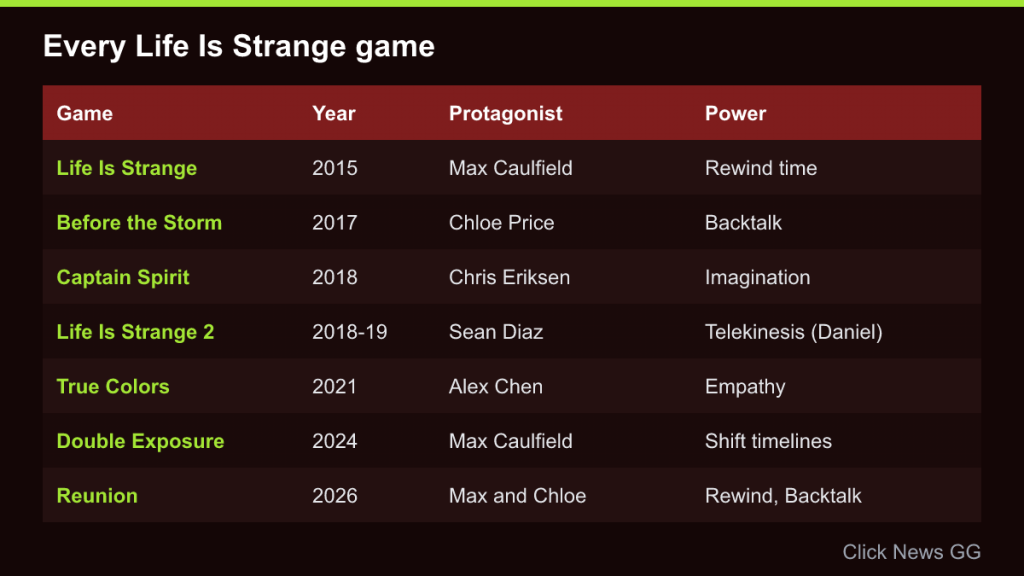
| Game | Year | Developer | Protagonist | Power or mechanic |
|---|---|---|---|---|
| Life Is Strange | 2015 | Dontnod | Max Caulfield | Rewind time |
| Before the Storm | 2017 | Deck Nine | Chloe Price | Backtalk (no power) |
| Captain Spirit | 2018 | Dontnod | Chris Eriksen | Imagination (free demo) |
| Life Is Strange 2 | 2018–19 | Dontnod | Sean Diaz | Brother Daniel’s telekinesis |
| True Colors | 2021 | Deck Nine | Alex Chen | Empathy |
| Double Exposure | 2024 | Deck Nine | Max Caulfield | Shifting between timelines |
| Reunion | 2026 | Deck Nine | Max and Chloe | Rewind and Backtalk |
What Order Should You Play In?
Release order is the best choice for most players. It preserves the reveals of the first game, which Before the Storm and the later Max games assume you know. A practical route:
- Life Is Strange (Remastered Collection or original).
- Before the Storm, ideally including Farewell, after the first game.
- Captain Spirit and Life Is Strange 2 — a self-contained story you can play any time.
- True Colors — also self-contained, and the most approachable entry for newcomers.
- Double Exposure, then Reunion — these continue Max’s story directly and should come after the first game.
If you only want a single, standalone taste of the series, True Colors or Life Is Strange 2 work without any background.
Common Threads Across the Series
Although each game has its own cast and power, the series shares a recognisable shape:
- An ordinary life interrupted. Every protagonist starts in an everyday situation — school, a new job, a family — before a supernatural element turns it upside down.
- Powers that serve the theme. Rewinding time is about regret, empathy is about understanding others, telekinesis seen through an older brother’s eyes is about responsibility, and shifting between timelines is about grief. The ability is never just a gameplay tool.
- Relationships as the real stakes. Friendships, romances and family bonds are where choices matter most, often more than the central mystery.
- A mystery at the core. A disappearance, a death or a local tragedy gives each story its forward momentum.
- Quiet moments. Optional “sit and reflect” scenes, journals and text messages let you slow down and absorb the atmosphere.
Quick Answers
Do I need to play the games in order?
Only for the games connected to Max and Chloe: the original, Before the Storm, Double Exposure and Reunion. Life Is Strange 2 and True Colors stand alone.
Which developer made which game?
Dontnod made the original, Captain Spirit and Life Is Strange 2. Deck Nine made Before the Storm, True Colors, Double Exposure and Reunion.
Does the series exist outside games?
Yes. Comics and novels have expanded the world, and a television adaptation of the first game is in the works at Amazon Prime Video, with Charlie Covell as showrunner. As of October 2026, we found no confirmed premiere date.
Why the Series Matters
Life Is Strange sits in the same family as Telltale’s choice-driven games (covered in our Telltale history), but with a distinct focus: everyday life. Between supernatural moments, you take photos, read diaries, sit on benches and listen to music. Those quiet scenes give weight to the big decisions. For how its choices compare with other approaches, see our guide to interactive drama games, and for the original’s place among the genre’s highlights, our list of the best story-driven adventure games.