
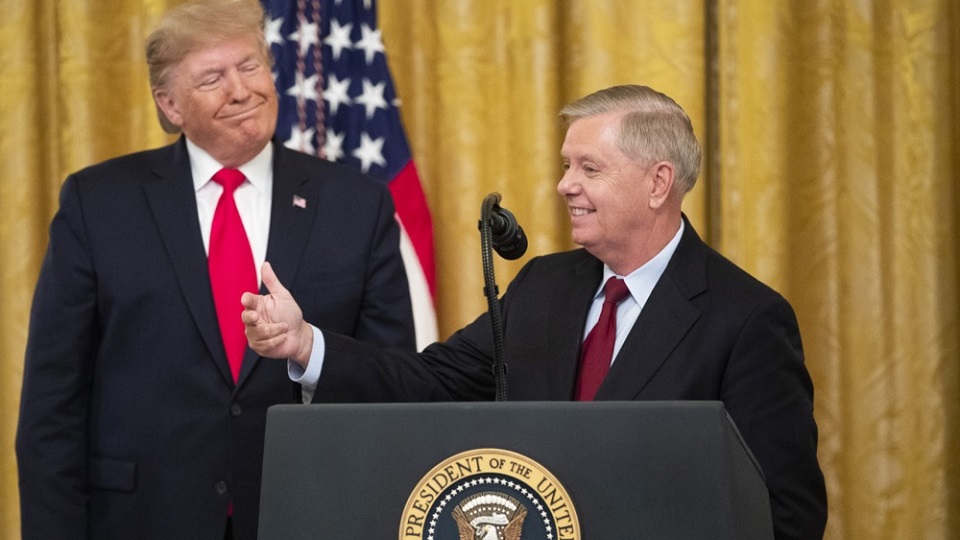
Former President Donald Trump has issued a public appeal urging the United States Senate to approve the Clarity Act, a significant piece of legislation aimed at establishing comprehensive regulatory frameworks for the cryptocurrency market. In a notable gesture, Trump specifically called for the bill’s passage as a tribute to Senator Lindsey Graham, the veteran Republican lawmaker from South Carolina who has been a key figure in shaping conservative policy positions over the past two decades. This call to action represents yet another indication of Trump’s evolving stance on digital currencies, marking a significant departure from his earlier skepticism toward Bitcoin and other cryptocurrencies during his presidency.
Understanding the Clarity Act and Its Implications
The Clarity Act represents one of the most ambitious attempts by American legislators to bring order to the often chaotic and unregulated world of digital assets. The legislation seeks to establish clear jurisdictional boundaries between the Securities and Exchange Commission and the Commodity Futures Trading Commission, two agencies that have frequently clashed over which entity should oversee various aspects of the cryptocurrency industry. For years, market participants have complained about regulatory uncertainty, arguing that the lack of clear rules has stifled innovation and driven blockchain companies to relocate to more crypto-friendly jurisdictions overseas.
The proposed legislation would create standardized definitions for different types of digital assets, distinguishing between securities tokens, utility tokens, and decentralized cryptocurrencies. This classification system would provide much-needed clarity for exchanges, developers, and investors who currently operate in a legal gray zone. Industry analysts estimate that regulatory uncertainty has cost the United States billions of dollars in potential investment and thousands of high-paying technology jobs that have migrated to countries like Singapore, Switzerland, and the United Arab Emirates, which have established more welcoming regulatory environments for blockchain enterprises.
Senator Lindsey Graham’s Role in Cryptocurrency Policy
Senator Lindsey Graham has served in the United States Senate since 2003 and has been a prominent voice on matters ranging from national security to judicial appointments. While not traditionally associated with cryptocurrency advocacy, Graham has increasingly expressed interest in ensuring American competitiveness in emerging technologies. His influence within Republican circles and his ability to build bipartisan coalitions make him a valuable ally for any legislative initiative seeking passage in the closely divided Senate. Trump’s decision to frame the Clarity Act as a tribute to Graham suggests both a recognition of the senator’s political importance and a strategic move to rally Republican support behind the measure.
The relationship between Trump and Graham has undergone significant evolution over the years. Initially a fierce critic of Trump during the 2016 presidential campaign, Graham later became one of the former president’s most reliable defenders in the Senate. This alliance has proven mutually beneficial, with Graham gaining influence within the MAGA movement while providing Trump with a respected voice in the upper chamber of Congress. By linking the cryptocurrency legislation to Graham’s legacy, Trump appears to be employing a time-honored political tactic of personalizing policy initiatives to build emotional investment among potential supporters.
The Broader Context of Crypto Regulation in America
The push for comprehensive cryptocurrency regulation comes at a critical juncture for the digital asset industry. Following the spectacular collapse of FTX in late 2022 and subsequent revelations of fraud involving billions of dollars in customer funds, calls for stricter oversight have intensified across the political spectrum. However, finding the appropriate balance between consumer protection and innovation promotion has proven challenging. Critics of heavy-handed regulation argue that excessive rules could push the entire industry underground or overseas, while consumer advocates contend that the current largely unregulated environment leaves investors vulnerable to scams and market manipulation.
Trump’s embrace of cryptocurrency represents a remarkable transformation from his earlier position. During his presidency, Trump publicly declared himself “not a fan” of Bitcoin, expressing concerns about its potential use in illegal activities. However, his recent statements suggest a complete reversal, with the former president now positioning himself as a champion of digital asset rights and criticizing what he characterizes as government overreach by the Biden administration’s approach to crypto regulation. This shift aligns with broader Republican efforts to court the significant and growing community of cryptocurrency enthusiasts, many of whom tend toward libertarian political philosophies and skepticism of government intervention in financial markets.
Expert Opinion: The passage of comprehensive cryptocurrency legislation like the Clarity Act could fundamentally reshape America’s position in the global digital economy. If enacted with bipartisan support, this framework would likely trigger a wave of institutional investment and corporate adoption, potentially establishing the United States as the world’s premier destination for blockchain innovation. However, the political maneuvering surrounding the bill suggests its fate may depend more on partisan dynamics than on its technical merits, making the 2024 election cycle a decisive factor in determining the future of American crypto policy.